
Madrid Protocol
We provide expert Madrid Protocol services to help businesses obtain and manage international trademark protection through a single application filed with WIPO
View Service →
A.A. Dewan & Co. assists Pakistan businesses seeking international trademark protection through the Madrid System and foreign trademark owners seeking protection in Pakistan through Madrid designation.
Explore our related legal services for this practice area.
We provide expert Madrid Protocol services to help businesses obtain and manage international trademark protection through a single application filed with WIPO
View Service →
Our expert trademark attorneys conduct a thorough search to identify potential conflicts before you apply for trademark registration.
View Service →
Industrial design refers to the visual aspects of a product that are new, original, and distinct, such as its shape, configuration, pattern, or ornamentation.
View Service →
Domain Name Registration with the Trademark Registry of Pakistan helps protect your brand from misuse or unauthorized use.
View Service →
Protect your brand identity with our fast and reliable trademark registration services.
View Service →
Are you an inventor, entrepreneur, or business owner with a unique idea? Securing a patent is crucial to protecting your innovation and preventing others from copying or profiting from your work.
View Service →
With the guidance of a skilled copyright lawyer, we ensure your creative works are properly protected under copyright law.
View Service →
Copyright Infringement happens when copyrighted material is used without permission, such as copying books, sharing music, or using images and software illegally.
View Service →The Madrid System is WIPO's international trademark registration framework. It allows an eligible trademark owner to use one international filing route to seek protection in selected Madrid System members while each designated office keeps authority to examine the mark under its own domestic law.
Pakistan became a Madrid Protocol member in 2021. This creates two important service routes: Pakistan-based applicants can use Pakistan as their Office of origin for eligible international filings, and foreign trademark owners can designate Pakistan when seeking protection for an international registration.
Important: A Madrid international registration is not a single worldwide trademark right. Protection depends on the territories designated and the legal decision of each designated trademark office.
Legal author: Ahmed Ali Dewan, Advocate Supreme Court. Reviewed by: A.A. Dewan & Co. Legal Team. Last substantive review: 26 September 2026.
A Pakistan-based brand with the required entitlement and basic mark can use the Madrid route to seek protection in selected Madrid System members through an international application originating from Pakistan.
A foreign Madrid applicant can designate Pakistan. The Pakistan designation remains subject to Pakistani trademark examination, opposition procedure and local response requirements.
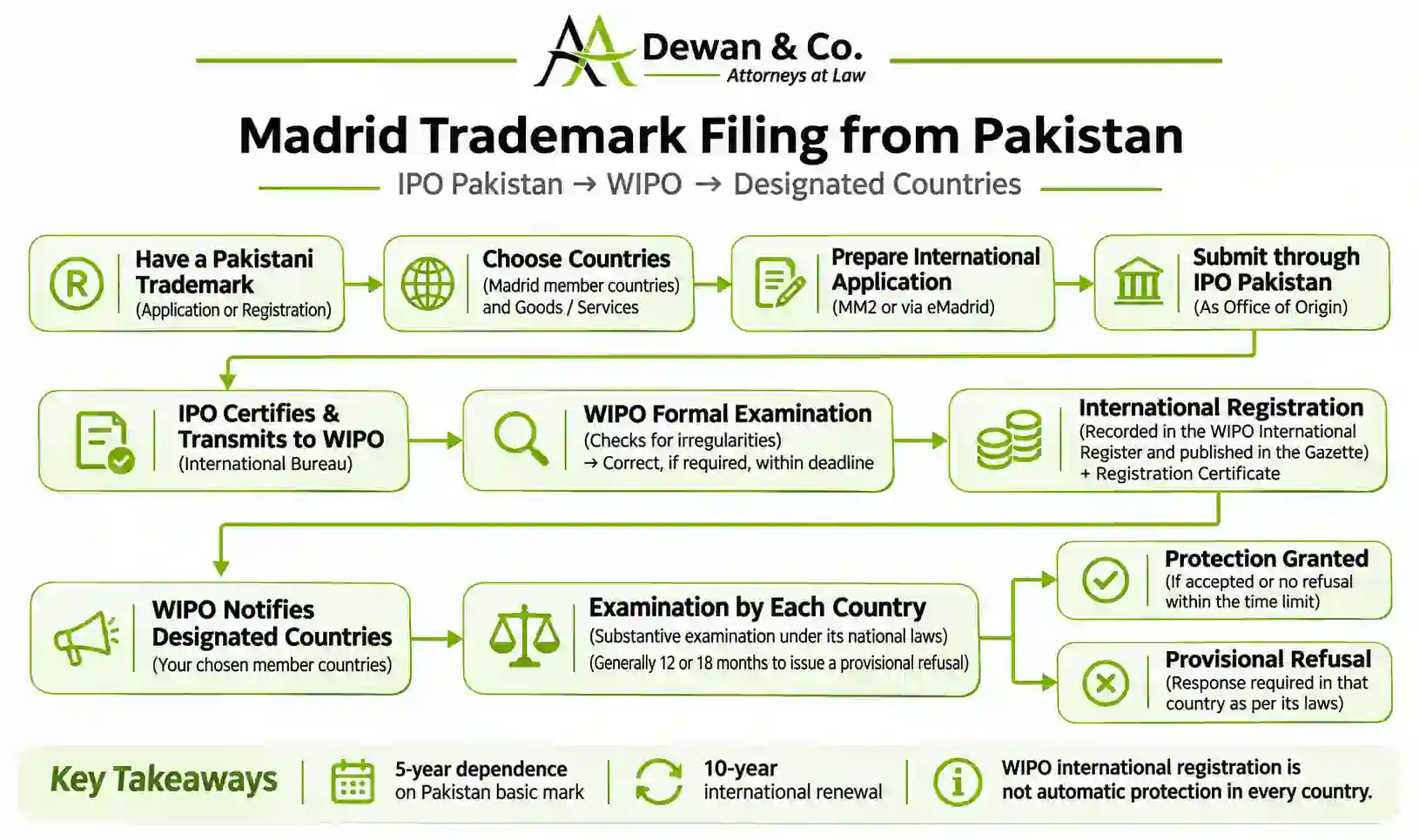
International trademark registration from Pakistan through the Madrid System allows eligible applicants to seek trademark protection in multiple Madrid System member countries through a single international application. Pakistan acts as the Office of origin, while the World Intellectual Property Organization (WIPO) administers the international registration system.
To file through IPO Pakistan, the applicant must have Pakistani nationality, domicile in Pakistan, or a real and effective industrial or commercial establishment in Pakistan. A qualifying Pakistan trademark application or registration, known as the basic mark, is also required.
An international Madrid application must be based on a trademark application or registration filed with the Office of origin. Where Pakistan is the Office of origin, the Pakistan filing or registration acts as the basic mark.
The international application must correspond to the basic mark. The mark itself should match, the applicant position should be consistent, and the goods and services in the Madrid application can be the same as or narrower than the basic mark but cannot be broader.
Before building an international filing strategy, it is useful to review the local position through our Trademark Search in Pakistan and Trademark Registration in Pakistan services.
A strong Madrid filing starts with a stable basic mark, clear goods and services, and country selection based on actual commercial priorities.
Check the applicant, mark representation, classes, goods and services, and the status of the underlying Pakistan application or registration.
Choose Madrid System members based on launch plans, exports, distribution, licensing, manufacturing and enforcement priorities.
Prepare the mark, applicant details, goods and services, classes, designations and supporting filing information consistently.
The international application is submitted through the Office of origin, which certifies the required relationship with the basic mark.
WIPO examines formal requirements and, where compliant, records the international registration and notifies the designated members.
Each designated member then applies its own trademark law and may grant protection, raise objections, or issue a provisional refusal.
More countries do not automatically mean a better filing strategy. The strongest designation plan normally follows the markets where the brand has genuine commercial exposure or a realistic expansion path.
Not every country is covered by the Madrid System. A national or regional filing route may still be necessary for markets outside the System or where a separate filing strategy is commercially preferable.
International companies can use the Madrid System to designate Pakistan where the applicant is eligible through its own Office of origin. A Pakistan designation is then examined under Pakistani trademark law rather than being automatically accepted because WIPO has recorded the international registration.
Pakistan has declared an 18-month period for notification of refusal under the Madrid Protocol, and an opposition-based refusal can in relevant circumstances be notified after that 18-month period. Foreign trademark owners should therefore monitor notices carefully and obtain local advice promptly where an objection, opposition or provisional refusal arises.
WIPO's international registration does not prevent a designated trademark office from refusing protection under local law. Refusals may arise from earlier rights, descriptiveness, classification, specification wording, formal requirements or other national grounds.
Response requirements normally follow the law and procedure of that designated jurisdiction and may require local counsel within the applicable deadline.
Where Pakistan raises an issue, local review can assess the objection, supporting evidence, available arguments and procedural response route.
A Madrid international registration remains dependent on the basic mark for the first five years from the date of the international registration. If the basic mark ceases to have effect wholly or partly during the relevant period, the international registration can be cancelled to the corresponding extent.
This makes the quality and stability of the basic mark strategically important. Filing internationally from a weak, inaccurate or vulnerable basic mark can create broader portfolio risk.
Madrid international registrations are valid for 10 years and can be renewed for further 10-year periods. Centralized management can simplify renewal and certain portfolio changes, but local rights still need to be monitored in the designated jurisdictions.
Plan renewal before the 10-year term expires and confirm which designated territories should remain in the portfolio.
Ownership, address and other record changes may be managed centrally where the Madrid framework permits.
Additional Madrid System members can often be added later as the brand expands into new markets.
There is no single Madrid filing cost for every application. Fees depend on the selected designated members, classes, individual-fee rules, filing structure and any professional work required for searches, drafting, irregularities or refusals.
Timeline also varies. WIPO handles formal examination, while each designated office follows its own examination and opposition procedure. Country-specific objections can therefore affect how quickly protection is confirmed.
Avoid relying on old fixed-fee charts. Madrid fees and member-specific charges can change, so the current filing calculation should be confirmed when the designation strategy is finalized.
The Madrid route can simplify multi-country filing and portfolio management, but it is not automatically the best route for every business. Separate national or regional applications may be appropriate where a market is not a Madrid member, where filing strategy requires a different specification, or where the commercial and legal circumstances favour direct national filing.
A focused review starts with the basic mark and the markets where protection is commercially important.
International filing decisions should connect trademark law with actual market strategy. Our role is to help clients build a practical filing route around the basic mark, priority markets, class coverage, risk and long-term portfolio management.
Check the local foundation before international filing decisions are made.
Align country selection with expansion, distribution, licensing and enforcement needs.
Assist international trademark owners whose Madrid registrations designate Pakistan.
Support objections, local coordination, renewals, changes and long-term filing strategy.
The Madrid Protocol is part of WIPO’s Madrid System for international trademark registration. An eligible applicant connected with Pakistan can use a Pakistan trademark application or registration as the basic mark, file an international application through the Office of origin, and designate Madrid System members where protection is sought. Each designated office then examines the mark under its own law.
Yes, if the applicant satisfies the Madrid System entitlement requirements through nationality, domicile, or a real and effective industrial or commercial establishment in Pakistan and has the required basic trademark application or registration in Pakistan.
A Madrid international application must be based on a basic mark filed or registered with the relevant Office of origin. Where Pakistan is the Office of origin, the international application must be supported by the corresponding Pakistan trademark application or registration.
No. The international application may use the same or a narrower list of goods and services, but it cannot extend beyond the scope covered by the basic mark. Broader protection normally requires first securing the necessary national or regional filing basis.
No. A Madrid registration is not a single worldwide trademark right. Protection depends on the Madrid members you designate, and each designated intellectual property office applies its own domestic trademark law before protection is granted or maintained in that territory.
Yes. An eligible foreign trademark owner can designate Pakistan through a Madrid international application or subsequent designation. Pakistan then examines the designation under Pakistani trademark law, and objections, opposition, or provisional refusal may require local legal handling.
A provisional refusal means the designated office has identified an objection under its local law. The response procedure, deadline, representation requirements, and available arguments depend on that jurisdiction. The refusal should be reviewed promptly because Madrid registration at WIPO does not override national examination.
An international registration is valid for 10 years and can be renewed for further 10-year periods. Renewal does not remove the need to monitor the status of protection, use requirements, refusals, limitations, ownership changes, and local compliance in designated jurisdictions.
For the first five years from the date of international registration, the international registration depends on the basic mark. If the basic mark ceases to have effect wholly or partly during the relevant dependency period, the international registration can be affected to the corresponding extent.
Yes. Additional Madrid System members can generally be added later through subsequent designation, subject to eligibility, the status and scope of the international registration, country-specific requirements, and payment of the applicable fees.
This page provides general information. Madrid System membership, declarations, fees, examination practices and procedural requirements can change. Current requirements should be confirmed for the specific filing or designation before action is taken.
Share your basic trademark details, owner information, goods or services, and the countries where protection is needed. Foreign trademark owners can also send the Pakistan designation or provisional-refusal details for review.
Get knowledge on business, IPR, employment, family, banking, and criminal laws in Pakistan.

How to Register for a Trademark Internationally? (Complete Guide to Worldwide Brand Registration)
Read Article →We provide professional legal advice and representation to individuals, businesses and international clients, with a commitment to protecting their legal interests.
Our lawyers focus on clear communication, practical legal guidance and responsible representation throughout every legal matter.
Our advocates apply professional legal knowledge and practical judgment to matters involving individuals, businesses and overseas clients.
We explain legal procedures, available options and potential risks in straightforward language, helping clients understand each stage of their legal matter.
We focus on careful documentation, professional confidentiality and timely communication, keeping our clients' rights and legal interests at the centre of our work.
Have questions or need legal advice? Our experienced law firm team is ready to assist you.
“Practical legal guidance with professional insight and client-focused support.”
Discuss your legal needs with our experienced team and explore tailored solutions.