
Criminal Justice System
The criminal justice system is a process, not a single lawsuit. Legal assistance must match the stage of the proceedings, the allegations, the available record and the competent court.
View Service →

A.A. Dewan & Co. assists local and overseas clients with FIRs, 22-A applications, Magistrate complaints and criminal complaint strategy in Pakistan.
Explore our related legal services for this practice area.
The criminal justice system is a process, not a single lawsuit. Legal assistance must match the stage of the proceedings, the allegations, the available record and the competent court.
View Service →
Our team of experienced cybercrime lawyers is committed to defending your digital rights and offering comprehensive legal protection
View Service →
A. A. Dewan & Co., a leading law firm, understands that facing legal trouble as a juvenile can be an incredibly stressful and confusing experience for both the young person and their family.
View Service →
A criminal appeal can be a complex and challenging process, but with the right guidance, it offers a chance for justice.
View Service →
Filing a criminal complaint is an essential first step in the legal process if you’ve been a victim of or witnessed a crime.
View Service →
Experienced criminal defense attorney providing expert advice and strategic representation for criminal revision and appeals.
View Service →
Defense attorneys help businesses navigate anti-money laundering (AML) laws, ensuring compliance with both national and international regulations.
View Service →
When facing anti-corruption charges in Pakistan, having the right criminal defense lawyer can make all the difference.
View Service →
A Lawyer Criminal Defense plays an essential role in ensuring that the bail process goes smoothly and in securing the best possible conditions for release.
View Service →
We handle a wide range of criminal cases, providing expert defense strategies for a variety of criminal charges, including but not limited to
View Service →A criminal complaint is not one single procedure. Depending on the facts, the first step may be information to police concerning a cognizable offence, an application concerning non-registration of a criminal case, or a complaint presented before a competent Magistrate. Using the wrong route can create delay and unnecessary procedural disputes.
The complaint should state the material facts, dates, locations, persons involved and available evidence accurately. It should not be overloaded with unsupported conclusions or exaggerated allegations.
For information relating to a cognizable offence, section 154 CrPC is a central starting point for police recording and investigation procedure.
Where non-registration or specified police-function issues arise, an application before the ex-officio Justice of the Peace may become relevant.
A court complaint under section 200 CrPC follows a different route and may involve examination of the complainant and further judicial procedure.
Section 154 of the Code of Criminal Procedure deals with information relating to the commission of a cognizable offence. Where such information is given orally to the officer in charge of a police station, the provision requires it to be reduced to writing, read over to the informant and signed; written information is also dealt with under the same statutory framework.
Section 22-A(6) gives an ex-officio Justice of the Peace power to issue appropriate directions to police authorities on a complaint concerning non-registration of a criminal case, transfer of investigation, or neglect, failure or excess by a police authority in relation to its functions and duties.
This is not the same as treating every complaint as automatically proved or automatically requiring prosecution. The application should clearly identify the prior complaint history, police response and the material relied upon.
Section 200 concerns examination of a complainant when a Magistrate takes cognizance of an offence on complaint, subject to the statutory provisos. This route is procedurally distinct from requesting police registration of an FIR.
A properly prepared complaint should explain the offence alleged, jurisdiction, complainant's basis of knowledge, witnesses and supporting material, while keeping the factual narrative consistent with the documents relied upon.
Arrange dates, events, communications, transactions and witness information in a single consistent chronology.
Keep original documents, screenshots, messages, medical records, transaction material and electronic files intact.
Assess whether the matter engages police FIR procedure, a special complaint mechanism or a court-based complaint route.
State material facts accurately, identify supporting proof and request relief that fits the legal procedure.
If the police route does not progress, assess whether section 22-A or another lawful remedy is appropriate.
Keep copies, submission records and evidence ready for inquiry, investigation, hearing or later criminal proceedings.
Cybercrime complaints now fall within the current PECA enforcement framework handled by the National Cyber Crime Investigation Agency (NCCIA), rather than the former FIA Cyber Crime Wing structure. Digital complaints require careful evidence preservation because accounts, URLs, messages and platform content can change or disappear quickly.
Profile links, usernames, URLs, screenshots, transaction records, message exports, email headers and device information may become important depending on the allegation.
For a dedicated digital-offence review, see our Cyber Crime legal services.
A criminal matter may affect someone living outside Pakistan where the alleged offence, accused, property, transaction, evidence or proceedings are connected with Pakistan. We assist overseas Pakistanis, foreign nationals and international businesses with document review, complaint strategy and coordination of the appropriate Pakistan legal route.
Personal appearance, authorization and procedural requirements vary by forum and case type, so they should be assessed before filing rather than assumed.
Criminal allegations should be based on facts that can be explained and supported. Adding allegations merely to increase pressure can weaken credibility, create contradictions and expose the complainant to legal consequences. The complaint should separate what the complainant personally knows from what is inferred or reported by others.
The first complaint often becomes part of the later procedural record. Wording, chronology and supporting documents can therefore matter beyond the initial filing stage.
There is no reliable single fee or fixed timeline for every criminal complaint. A straightforward drafting review differs from a section 22-A application, a Magistrate complaint, cybercrime evidence review or connected court proceedings. Professional fees depend on urgency, document volume, forum and required representation.
Timing also depends on the nature of the allegation, police response, court scheduling, evidence availability and whether the matter moves into investigation or litigation.
The correct route depends on the alleged offence and forum. For information relating to a cognizable offence, the process may begin with the police under section 154 CrPC. If non-registration becomes an issue, section 22-A(6) may be relevant. A separate complaint procedure before a Magistrate may also be available under section 200 CrPC where appropriate.
An FIR is the police record made under section 154 CrPC in relation to information about a cognizable offence. The word complaint is broader and may refer to the initial written application, an application regarding non-registration, or a complaint presented before a Magistrate under the Code of Criminal Procedure.
Section 22-A(6) CrPC empowers an ex-officio Justice of the Peace to issue appropriate directions to the police authorities on complaints concerning non-registration of a criminal case, transfer of investigation, or neglect, failure or excess by police in relation to their functions. The appropriate route depends on the record and circumstances.
Section 200 CrPC deals with examination of a complainant when a Magistrate takes cognizance of an offence on complaint, subject to the statutory provisos. It is a court-based complaint route and is different from simply requesting police registration of an FIR.
Useful material may include a dated chronology, identity documents, witness details, contracts, receipts, bank records, medical material, photographs, CCTV references, messages, screenshots, URLs, call records and any original electronic files relevant to the allegation.
Yes. Cybercrime complaints are handled under the current PECA framework through the National Cyber Crime Investigation Agency (NCCIA). Digital evidence should be preserved carefully, including account details, URLs, screenshots, message history, transaction records and device information where relevant.
An overseas complainant may seek legal guidance where the alleged offence, accused, evidence or legal proceedings are connected with Pakistan. The exact filing, appearance and document requirements depend on the forum, facts and procedural route.
No. The legal response depends on whether the facts disclose an offence, the nature of the offence, the available evidence, jurisdiction and the procedure that applies. A complaint should present the facts accurately without exaggeration or unsupported allegations.
Yes. Inaccurate, contradictory or deliberately false allegations can create serious legal and evidentiary consequences. Complaint drafting should be based on verifiable facts, available documents and a consistent chronology.
Professional fees depend on the work required, such as document review, complaint drafting, section 22-A proceedings, a Magistrate complaint, hearing preparation or connected criminal litigation. The scope should be reviewed before a fee is quoted.
Share the incident timeline, prior complaint copies, police response, available evidence and your current procedural stage. We can review whether the matter is best approached through police procedure, section 22-A, a Magistrate complaint or another criminal-law route.
Get knowledge on business, IPR, employment, family, banking, and criminal laws in Pakistan.

If you have suffered an injury due to an accident, negligence, or another person's fault, our personal injury lawyers in Pakistan can help you understand your legal rights and available compensation options.
Read Article →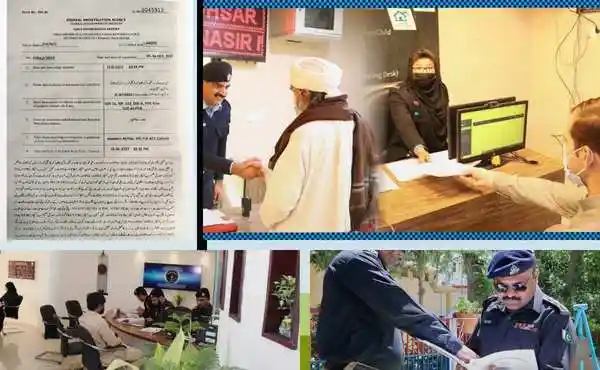
How to File a FIR in Pakistan (Process, Time Frames & Legal Tips) Complete Guide 2026
Read Article →We provide professional legal advice and representation to individuals, businesses and international clients, with a commitment to protecting their legal interests.
Our lawyers focus on clear communication, practical legal guidance and responsible representation throughout every legal matter.
Our advocates apply professional legal knowledge and practical judgment to matters involving individuals, businesses and overseas clients.
We explain legal procedures, available options and potential risks in straightforward language, helping clients understand each stage of their legal matter.
We focus on careful documentation, professional confidentiality and timely communication, keeping our clients' rights and legal interests at the centre of our work.
Have questions or need legal advice? Our Law Firm expert team is ready to assist you.
“A trusted consulting Law Firm is providing expert solutions with strategic insights.”
Discuss your legal needs with our experienced team and explore tailored solutions.