

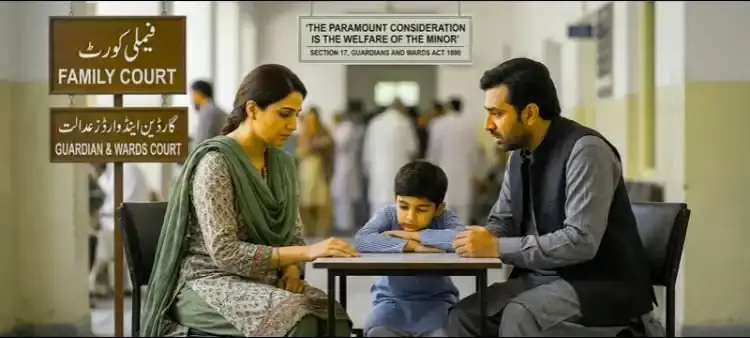
After divorce, who gets custody of the children in Pakistan—the mother or the father? There is no automatic answer. A Family Court looks at what is best for the child, not simply which parent demands custody.
Some parents believe a son must go to his father at seven or a mother loses custody if she remarries. Neither is automatic.
This guide explains child custody after divorce in Pakistan: parents' rights, khula, visitation, maintenance and Family Court procedures. It mainly addresses Muslim family law.
On This Page
- Who Gets Custody After Divorce?
- Does a Son Go to His Father at Seven?
- Custody After Khula or the Mother's Remarriage
- How Does the Court Decide What Is Best for a Child?
- Mother's and Father's Rights: Custody, Visits and Maintenance
- How to File a Child Custody Case in Pakistan
- Can a Parent Move the Child to Another City or Country?
- Frequently Asked Questions
- What Parents Should Do Next
Who Gets Custody After Divorce?
Short answer: Neither parent receives custody simply because a divorce has taken place. The court decides where the child should live by considering the child's welfare—meaning their overall well-being.
Under Muslim family law, a mother may have a preferential right to care for a young child (hizanat), while the father is traditionally recognised as a natural guardian. Custody and guardianship differ, and neither label settles every dispute.
Section 17 of the Guardians and Wards Act, 1890 makes the child's welfare central to guardianship decisions.
Example: A six-year-old has lived safely with her mother, attends a nearby school and has a stable routine. The father requests custody because he earns more. Higher income alone does not decide the case. The court also looks at daily care, safety, emotional bonds and the child's needs.
Does a Son Go to His Father at Seven?
A common belief is that a boy must move to his father when he turns seven, while a girl stays with her mother until puberty.
These ages reflect traditional Muslim-law hizanat principles, but a seventh birthday does not automatically transfer custody. The court still assesses the child's welfare.
Moving a child could disrupt school, medical care or emotional stability. The court may consider those effects.
The Supreme Court's judgment in Raja Muhammad Owais v. Mst. Nazia Jabeen (Civil Petition No. 240 of 2021) discusses traditional custody principles and explains why the child's welfare remains decisive.
There is no automatic custody handover at a fixed age.
Custody After Khula or the Mother's Remarriage
Does a mother lose custody after khula?
No. Khula does not automatically take children away from their mother. Divorce and custody are separate questions. Either parent may seek an appropriate court order.
For the separate process of ending a marriage, read How to File for Divorce in Pakistan.
What if the mother marries again?
A second marriage may change the child's home environment, but remarriage alone does not automatically remove custody.
In Raja Muhammad Owais v. Mst. Nazia Jabeen, the Supreme Court explained that the traditional remarriage restriction is not absolute. The court must assess the actual circumstances and the child's best interests.
The Sindh High Court has also examined custody after a mother's remarriage, stressing the child's welfare rather than a one-rule answer.
The court considers the new home's safety and the continuity of care, whether the mother or father remarries.
How Does the Court Decide What Is Best for a Child?
Child welfare includes much more than money. Courts examine everyday care and well-being.
Relevant questions may include:
- Safety: Is the child protected from violence, neglect and serious harm?
- Daily care: Who has been managing meals, school, medical appointments and daily routines?
- Emotional stability: Where does the child feel secure, supported and connected?
- Education and health: Can schooling, treatment and special needs continue without harmful disruption?
- Home environment: Are the proposed living conditions suitable and stable?
- Relationships: How can the child maintain healthy contact with each parent and, where relevant, siblings?
- The child's views: If mature enough to express an informed preference, what does the child want?
Section 17(3) of the Guardians and Wards Act allows a court to consider the preference of a child old enough to form an intelligent view. A child's wish matters, but it is not an automatic veto or final decision.
Example: If a 12-year-old prefers a parent only because of fewer rules, the judge may consider the reasons and the child's maturity.
Mother's and Father's Rights:
Custody, Visits and Maintenance
Three legal ideas are often confused:
| Term | What it generally means | |---|---| | Physical custody | Where the child lives and who handles everyday care | | Guardianship | Legal responsibility or authority concerning the child's person or property, subject to applicable law | | Visitation or contact | The child's arrangements for meeting or communicating with the parent they do not live with |
The Family Courts Act, 1964, section 5 and Schedule, provides for custody, guardianship and parental visitation matters, subject to the applicable provincial version.
Can a father see his child if the mother has custody?
Yes, a father may seek visitation or contact arrangements even when the child lives with the mother. The reverse also applies. Depending on the child's welfare and the circumstances, arrangements might cover regular meetings, phone or video calls, holidays or supervised contact where necessary.
Personal anger or unpaid support does not, by itself, justify ignoring a visitation order. For genuine safety concerns, seek court protection or modification.
Does custody decide who pays child maintenance?
No. Custody and maintenance are separate. Under Muslim family law, a father ordinarily has primary child-maintenance obligations. The mother having custody does not remove the child's claim.
For the practical procedure, see How to File a Child Maintenance Case in Family Court. For questions about school fees, medical needs and income, read How Child Maintenance Is Calculated.
How to File a Child Custody Case in Pakistan
If parents cannot agree, a case may be filed before the competent Family Court, subject to local rules.
Step 1: Check the correct court
For guardianship-of-the-person applications, section 9 of the Guardians and Wards Act generally points to where the child ordinarily resides. Check the applicable Family Court rules too.
Step 2: Gather the important documents
Documents commonly useful include:
- Child's birth certificate or NADRA B-Form.
- Parents' CNICs and relevant marriage/divorce or khula records.
- Child's usual address, school and medical records.
- Existing custody, guardianship, visitation or maintenance orders.
- Messages or other lawful evidence showing the child's care arrangements.
- Records supporting any genuine safety concerns.
Not every document is compulsory in every case. Avoid making exaggerated allegations or using edited evidence.
Step 3: Explain the custody arrangement you are requesting
State the child's details, usual residence, important facts and requested relief: custody, contact, schooling or protection where justified.
Step 4: Ask about temporary arrangements if the matter is urgent
Section 12 of the Guardians and Wards Act permits interim orders concerning the production and temporary protection of a minor in appropriate circumstances. The court may consider a temporary arrangement while the case is being heard. Interim custody is not necessarily the final decision.
Step 5: Attend proceedings and follow the order
Both parents may present their positions and evidence. Keep a certified copy of the decision and follow its terms.
Time and cost vary with the dispute, evidence and local procedure.
Can a Parent Move the Child to Another City or Country?
Physical custody does not necessarily permit unrestricted relocation, especially against a court order.
Before planning a permanent move, check:
- The wording of any court order or agreement.
- Whether the other parent has legal rights that will be affected.
- Applicable passport, immigration, travel and consent requirements.
- Whether the child's schooling, health and contact with both parents can be protected.
If relocation is disputed, seek directions from the competent court before making irreversible arrangements. International moves may also involve separate cross-border laws.
If a child is taken without agreement, keep evidence and obtain prompt legal advice. Not every dispute is a criminal kidnapping case.
Frequently Asked Questions
1. Who gets custody of a daughter after divorce in Pakistan?
There is no automatic outcome based on gender alone. Traditional Muslim-law rules concerning a daughter's custody are relevant, but the court must consider the child's welfare, circumstances and, where appropriate, her views.
2. Can a mother keep a son after he turns seven?
Yes, potentially. Turning seven does not automatically hand a boy to his father. A court can decide that remaining with the mother better serves the child's welfare.
3. Does khula mean the mother gives up child custody?
No. Khula dissolves the marriage; custody is decided separately by reference to the child's welfare.
4. Does the mother lose custody if she remarries?
Not automatically. Remarriage is a relevant change, but courts assess the child's actual circumstances rather than treating the second marriage as a complete bar.
5. Can a father win custody because he earns more?
Income can matter because children need suitable care, but wealth alone does not decide custody. Safety, continuity of care and emotional well-being also matter.
6. Can a child choose which parent to live with?
A mature child's informed preference may be considered under section 17(3) of the Guardians and Wards Act. The judge still makes a welfare-based decision.
7. Can a parent stop the other parent's visits?
An existing visitation order should not be ignored unilaterally. Where contact creates a genuine safety risk, the parent should seek urgent legal protection or a change to the order.
8. Can a custody order be changed later?
A parent may seek an appropriate variation when circumstances materially change, such as serious safety concerns, relocation or changing needs. The court assesses the child's welfare and the applicable procedure; a new outcome is not guaranteed.
What Parents Should Do Next
Put the child's needs ahead of the conflict:
- Write down the child's daily routine, school schedule, medical needs and current care arrangements.
- Keep copies of identity records, previous court orders and relevant communications.
- Propose a practical, child-focused plan for residence, visits and communication.
- Avoid involving the child in threats, bargaining or pressure to choose sides.
- Where safety is at risk or an order is being breached, obtain prompt advice about the correct legal remedy.
The key principle is simple: Divorce ends a marriage, but it does not end either parent's responsibilities toward a child. Child custody after divorce in Pakistan is decided on the child's welfare—not by a single age rule, a parent's income or a remarriage alone.
Legal information notice: This article provides general educational guidance, primarily on Muslim family-law custody matters in Pakistan. The applicable personal law, provincial amendments, current court orders, child's circumstances and case-specific evidence can change the legal position. It is not a substitute for individual legal advice.



Comments
No comments yet. Be the first to comment!
Leave a Comment