

Company Closing in Pakistan – SECP Easy Exit & Winding Up
Get legal support to close a Pakistan-registered company through the correct SECP route, including Easy Exit, strike-off or formal winding up, with connected FBR and compliance review.
- SECP Easy Exit & Strike-Off
- Voluntary & Court Winding Up
- FBR Tax Closure Review
- Overseas Owner Support

Corporate & Business Law Services
Explore our related legal services for this practice area.
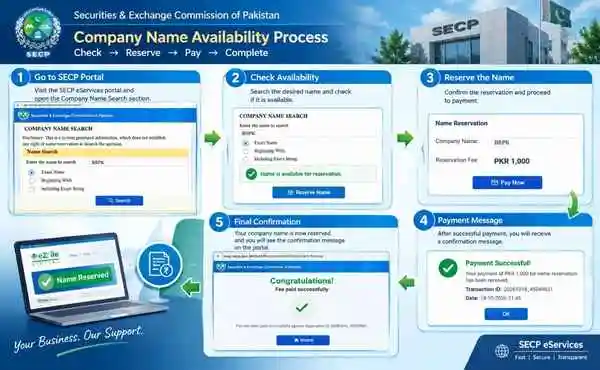
Company Name Availability
Before you register a company, choose a name that is distinctive, appropriate for your business and ready for SECP review.
View Service →
Company Registration from SECP
Incorporation is a legal setup decision, not only a portal submission. Our role is to connect the registration filing with the ownership, business objects, governance, tax coordination and compliance issues that matter after the certificate is issued.
View Service →
Corporate Legal Services
We assist with Pakistan-law matters for foreign companies, foreign investors, overseas Pakistanis and cross-border businesses.
View Service →
LLP Registration Pakistan
LLP registration in Pakistan with SECP: name reservation, partners, designated partner, LLP agreement, LEAP filing, NTN and overseas business support.
View Service →
NTN Registration in Pakistan
NTN registration in Pakistan through FBR Iris for individuals, companies and AOPs. Get NTN, verification, company tax setup and overseas support.
View Service →
SMC Registration
Register a Single Member Company in Pakistan with SECP. Get help with name reservation, nominee details, MOA/AOA, eZfile incorporation, NTN and compliance.
View Service →
Real Estate Investment
Our experienced attorneys provide comprehensive services tailored to your specific needs, guiding you through every stage of the real estate investment.
View Service →
Memorandum of Association
A corporate lawyer can help draft a solid MOA that meets legal requirements and supports smooth company operations.
View Service →
Company Registration Procedure (Full Guide)
The company registration process can feel overwhelming, but it’s a crucial step in launching your business.
View Service →
Company Closing
A corporate lawyer plays a key role in guiding the company through each step of the Company Closing Procedure.
View Service →
Trade Union and Labour Law
Forming a trade or labour union in Pakistan is an important way for workers to unite, protect their rights, and push for improved working conditions.
View Service →How to Close a Company in Pakistan
To close a company in Pakistan, first determine whether the company qualifies for SECP Easy Exit or requires a formal winding-up process. Easy Exit is a strike-off route for eligible companies that have ceased operations and meet the applicable conditions. Companies with assets, liabilities, disputes, creditor issues or other disqualifying circumstances may require a different route.
Simply stopping business activity does not by itself end a registered company. The company remains subject to its legal, regulatory and tax position until the relevant closure steps are completed.
Important: SECP company closure and FBR tax-registration cancellation are separate matters. A clean exit should review both corporate and tax compliance instead of treating the SECP filing as the only step.
SECP Company Closing Routes in Pakistan
The correct closure route depends on the company’s legal and financial position. Easy Exit, voluntary winding up and court-related winding up are different procedures and should not be treated as interchangeable.
SECP Easy Exit / Company Strike-Off
Under SECP’s Easy Exit framework, an eligible private or public unlisted company that has ceased operations and satisfies the prescribed conditions may apply to have its name struck off the register instead of going through a full winding-up process.
Before filing, review the official SECP Company Easy Exit requirements .
Voluntary Winding Up
Voluntary winding up is a formal route used to bring the company’s legal life to an end. Depending on the circumstances, the process can involve corporate resolutions, appointment of a liquidator, settlement of liabilities, realization of assets, statutory filings and eventual dissolution.
Court / Compulsory Winding Up
Court-related winding up may arise where statutory grounds, creditor claims, disputes or other circumstances require judicial proceedings rather than a simple strike-off or voluntary exit.
Who Qualifies for SECP Easy Exit?
Easy Exit is designed for eligible companies that have ceased business operations and meet SECP’s regulatory conditions. It should not be assumed that every inactive company qualifies.
Common Eligibility Indicators
- The company has ceased business operations
- The company does not have disqualifying assets or liabilities
- There is no disqualifying investigation, prosecution or court matter
- There is no management or shareholding dispute affecting eligibility
- The required corporate records and declarations can be prepared accurately
Common Easy Exit Disqualifications
- Outstanding bank or financial-institution loans
- Outstanding taxes, utility charges or government liabilities
- Outstanding obligations to private parties
- Pending investigations, enquiries, prosecutions or court proceedings
- Management or shareholding disputes
- Other excluded company categories identified by SECP
SECP’s current Easy Exit page expressly lists categories that cannot use the scheme. Eligibility should therefore be checked against the current official requirements before filing.
SECP Easy Exit Forms, Documents and Government Fee
SECP’s current Easy Exit guidance identifies the following forms and supporting documents for an application to strike a company’s name off the register:
- Form EE-I: Application for striking off the company’s name
- Form EE-II: Members’ resolution
- Form EE-III: Declaration / indemnity
- Form EE-IV: Auditors’ certificate
SECP’s current Easy Exit page lists an application fee of Rs 5,000 for online submission and Rs 10,000 for manual submission. Government fees can change, so the current SECP Easy Exit page should be checked before filing.
You can also review the SECP guide for applying for Easy Exit .
Review Liabilities Before Closing a Company
Liabilities can determine whether Easy Exit is available and can also change the way a formal winding-up matter must be handled. A closure review should identify unresolved obligations before filing.
Creditors, Vendors and Contracts
- Unpaid suppliers, lenders and vendor balances
- Continuing contracts and termination obligations
- Guarantees, security interests and unresolved claims
- Settlement and termination records
Employees and Employment Dues
- Outstanding salaries, benefits and reimbursements
- Termination documentation where applicable
- Pending employee disputes or claims
Banking, Loans and Finance
- Outstanding loans and banking obligations
- Active company bank accounts
- Leases, financing documents and security arrangements
- Evidence of settlement and account closure
Documents for Company Closing in Pakistan
The required documents depend on whether the matter involves Easy Exit, voluntary winding up, court proceedings, tax closure, overseas ownership or unresolved liabilities.
- Certificate of Incorporation and company registration details
- Director, shareholder and beneficial-ownership records where relevant
- Board or members’ resolutions required for the selected route
- Financial information, accounts and asset records where applicable
- Liability, creditor, vendor and employee records
- Tax returns, notices and FBR registration information
- SECP forms, declarations, certificates and supporting papers
- Authorization documents for representatives or overseas owners where needed
If the company’s constitutional documents need review, see our MOA and AOA drafting and review service.
Company Closing Process with SECP
Step 1: Review the Company’s Current Status
Check the company’s operational status, filing history, ownership, assets, liabilities, disputes, pending proceedings and tax record.
Step 2: Choose the Correct Closure Route
Determine whether the company qualifies for Easy Exit or requires voluntary or court-related winding up.
Step 3: Prepare the Required Corporate Documents
Prepare the relevant resolutions, declarations, certificates, financial information and supporting records.
Step 4: Submit the SECP Filing
File through the applicable SECP procedure and respond accurately to any clarification, objection or correction requirement.
Step 5: Resolve Connected Obligations
Address relevant creditor, employee, banking, contractual and tax matters rather than treating the SECP filing as the entire closure process.
Step 6: Preserve Final Closure Records
Keep final SECP, tax, settlement, banking and corporate records after the closure process is completed.
FBR Tax Closure After Company Closing
SECP closure does not automatically cancel the company’s FBR income-tax registration. Pending returns, statements, tax liabilities, notices, sales-tax matters and withholding obligations should be reviewed separately.
FBR states that the Commissioner may cancel an income-tax registration after determining that there is no outstanding liability and that the taxpayer’s registration information and records warrant cancellation.
- Pending income tax returns and statements
- Outstanding tax liabilities or notices
- Sales tax registration and returns where applicable
- Withholding obligations and reconciliation matters
- FBR Iris profile and company particulars
- Records required for a tax-registration cancellation request
Official references: FBR Cancellation of Income Tax Registration and FBR Iris.
Winding Up, Liquidation and Company Dissolution
Winding up is the formal process of bringing the company’s affairs to an end before dissolution. SECP explains that the process can involve dealing with company assets, paying debts and distributing any remaining surplus according to the applicable legal process.
- Identify and preserve company assets and financial records
- Determine liabilities and creditor claims
- Deal with debts under the applicable winding-up process
- Record asset realizations, transfers and distributions
- Complete required liquidator and corporate filings where applicable
- Proceed toward dissolution after the winding-up process is completed
See the official SECP Winding Up Procedure .
Company Closing Cost and Timeline in Pakistan
There is no single total cost or timeline for every company closure. The result depends on the route, company status, records, liabilities, tax position, objections and whether formal winding-up steps are required.
For an eligible Easy Exit application, SECP’s current official page lists the government application fee described above. Legal and professional fees depend on the facts and work required in the specific matter.
Common Reasons a Company Closure Is Delayed
- The company does not qualify for the selected Easy Exit route
- Outstanding liabilities or creditor matters
- Missing or inconsistent corporate documents
- Mismatch between SECP records and submitted information
- Pending investigations, disputes or court proceedings
- Unresolved FBR returns, liabilities or notices
- Overseas signing, authorization or document issues
Company Closing in Pakistan for Overseas Owners
Directors and shareholders living abroad may still need to close or regularize a Pakistan-registered company. The closure remains a Pakistan corporate process even when the owners are based in the United Kingdom, UAE, Saudi Arabia, United States, Canada, Europe or another jurisdiction.
Overseas matters can require additional attention to signatures, authorizations, identity documents, attestation, FBR access, banking records and local filing coordination.
- Review SECP and FBR status before preparing documents
- Identify which documents can be signed from abroad
- Check whether notarization, attestation or authorization is required
- Coordinate filings and responses in Pakistan
- Keep complete digital and physical closure records
What to Keep After a Company Is Closed
Former directors and shareholders may later need evidence of the closure, tax history, settlements or corporate decisions for banking, audit, litigation, immigration, investment or other legitimate purposes.
- SECP filings, acknowledgements and final closure records
- Board and members’ resolutions
- Tax returns, FBR correspondence and cancellation records
- Creditor and employee settlement documents
- Bank closure and financing records
- Asset disposal and distribution records where relevant
Official SECP and FBR Company Closure Resources
Use current official sources when preparing a company closure because forms, procedures and fees can change.
Why Choose A.A. Dewan & Co. for Company Closing?
Company closure is not only a form-filing exercise. The route should be selected after reviewing the company’s legal status, liabilities, assets, records, disputes and tax position so unresolved obligations are not overlooked when the business stops operating.
- Easy Exit versus winding-up route assessment
- SECP status, filing and document review
- Corporate resolutions and closure-document support
- Liability, creditor, employee and banking review
- FBR tax-registration and pending-compliance review
- Support for overseas owners and foreign-connected companies
Need to close an inactive company, check Easy Exit eligibility or plan a formal winding up? Share the company name, current SECP status, operating status and any known liability or tax issues.
FAQs About Company Closing in Pakistan
Find answers to common questions about SECP Easy Exit, winding up, company strike-off, government fees, tax closure and overseas-owned companies.
How do I close a private limited company in Pakistan?
The correct route depends on the company’s status. An eligible company that has ceased operations and meets SECP Easy Exit conditions may apply for strike-off. Companies that do not qualify may require voluntary or court-related winding up. Liabilities, assets, filings, disputes and tax matters should be reviewed before selecting the route.
What is SECP Easy Exit in Pakistan?
SECP Easy Exit is a strike-off mechanism for eligible companies that have ceased operations and satisfy the applicable conditions. It is not available to every company, so eligibility should be checked before filing.
Can a company with liabilities use SECP Easy Exit?
SECP’s Easy Exit guidance excludes companies with specified outstanding liabilities, including certain bank, tax, utility, government and private-party obligations. A company with liabilities should be reviewed for another closure or winding-up route.
What documents are required for SECP Easy Exit?
SECP currently lists Form EE-I, members’ resolution on Form EE-II, declaration or indemnity on Form EE-III and an auditors’ certificate on Form EE-IV among the Easy Exit filing documents, subject to the applicable requirements and company circumstances.
What is the SECP Easy Exit fee?
SECP’s current Easy Exit page lists an application fee of Rs 5,000 for online submission and Rs 10,000 for manual submission. Government fees can change, so the official SECP source should be checked at the time of filing.
What is the difference between Easy Exit and winding up?
Easy Exit is a simpler strike-off route for eligible companies that meet the prescribed conditions. Winding up is a formal process used to bring a company’s legal life to an end and may involve assets, liabilities, creditors, a liquidator and eventual dissolution.
Does FBR tax registration close automatically after SECP closure?
No. SECP company closure and FBR tax-registration cancellation are separate matters. FBR states that the Commissioner may cancel an income tax registration after confirming there is no outstanding liability and the registration record warrants cancellation.
Can overseas Pakistanis close a company in Pakistan?
Yes. Directors and shareholders living abroad can obtain assistance with a Pakistan company closure. The process depends on the company’s status, closure route, authorization documents, liabilities, tax record and any signing or attestation requirements.
How long does company closing in Pakistan take?
There is no single timeline for every company. Timing depends on the route used, SECP processing, document completeness, liabilities, objections, pending proceedings, tax matters and whether a formal winding-up process is required.
This page provides general legal information. SECP and FBR requirements, forms, fees and procedures can change, and the correct route depends on the company’s actual facts and current records.
