

LLP Registration in Pakistan – Limited Liability Partnership
Register a Limited Liability Partnership in Pakistan with legal support for SECP name reservation, partner and designated-partner requirements, LLP Agreement drafting, LEAP filing, NTN planning and overseas or foreign-partner documentation.
- SECP LLP Name Reservation
- LLP Agreement & LEAP Filing
- Partner & Designated Partner Setup
- Overseas & Foreign Partner Support

Corporate & Business Law Services
Explore our related legal services for this practice area.
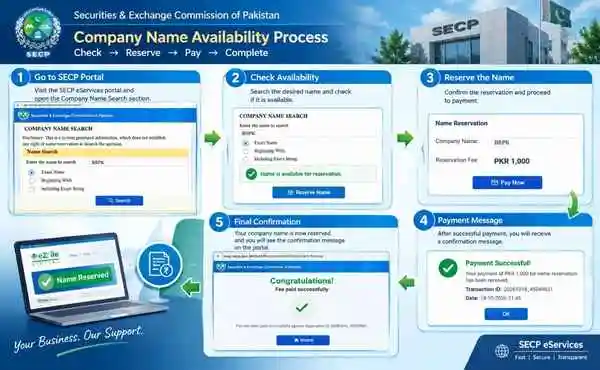
Company Name Availability
Before you register a company, choose a name that is distinctive, appropriate for your business and ready for SECP review.
View Service →
Company Registration from SECP
Incorporation is a legal setup decision, not only a portal submission. Our role is to connect the registration filing with the ownership, business objects, governance, tax coordination and compliance issues that matter after the certificate is issued.
View Service →
Corporate Legal Services
We assist with Pakistan-law matters for foreign companies, foreign investors, overseas Pakistanis and cross-border businesses.
View Service →
LLP Registration Pakistan
LLP registration in Pakistan with SECP: name reservation, partners, designated partner, LLP agreement, LEAP filing, NTN and overseas business support.
View Service →
NTN Registration in Pakistan
NTN registration in Pakistan through FBR Iris for individuals, companies and AOPs. Get NTN, verification, company tax setup and overseas support.
View Service →
SMC Registration
Register a Single Member Company in Pakistan with SECP. Get help with name reservation, nominee details, MOA/AOA, eZfile incorporation, NTN and compliance.
View Service →
Real Estate Investment
Our experienced attorneys provide comprehensive services tailored to your specific needs, guiding you through every stage of the real estate investment.
View Service →
Memorandum of Association
A corporate lawyer can help draft a solid MOA that meets legal requirements and supports smooth company operations.
View Service →
Company Registration Procedure (Full Guide)
The company registration process can feel overwhelming, but it’s a crucial step in launching your business.
View Service →
Company Closing
A corporate lawyer plays a key role in guiding the company through each step of the Company Closing Procedure.
View Service →
Trade Union and Labour Law
Forming a trade or labour union in Pakistan is an important way for workers to unite, protect their rights, and push for improved working conditions.
View Service →LLP Registration in Pakistan: What It Means
A Limited Liability Partnership (LLP) is a body corporate registered under the Limited Liability Partnership Act, 2017. It has a legal identity separate from its partners and perpetual succession.
An LLP can be useful where two or more people want a separate legal entity but prefer a partner-led structure whose internal rights, duties, contribution, management and profit-sharing arrangements can be documented through an LLP Agreement.
Important: LLP registration is different from registering a private limited company or an ordinary partnership. The correct structure should be selected after considering ownership, investment, management, tax, liability and future growth.
LLP Requirements at a Glance
The core legal and filing requirements should be checked before the LEAP application is prepared.
- Minimum partners: at least two partners
- Designated partner: at least one individual designated partner resident in Pakistan
- Registered office: an address in Pakistan for the LLP
- Core document: a properly prepared LLP Agreement
- Name: an acceptable LLP name reserved through SECP
- Filing: partner, consent, incorporation and supporting information through the applicable SECP process
- Post-registration: FBR, banking, records and other compliance as applicable
LLP vs Private Limited Company in Pakistan
Both an LLP and a Private Limited Company can provide a separate legal structure, but they differ in ownership, management and governing documents. The suitable option depends on how the founders want to manage the business, share ownership and plan for future growth.
Limited Liability Partnership (LLP)
- Owners: Partners
- Management: Partner-led under the LLP Agreement
- Core document: LLP Agreement
- Minimum owners: At least two partners
- Legal framework: Limited Liability Partnership Act, 2017
Private Limited Company
- Owners: Shareholders or members
- Management: Managed through directors and company governance
- Core documents: Memorandum and Articles of Association
- Ownership: Depends on the type of company
- Legal framework: Companies Act, 2017
Choosing between an LLP and a company: An LLP may suit businesses that prefer partner-led management and a flexible internal agreement, while a Private Limited Company may be more suitable where ownership through shares, directors and future investment are important.
If you are considering a company structure, review our Private Limited Company Registration in Pakistan service. A single founder can also review Single Member Company Registration .
LLP Partners and Designated Partner Requirements
Minimum Two Partners
The LLP Act requires an LLP to have at least two partners. The identity, legal capacity, contribution and role of each partner should be documented consistently in the LLP Agreement and SECP filing.
Designated Partner
Every LLP must have at least one designated partner who is an individual and resident in Pakistan. Designated partners carry statutory responsibility for filings, statements, returns and other compliance matters.
Body Corporate Partners
Where a body corporate participates as a partner, additional nominee, authorization and designated-partner requirements can apply. Corporate documents and beneficial-ownership information should be reviewed before filing.
LLP Agreement in Pakistan
The LLP Agreement is the main internal document governing the relationship between the LLP and its partners. It should reflect the real commercial arrangement rather than relying only on a generic template.
- Partner contributions
- Profit and loss sharing
- Management authority and voting
- Banking and signing powers
- Admission of new partners
- Retirement, death or cessation of a partner
- Transfer of partnership interests
- Confidentiality and lawful restrictive obligations
- Deadlock and dispute-resolution procedures
- Exit, dissolution and winding-up arrangements
SECP publishes an official LLP Agreement resource .
Documents for LLP Registration in Pakistan
Documents vary according to the type of partners, ownership structure and business activity. A simple all-Pakistani LLP file is different from an LLP involving an overseas person or foreign body corporate.
Basic LLP Information
- Proposed LLP name options
- Principal business activity
- Registered office address in Pakistan
- Partner and designated-partner details
- Contribution and profit-sharing arrangement
- Management and signing-authority information
- Contact details and email addresses
Identity and Supporting Documents
- CNIC details for Pakistani partners where applicable
- NICOP or passport documents for overseas Pakistanis where applicable
- Passport and required undertakings for foreign partners where applicable
- Corporate records and authorization where a partner is a body corporate
- Partner / designated-partner consent documents
- LLP Agreement
- Sector approval or NOC where the proposed activity requires one
SECP’s applications section includes separate documentation resources for foreign participants. Review the current SECP applications and supporting-document requirements before filing.
LLP Registration Procedure in Pakistan
LLP registration should be handled in a clear sequence so the reserved name, partner information, LLP Agreement and incorporation application remain consistent.
Step 1: Review the LLP Structure
Confirm that an LLP is appropriate for the founders, identify the partners and designated partner, and review any foreign, regulated-sector or body-corporate participation.
Step 2: Reserve the LLP Name
Search and submit the proposed LLP name through SECP. The final decision on availability rests with the Registrar and a search result alone does not guarantee approval.
Step 3: Prepare the LLP Agreement
Finalize contribution, profit sharing, management, authority, admission, retirement, dispute and exit terms before the incorporation record is completed.
Step 4: Prepare Partner and Consent Information
Ensure partner identity details, designated-partner requirements and relevant consent or corporate-authorization documents match the proposed LLP structure.
Step 5: Submit the SECP Incorporation Filing
SECP’s LLP resources list LLP Form III for incorporation and LLP Form IV for consent to act as partner or designated partner. Online filing is handled through the current SECP digital environment.
Step 6: Respond to SECP Review
Any clarification or correction should remain consistent with the LLP Agreement, partner records and actual business activity.
Step 7: Complete Post-Registration Setup
After incorporation, review FBR taxpayer registration, banking, accounting records, beneficial-ownership requirements and any activity-specific licence or registration.
LLP Name Reservation with SECP
The proposed LLP name must satisfy the LLP Act and the applicable SECP name-reservation rules. Similar, misleading, prohibited or restricted wording can prevent approval.
- Search the proposed name before filing
- Keep alternative names ready
- Explain abbreviations or unusual wording where required
- Check whether the business activity requires an approval or NOC
- Complete incorporation before the LLP name reservation expires
Current SECP position: SECP’s current FAQ states that an LLP name is reserved for 30 days, with no automatic extension. It also lists LLP name-reservation fees of Rs. 100 online and Rs. 200 offline. Fees and procedures can change, so verify the current SECP source when filing.
See the SECP name-reservation FAQs and SECP LEAP .
LLP Registration for Overseas and Foreign Partners
Overseas Pakistanis and foreign participants can require additional identity, undertaking, authorization, beneficial-ownership and corporate-document review. The Pakistan-resident designated-partner requirement must also be addressed.
- Review NICOP, passport and identity requirements
- Confirm the designated-partner structure
- Review foreign-company or body-corporate authorization
- Prepare required undertakings and supporting documents
- Check registered-office and local compliance arrangements
- Coordinate FBR and banking setup after incorporation
For broader Pakistan business setup from abroad, see our Business Setup Services for Overseas Pakistanis and Overseas Pakistani Legal Services. Where documents must be prepared for use from abroad, review our Overseas Legal Document Preparation service.
This service concerns a Pakistan LLP. It does not mean registration of an LLP under the law of the foreign country in which a partner lives.
Convert a Firm or Company into an LLP
The LLP framework provides a conversion route for eligible firms and companies. A conversion should be reviewed more carefully than a fresh LLP because the existing entity may already have assets, liabilities, contracts, employees, banking arrangements, tax records and licences.
- Confirm legal eligibility for conversion
- Review assets, liabilities and contracts
- Prepare the proposed LLP Agreement
- Review creditor, banking and tax implications
- Prepare partner and designated-partner records
- Complete the applicable SECP conversion filing
If you are still comparing structures, see our Company Registration Procedure and Corporate Legal Services in Pakistan.
NTN and FBR Registration After LLP Incorporation
SECP incorporation and FBR taxpayer registration are separate compliance matters. FBR states that e-enrollment in Iris provides the taxpayer with an NTN or registration number and credentials for the online income-tax system.
- Confirm the LLP’s correct FBR taxpayer classification
- Obtain or verify NTN and Iris access
- Record the principal business activity and accounting period correctly
- Review return and record-keeping obligations
- Check whether sales tax or provincial service-tax registration applies
See our NTN Registration in Pakistan and Sales Tax Registration pages. Official references: FBR Income Tax Registration and FBR Iris .
LLP Post-Registration Compliance
Incorporation is the beginning of the LLP’s compliance lifecycle. Partner, address, agreement, beneficial-ownership, accounting and tax records should remain current.
- Maintain the registered office and contact information
- Keep partner and designated-partner information current
- File relevant changes in partners or designated partners
- File LLP Agreement changes where required
- Maintain proper books and financial records
- Review applicable accounts and audit requirements
- Maintain beneficial-ownership information and filings
- Keep FBR and other applicable registrations current
LLP Registration Cost and Timeline in Pakistan
There is no single total cost or guaranteed processing time for every LLP. The final cost depends on government charges, professional drafting, partner structure, foreign or overseas documents and the complexity of the LLP Agreement.
Processing time depends on name approval, document completeness, partner information, payment, SECP review and whether clarification or correction is required. Avoid relying on a fixed “same-day registration” promise for every case.
Fee note: The LLP name-reservation fee is only one part of the overall setup cost. Current government charges should be checked from SECP at the time of filing.
Common LLP Registration Mistakes
- Choosing an LLP without comparing it with a private limited company
- Using an LLP Agreement that does not match the real commercial arrangement
- Ignoring the minimum two-partner requirement
- Missing the Pakistan-resident designated-partner requirement
- Mismatch between identity documents and SECP filing information
- Ignoring foreign-partner or body-corporate documentation
- Failing to document contribution, management and profit-sharing terms
- Assuming SECP incorporation completes FBR and tax registration
- Ignoring post-incorporation changes and compliance filings
Official SECP and FBR LLP Resources
Forms, procedures and fees can change. Use current official sources when preparing or reviewing an LLP filing.
LLP Registration Legal Support
An LLP filing should align the legal structure, partner relationship, LLP Agreement and post-registration compliance from the beginning.
- LLP versus company structure review
- SECP LLP name-reservation guidance
- Partner and designated-partner requirement review
- LLP Agreement drafting and review
- LEAP incorporation-document support
- Conversion planning for an eligible firm or company
- Overseas and foreign-partner document review
- NTN, FBR and post-registration planning
Planning an LLP? Share the proposed business activity, number and type of partners, whether any partner is overseas or foreign, and whether you are forming a new LLP or considering conversion.
FAQs About LLP Registration in Pakistan
Answers to common questions about SECP LLP registration, partners, LLP Agreements, foreign participation, NTN and registration cost.
What is an LLP in Pakistan?
A Limited Liability Partnership (LLP) is a body corporate registered under the Limited Liability Partnership Act, 2017. It has a legal identity separate from its partners and perpetual succession, while the partners can regulate many internal rights and duties through the LLP Agreement.
How many partners are required for LLP registration in Pakistan?
An LLP must have at least two partners. If the number falls below two and the LLP continues business beyond the period allowed by law, personal-liability consequences can arise in the circumstances described by the LLP Act.
Does an LLP need a designated partner in Pakistan?
Yes. The LLP Act requires at least one designated partner who is an individual and resident in Pakistan. Additional rules apply where body corporates are partners.
What documents are usually required to register an LLP?
The file commonly includes proposed LLP names, business activity, registered-office information, partner and designated-partner details, identity documents, contribution information, consents and the LLP Agreement. Foreign or body-corporate partners may require additional supporting documents.
How long is an LLP name reserved by SECP?
SECP’s current name-reservation FAQ states that an LLP name is reserved for 30 days and there is no automatic extension. If the reservation expires, a fresh application is required, subject to availability.
Can overseas Pakistanis or foreign persons be partners in a Pakistan LLP?
Foreign and overseas participation can be possible, subject to current SECP identity, undertaking, beneficial-ownership, designated-partner and sector-specific requirements. The structure should be reviewed before filing.
Can an existing partnership or company convert into an LLP?
The LLP framework provides conversion routes for eligible firms and companies. Conversion requires a review of the existing entity, assets, liabilities, contracts, tax position and the applicable SECP filing requirements.
Is an LLP the same as a private limited company?
No. Both are separate legal structures, but an LLP is governed by the LLP Act and its LLP Agreement, while a private limited company is governed by the Companies Act and its constitutional documents. Governance, ownership, capital and compliance differ.
Does an LLP need NTN and FBR registration?
SECP incorporation and FBR taxpayer registration are separate compliance matters. After LLP incorporation, the taxpayer classification, NTN, Iris access, accounting period, returns and any sales-tax obligations should be checked under current FBR rules.
How much does LLP registration cost in Pakistan?
The total cost depends on current SECP charges, professional drafting, the number and type of partners, foreign or overseas documentation and the complexity of the LLP Agreement. SECP’s current FAQ lists a separate LLP name-reservation fee, but official fees should always be verified at the time of filing.
This page provides general legal information. LLP forms, fees, SECP procedures, tax rules and foreign-partner document requirements can change. The current official position and the facts of the proposed LLP should be checked before filing.