

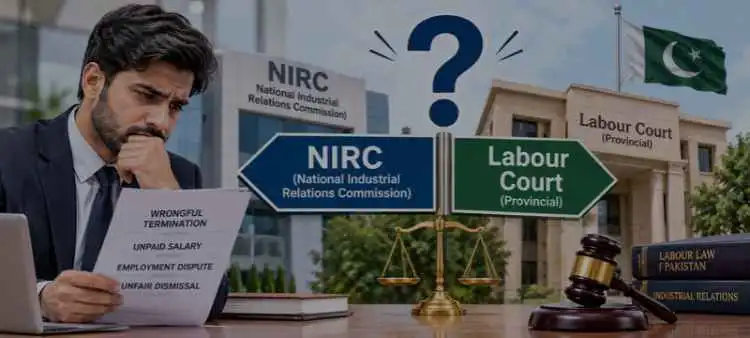
f you are facing wrongful termination, unpaid salary or an employment dispute in Pakistan, choosing the right legal forum is important.
Should you approach the National Industrial Relations Commission (NIRC) or a provincial Labour Court? The answer depends on your employer and the nature of your dispute.
NIRC and Labour Courts operate under different legal frameworks. Each forum has its own statutory jurisdiction and filing procedures.
This guide explains NIRC vs Labour Courts in Pakistan, including their jurisdiction, worker eligibility, complaint procedures and important filing deadlines.
What Is National Industrial Relations Commission?
The National Industrial Relations Commission (NIRC) is a federal industrial relations body established under the Industrial Relations Act, 2012.
It handles industrial relations matters falling within the federal legal framework. These include qualifying establishments operating in Islamabad Capital Territory (ICT) and across multiple provinces.
The Industrial Relations Act, 2012 provides rules for trade unions, collective bargaining, industrial disputes and individual worker grievances.
You can visit the official National Industrial Relations Commission website to learn more about its jurisdiction, procedures and services.
When Does NIRC Have Jurisdiction?
Section 1(3) of the Industrial Relations Act, 2012 identifies the establishments and industries covered by the federal legislation.
Generally, the federal framework applies to establishments or industries operating in Islamabad Capital Territory or carrying on business in more than one province, subject to statutory exclusions.
Relevant establishment structures may include:
- An establishment having an office in Islamabad Capital Territory.
- An establishment maintaining offices in at least two provinces.
- An establishment having offices in one province as well as Islamabad Capital Territory.
Section 54 of the Industrial Relations Act, 2012 sets out the functions of the Commission, including matters involving individual grievances, unfair labour practices and industrial relations within its statutory jurisdiction.
However, operating a business across Pakistan does not automatically establish NIRC jurisdiction. The actual establishment structure and applicable statutory requirements must be examined.
What Types of Cases Can NIRC Handle?
Depending on statutory coverage and employee eligibility, NIRC may deal with:
- Individual worker grievances under Section 33.
- Wrongful dismissal and employment-related grievances.
- Unfair labour practices by employers or workers.
- Trade union registration and related disputes.
- Collective bargaining agent matters.
- Industrial disputes involving covered establishments.
- Other matters assigned to the Commission under applicable legislation.
Not every workplace complaint automatically falls within NIRC jurisdiction. The employee's legal status and the nature of the dispute are important.
What Is a Provincial Labour Court?
A Labour Court is a specialised judicial forum established under the relevant provincial industrial relations legislation.
Provincial Labour Courts deal with employment and industrial disputes falling within their statutory territorial and subject-matter jurisdiction.
Unlike NIRC, which operates under the federal Industrial Relations Act, 2012, provincial Labour Courts function under the relevant provincial laws.
For example, the Sindh Industrial Relations Act, 2013 provides an individual grievance procedure under Section 34 and deals with Labour Courts under Sections 45 and 46.
What Matters Can a Labour Court Handle?
Depending on the applicable provincial legislation, a Labour Court may deal with:
- Wrongful dismissal and unlawful termination disputes involving eligible workers.
- Individual employment grievances.
- Industrial disputes between employers and workers.
- Unfair labour practices.
- Disputes involving settlements and awards.
- Other matters assigned under the relevant provincial legislation.
The exact jurisdiction depends on the applicable statute and the territorial limits of the relevant Labour Court.
NIRC vs Labour Courts in Pakistan - Key Differences
Understanding the difference between NIRC and provincial Labour Courts helps employees identify the appropriate legal forum.
1. Legal Framework
- NIRC operates primarily under the Industrial Relations Act, 2012.
- Provincial Labour Courts operate under applicable provincial industrial relations legislation and other laws conferring jurisdiction.
2. Territorial Jurisdiction
- NIRC deals with matters falling within the federal framework, particularly ICT and qualifying trans-provincial establishments.
- Provincial Labour Courts deal with matters falling within the relevant provincial legal framework and their notified territorial jurisdiction.
3. Individual Employment Grievances
NIRC handles eligible individual grievances under Section 33 of the Industrial Relations Act, 2012.
Provincial Labour Courts handle grievances under the relevant provincial legislation.
4. Trade Unions and Collective Bargaining
- NIRC performs federal industrial relations functions concerning trade unions and collective bargaining in covered establishments.
- Provincial Labour Courts exercise powers assigned under provincial industrial relations legislation.
5. Filing Procedures
- NIRC individual grievance proceedings follow Section 33 of the Industrial Relations Act, 2012.
- Provincial grievance procedures and limitation periods depend on the relevant provincial legislation.
Neither forum should be treated as interchangeable with the other. The applicable legal framework must be identified before filing.
Who Can File an Employment Complaint Before NIRC?
Not every person employed by a private company automatically qualifies to bring a statutory grievance under the Industrial Relations Act, 2012.
Section 2 of the Act defines a worker or workman and provides for statutory inclusions and exclusions. Persons employed mainly in managerial or administrative capacities are excluded from the relevant definition.
Before approaching NIRC, consider the following factors:
- Nature of employment: Determine whether the individual qualifies as a worker or workman under the applicable law.
- Actual job responsibilities: Examine the employee's real duties, authority and responsibilities rather than relying only on the job title.
- Employer's establishment: Identify whether the employer operates within ICT or across multiple provinces.
- Nature of the dispute: Determine whether the complaint concerns a right protected under the applicable industrial relations legislation.
- Statutory exclusions: Check whether the employee or establishment falls within an exclusion under the relevant law.
A person working as a senior executive may have a different legal position from an employee performing operational, clerical or technical duties.
The actual nature of the employment relationship is important when determining worker status.
How to File an Employment Grievance Before NIRC
Section 33 of the Industrial Relations Act, 2012 establishes a procedure for individual worker grievances.
An eligible worker should follow the statutory grievance procedure rather than immediately filing a petition without serving the required written notice.
Step 1 - Prepare a Written Grievance Notice
The worker should bring the grievance to the employer's attention in writing.
The grievance may be submitted personally or through a shop steward or collective bargaining agent, where applicable.
The notice should clearly explain:
- The nature of the employment grievance.
- The relevant events and dates.
- The employment right involved.
- The remedy or action being requested.
Step 2 - Observe the Initial Time Limit
Under Section 33(1), the worker must bring the grievance to the employer's attention within 90 days from the date on which the cause of grievance arises.
Step 3 - Allow the Employer to Respond
The employer must communicate a written decision within the prescribed period:
- 15 days where the worker personally submits the grievance.
- 7 days where the grievance is submitted through a shop steward or collective bargaining agent.
Step 4 - Approach NIRC Where Legally Permitted
If the employer does not communicate a decision within the prescribed period or the worker is dissatisfied with the decision, the matter may be taken forward under Section 33(4).
The Act provides a further 60-day period for approaching the Commission, calculated from the communication of the employer's decision or expiry of the applicable response period.
Step 5 - Prepare Supporting Documents
Before filing, organise the relevant evidence, including:
- Appointment letter or employment contract.
- Termination or dismissal letter, where applicable.
- Salary slips and payment records.
- Written grievance notice.
- Proof of delivery or service of the grievance notice.
- Employer's written response, if available.
- Relevant HR emails and correspondence.
- Other documents supporting the grievance.
The exact documents required depend on the nature of the complaint and applicable procedural requirements.
How to Approach a Provincial Labour Court?
Employees whose disputes fall within provincial jurisdiction may need to approach the relevant Labour Court under the applicable provincial industrial relations legislation.
The procedure is not identical across Pakistan. Each province has its own legal framework, and the relevant grievance procedure and limitation period must be checked before filing.
Example - Sindh Industrial Relations Act, 2013
Section 34 of the Sindh Industrial Relations Act, 2013 provides a procedure for individual worker grievances.
Under this provision:
- A qualifying worker must bring the grievance to the employer's attention in writing within three months from the date on which the cause of grievance arises.
- The employer generally has 15 days to communicate a decision where the worker personally submits the grievance.
- Where the grievance is submitted through a shop steward or collective bargaining agent, the employer has 7 days to respond.
- If the worker is dissatisfied or the employer fails to respond within the prescribed period, the matter may be taken to the Labour Court under the applicable procedure.
- Section 34(6) provides a further 60-day period for approaching the Labour Court, calculated from the employer's decision or expiry of the applicable response period.
These provisions relate to Sindh and should not automatically be applied to employees working under another provincial legal framework.
What About Punjab, Khyber Pakhtunkhwa and Balochistan?
Employment disputes in other provinces must be examined under their respective legislation.
- Punjab: The Punjab Labour Code 2026 contains provisions relating to worker grievances and Labour Courts. Its commencement notification and transitional provisions must be checked before relying on particular sections.
- Khyber Pakhtunkhwa: The Khyber Pakhtunkhwa Industrial Relations Act, 2010 provides the provincial industrial relations framework, subject to applicable amendments.
- Balochistan: The Balochistan Industrial Relations Act, 2022 provides the provincial framework for industrial relations and Labour Courts.
The applicable law should always be verified against current official legislation and notifications.
Important Filing Deadlines for Employment Disputes
Limitation periods are particularly important in employment disputes. Missing a statutory deadline can create serious procedural difficulties.
Some important examples include:
- Federal Industrial Relations Act, 2012: Section 33 provides 90 days for bringing an individual grievance to the employer.
- Federal employer response: Generally 15 days for a personally submitted grievance or 7 days where submitted through a shop steward or collective bargaining agent.
- Further NIRC filing period: Section 33(4) provides 60 days from the employer's decision or expiry of the applicable response period.
- Sindh Industrial Relations Act, 2013: Section 34 provides a three-month initial grievance period, followed by the applicable employer response and further filing periods.
These periods apply to the specific statutory grievance procedures discussed above. Other employment claims may follow different limitation rules.
Do not assume that the same deadline applies to wrongful termination, unpaid salary, compensation and every other employment-related claim.
Documents Required for a Labour Complaint
Whether approaching NIRC or a provincial Labour Court, preparing the relevant documents is an important first step.
Commonly required documents may include:
- Appointment letter or employment contract.
- Employee identity card or other employment evidence.
- Salary slips and bank payment records.
- Termination, dismissal or suspension letter.
- Show-cause notices and disciplinary inquiry documents.
- Written grievance notice submitted to the employer.
- Proof of delivery or service of the grievance notice.
- Employer's written response, if available.
- Relevant HR emails and workplace correspondence.
- A date-wise summary of important events.
Where the employer has not issued an appointment letter or formal termination order, other lawful evidence may help establish the employment relationship.
Common Mistakes When Filing Labour Complaints in Pakistan
Employees and employers should avoid common procedural mistakes that can create unnecessary legal complications.
- Choosing the wrong forum: Approaching NIRC when the matter falls within provincial jurisdiction, or approaching a provincial Labour Court when federal jurisdiction applies.
- Ignoring worker eligibility: Assuming that every employee automatically qualifies as a worker under industrial relations legislation.
- Missing limitation periods: Delaying the written grievance notice or subsequent legal proceedings.
- Failing to preserve evidence: Not keeping employment contracts, salary records, dismissal letters and relevant correspondence.
- Skipping mandatory procedures: Filing a petition without following the grievance notice requirements of the applicable law.
- Relying on outdated legislation: Using old provincial laws without checking amendments, commencement notifications and transitional provisions.
Which Forum Should You Approach?
Before filing an employment dispute in Pakistan, consider these questions:
- Where does the employer operate?
- Does the establishment fall within the federal Industrial Relations Act, 2012?
- Does the employee qualify as a worker under the relevant legislation?
- What is the actual nature of the employment dispute?
- Which statutory grievance procedure applies?
- What limitation period must be observed?
- Are there any statutory exclusions?
A careful jurisdiction assessment can help avoid unnecessary objections and procedural delays.
Legal Assistance for NIRC and Labour Court Matters
Employment disputes require careful examination of the relevant legislation, employment documents, jurisdiction and filing deadlines.
A.A. Dewan & Co. provides legal assistance in employment and labour law matters, including:
- Assessment of NIRC and provincial Labour Court jurisdiction.
- Review of employment contracts and appointment letters.
- Wrongful termination and unfair dismissal disputes.
- Preparation and review of grievance notices.
- Employment-related legal notices and replies.
- Assessment of unpaid salary and other employment dues.
- Legal assistance and representation in qualifying employment disputes.
Explore our Employment and Labour Law services in Pakistan for further information.
If you are facing an unlawful dismissal, read our guide on How to File a Wrongful Termination Complaint in Pakistan.
You can also read our guide on Termination of Employment Without Notice.
Frequently Asked Questions
What is the main difference between NIRC and a Labour Court?
NIRC operates under the federal Industrial Relations Act, 2012 and deals with matters within its federal jurisdiction. Provincial Labour Courts operate under the relevant provincial industrial relations laws and exercise jurisdiction within their statutory limits.
Can an employee file a complaint directly with NIRC?
An eligible worker may approach NIRC where the dispute falls within its jurisdiction. However, an individual grievance under Section 33 generally requires the worker to follow the prescribed written grievance notice procedure first.
Does NIRC have jurisdiction over every private company in Pakistan?
No. NIRC jurisdiction depends on the statutory coverage of the establishment, its operations in ICT or multiple provinces, the nature of the dispute and the worker's eligibility.
Can an employee in Karachi approach NIRC?
Not automatically. If an establishment operates only within Sindh and does not fall within the federal jurisdictional framework, the relevant Sindh labour legislation may apply. Qualifying trans-provincial or ICT operations may change the jurisdictional assessment.
Can an employee in Islamabad file a case before NIRC?
An eligible worker employed in an establishment falling within the federal framework may approach NIRC, subject to the applicable statutory requirements.
Is NIRC a Labour Court?
No. NIRC is a separate federal industrial relations commission, while provincial Labour Courts are judicial forums established under relevant provincial legislation.
How many days does an employee have to approach NIRC?
Under Section 33 of the Industrial Relations Act, 2012, the worker generally has 90 days to bring the grievance to the employer in writing. A further 60-day period applies after the employer's decision or expiry of the prescribed response period.
Can a senior manager file a case before a Labour Court?
Not automatically. The statutory definition of worker may exclude persons employed mainly in managerial or administrative capacities. Actual job responsibilities must be examined.
Can an employee claim unpaid salary through a Labour Court?
Potentially, where the relevant legislation gives the Labour Court jurisdiction over the claim. Some wage-related claims may fall under separate statutory authorities, depending on their nature.
What happens if a complaint is filed before the wrong forum?
The opposing party may raise a jurisdictional objection. Depending on the applicable law, the matter may face dismissal, transfer or other procedural consequences.
Legal References and Official Sources
The following legislation and official resources provide the legal basis for this guide.
- Industrial Relations Act, 2012 — Pakistan Code
- National Industrial Relations Commission — Official Website
- NIRC Jurisdiction and Grievance FAQs — Ministry of Overseas Pakistanis and Human Resource Development
- Sindh Industrial Relations Act, 2013 — Government of Sindh
- Khyber Pakhtunkhwa Industrial Relations Act, 2010 — KP Code
- Balochistan Industrial Relations Act, 2022 — Labour Department
Legal Information Notice: This article provides general legal information and educational guidance. It does not replace advice based on the facts and documents of an individual employment dispute. Applicable legislation, jurisdiction, worker status, amendments, commencement notifications and limitation periods should be verified before taking legal action.
Comments
No comments yet. Be the first to comment!
Leave a Comment