

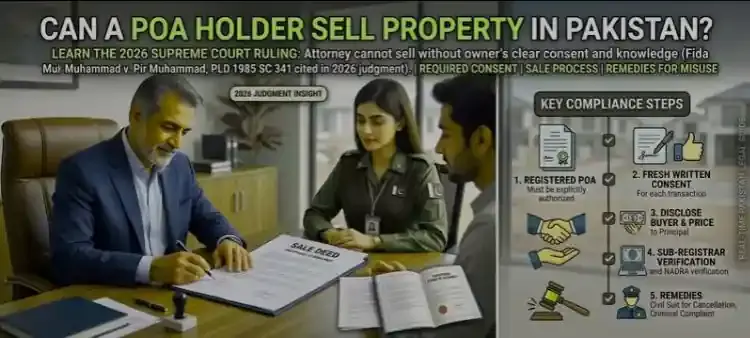
A relative in Pakistan offers to sell your house while you live abroad. You have already given that relative a General Power of Attorney (GPA). Can they sign a sale deed, choose the buyer and collect the money without asking you again?
Not automatically. A power of attorney for property sale in Pakistan must clearly authorize the relevant sale. A General Power of Attorney does not give unlimited permission merely because it is called “general.†Selling property to the attorney or the attorney's close relatives raises even stricter questions about the owner's informed consent.
This guide explains what a POA holder can legally do, what the Supreme Court decided in 2026, what buyers and overseas owners should check, and what happens if a property is sold without permission.
On This Page
- Can a Power of Attorney Holder Sell Property?
- General vs Special POA for Property Sale
- What Did the Supreme Court Decide in 2026?
- Can an Attorney Sell to Himself or Relatives?
- How a Lawful POA Property Sale Works
- Selling Property from Abroad
- Checks Every Buyer Should Make
- How Owners Can Reduce Fraud Risk
- What If Property Was Sold Without Permission?
- Frequently Asked Questions
- Final Checklist
Can a Power of Attorney Holder Sell Property?
Yes, a POA holder may sell a property when the owner has validly given the necessary authority and the sale follows the applicable law. The document should make the power to sell clear. A right to manage, rent, maintain or collect documents is not necessarily a right to sell.
The owner who grants authority is called the principal . The person acting under it is the attorney or agent . Despite the name, this person does not have to be a practising lawyer.
Consider two instructions:
- “My brother may collect ownership records and pay property dues.†This does not clearly authorize a sale.
- “My brother may sell Plot 24, Block B, after obtaining my written approval of the buyer and price, and sign the required sale documents.†This expressly addresses a sale , subject to valid execution, registration requirements and the rest of the law.
A POA itself does not transfer ownership to the agent or the purchaser. A separate, legally effective property transaction is still required. Section 54 of the Transfer of Property Act, 1882 addresses sale of immovable property and the requirements for a registered instrument in circumstances covered by that provision.
General vs Special POA for Property Sale
| Document | What it usually covers | Important warning |
|---|---|---|
| General Power of Attorney (GPA) | A wider range of stated tasks | “General†is not automatic permission to sell or transfer ownership. |
| Special Power of Attorney (SPA) | A particular property, transaction or limited task | Check the actual clauses; a “special†document can still be drafted too broadly. |
For a single property sale, a carefully drafted Special Power of Attorney is often easier to control. It can identify the property, the permitted acts, a minimum acceptable price, a buyer-approval requirement and the method of receiving payment.
However, the heading does not decide the legal effect . Courts and registration authorities look at the authority actually granted, compliance with applicable law and the circumstances of the transaction.
For the wider online and embassy process, read Power of Attorney for Overseas Pakistanis .
What Did the Supreme Court Decide in 2026?
A recent case shows why these details matter.
In Javed Iqbal v. Mst. Farhat Iqbal (deceased) , 2026 SCMR 1119 , Civil Appeal No. 852 of 2025, decided on 6 April 2026 , a woman had given her brother a General Power of Attorney relating to inherited land. He subsequently transferred the property to his own sons through a registered sale deed and mutation. She challenged the transaction.
The Supreme Court dismissed the appeal against the decision restoring cancellation of the transaction . It emphasized two principles:
- A General Power of Attorney does not, merely by being general, authorize the sale or other alienation of property. The relevant power must be clear and specific.
- An attorney who transfers property to himself or close relatives must establish the principal's prior, informed and express approval . A family relationship or a claim of payment does not automatically prove consent.
The decision applied earlier case law and agency duties under the Contract Act. You can read the reported judgment text and case details (third-party legal database reproduction).
The lesson is not that every POA sale is invalid. It is that the agent must stay within the authority given, especially where the transaction benefits the agent's own family.
Can an Attorney Sell to Himself or Relatives?
Not simply because the POA contains a general power to sell. A sale to the attorney, the attorney's children or another close relative creates a possible conflict of interest : the person supposed to protect the owner's interests may also benefit from the sale.
Sections 211, 214 and 215 of the Contract Act, 1872 concern an agent's duty to follow instructions, communicate with the principal and deal fairly when acting on the agent's own account. In the circumstances described by section 215, the principal may be able to repudiate the transaction.
Example: A man in the UAE authorizes a cousin to arrange a sale at a fair market price. The cousin sells the house to his own son for much less than the proposed price, without informing the owner. That is not an ordinary arm's-length sale. The actual POA, disclosure, permission, consideration and evidence would need careful legal examination.
Where a related-party sale is genuinely intended, obtain specific, informed, documented approval before proceeding; do not rely on a broad phrase hidden in a long document.
How a Lawful POA Property Sale Works?
The exact steps vary between Punjab, Sindh, Islamabad and different housing societies or development authorities. The following is a practical sequence, not one universal registration checklist.
Step 1 — Check the owner's title and the property
Obtain the current ownership or allotment record. Check the exact plot number, area, address, co-owners, mortgages, existing court orders and any restrictions on transfer.
Step 2 — Prepare and authenticate the correct POA
The document should identify the principal, agent and property, and state the authorized acts. For presentation of documents for registration, sections 32–33 of the Registration Act, 1908 contain rules concerning agents and authentication. Provincial amendments and the receiving registrar's requirements must also be checked.
Step 3 — Verify that the authority is still effective
Check the original POA, its execution and authentication, any stated end date, revocation, and any event that may have ended the agency. Confirm the principal is alive and has not withdrawn authority. A stamp, attestation or registration entry does not by itself prove permission for every proposed act.
Step 4 — Agree the buyer, price and payment method
Ask for the owner's direct confirmation of the buyer and material terms, especially if the buyer is connected to the agent. Agree how the sale money will reach the owner. Sending payment directly to a verified account controlled by the principal can reduce risk; the precise arrangement depends on the transaction.
Step 5 — Complete required sale instrument & registration
Where the law requires a registered sale deed or other prescribed transfer instrument, the authorized person must complete that process before the competent office. A POA is not a substitute for the actual conveyance .
Step 6 — Update the relevant property record
Obtain the registered document and complete any required mutation, society transfer or other record update. Keep receipts and certified copies. A mutation entry alone does not cure an unauthorized or fraudulent sale.
Selling Property from Abroad
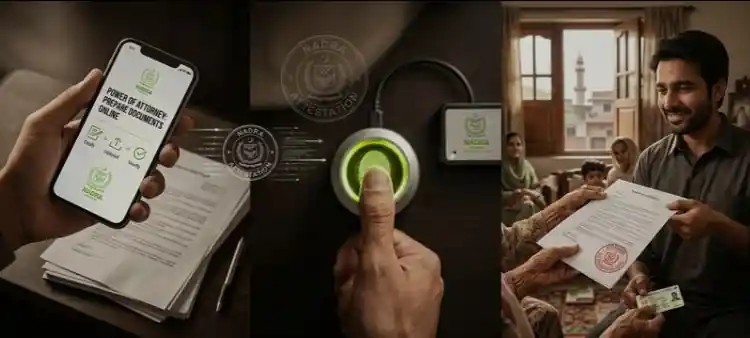
Overseas owners may use the NADRA Digital Power of Attorney facility and the relevant Pakistan mission's instructions where eligible. The process concerns execution and attestation of authority ; it does not approve a buyer, sale price or ownership transfer.
Pakistan's Ministry of Foreign Affairs consular guidance describes verification of POAs originating abroad and a 120-day attestation/re-verification requirement . Do not assume this means every POA automatically loses all legal effect after 120 days. Ask the receiving registrar or society about its current acceptance and presentation deadlines.
A remote seller should also ask whether the property authority accepts the proposed POA format, whether further registration is needed and which original documents must reach Pakistan.
For document preparation connected to overseas transactions, see Legal Document Preparation for Overseas Pakistanis .
Checks Every Buyer Should Make
Buying from an attorney adds another issue to ordinary title verification: does this person have authority to sell this particular property now?
Before paying a large deposit:
- Obtain and verify the original POA and the principal's identity.
- Look for a clear sale clause covering the same property.
- Check authentication, registration and whether the POA has been revoked or otherwise ended.
- Independently verify title, encumbrances, litigation and the seller's ownership share.
- Where practical, confirm the transaction and price directly with the principal through reliable channels—not only a phone number supplied by the agent.
- Treat a proposed sale to the attorney's family, unusually low price or pressure to pay cash as a reason for deeper checks.
- Confirm the registrar's or housing society's requirements before completing payment.
Example: A buyer is told that a registered GPA means the attorney can sell any property owned by his uncle. That is unsafe. The buyer must confirm the exact wording, property details and present authority.
How Owners Can Reduce Fraud Risk
A person selling from abroad can prevent many disputes by limiting the authority before signing.
A purpose-specific POA can address:
- The exact property and permitted task.
- Whether the attorney may negotiate, sign an agreement, execute a sale deed or only collect documents.
- The owner's written approval of buyer and final price.
- Whether the attorney may deal with himself or close relatives —and, if so, the precise approvals required.
- How the full sale consideration must be paid and acknowledged.
- Whether the agent may delegate authority to another person.
- The document's duration and the reporting or document-delivery requirements.
Do not sign blank stamp papers, an open-ended sale authority or an acknowledgment that you have received money when you have not. Keep a signed copy and monitor property records during the transaction.
What If Property Was Sold Without Permission?
An owner who discovers an unauthorized transfer should act promptly, but the best legal remedy depends on the document trail and who now claims the property.
First, preserve evidence: Obtain certified copies of the POA, sale deed, mutation, title history, payment records and relevant messages. Record when you discovered the transfer.
Next, establish the problem: Was the POA forged, valid but exceeded, revoked before sale, used for a sale to relatives without consent, or used after the principal's death? Those are different legal issues.
Then, check available remedies: Depending on the facts, a civil suit seeking cancellation of a written instrument , declaration, injunction or other appropriate relief may be available. Section 39 of the Specific Relief Act, 1877 addresses cancellation of void or voidable instruments where the statutory requirements are met. Alleged forgery may also call for a separate complaint to the competent authority, but a police report is not automatically a substitute for resolving title in court.
If a transaction is still pending, ask promptly about lawful protective steps, including an injunction where justified. Revoking a POA does not automatically reverse a completed registered sale . Notice to the agent and affected third parties, legal deadlines and possible rights of later purchasers all matter.
For connected ownership disputes, see Property Disputes for Overseas Pakistanis .
Frequently Asked Questions
1. Can a General Power of Attorney holder sell property in Pakistan?
Only where valid, clear authority covers the sale and the transaction meets applicable legal requirements. A document's label as “general†does not by itself grant the power to sell.
2. Is a Special Power of Attorney compulsory for selling a house?
Not automatically in every case. The key questions are whether the actual authority is sufficient and whether the relevant registrar or property authority accepts its form and authentication. A purpose-specific SPA may offer better control.
3. Can my brother sell my property without telling me?
Being your brother does not give him sale authority. If you have appointed him as agent, the wording and circumstances determine his powers. A sale made outside authority may be challenged using the appropriate legal process.
4. Can an attorney transfer my property to his own son?
The Supreme Court's 2026 SCMR 1119 decision confirms the need for proven prior, informed and express approval for such a related-party transaction. A broad GPA and an alleged payment alone are not enough.
5. Does registering a Power of Attorney make the attorney the owner?
No. A POA grants authority to act. Property ownership changes through the legally required transaction and transfer process, not merely because a POA has been registered.
6. Can an overseas Pakistani sell a plot without travelling to Pakistan?
It may be possible through a validly executed and authenticated POA if the particular property authority accepts it and all sale formalities are completed. Not every property or transaction has identical requirements.
7. Can a POA holder receive the entire sale price?
Only if the authority and payment arrangement legally permit it. For protection, the owner should control the payment instructions, verify amounts and keep bank and transaction records.
8. Does a POA remain valid after the principal dies?
An ordinary agency generally ends on death under the Contract Act, subject to legal exceptions and rules protecting certain interests and third-party dealings . Do not attempt a sale after learning of the principal's death without checking the legal position.
9. Can I cancel a sale made through a fake or misused POA?
A challenge may be possible, including a civil claim involving cancellation or declaration. The remedy depends on the original document, evidence, dates, buyers and applicable law; the sale does not automatically disappear when fraud is alleged.
Final Checklist
Before any property sale through Power of Attorney, confirm:
- Ownership: The principal owns the interest being sold.
- Authority: The document clearly permits this exact sale.
- Consent: The buyer, price and any related-party interest are properly disclosed and approved.
- Authentication: The POA meets the applicable registrar or society requirements.
- Payment: The owner knows how and when the full price will be received.
- Transfer: The proper deed and registration or other prescribed transfer steps will be completed.
- Records: The parties will retain copies of the POA, sale instrument, receipts and updated title records.
Bottom line: A Power of Attorney can help an owner sell property in Pakistan without appearing personally, but it is not a blank cheque . The agent must act within clear authority, protect the owner's interests and follow the legal sale procedure. Where a transfer benefits the attorney or close relatives, the need for informed consent is especially important.
Legal information notice: This guide provides general information on Pakistan law as of November 2026. Provincial amendments, property-authority rules, the actual POA, title documents, evidence and relevant dates may change the outcome. It is not case-specific legal advice.


Comments
No comments yet. Be the first to comment!
Leave a Comment