

Legal Guide • Pakistan • Domestic Violence • Family Law • Women's Rights
Domestic violence and dowry disputes can have serious consequences for women, affecting their safety, financial independence, property rights and family relationships. For many women, the difficulties do not end when they leave an abusive marriage. They may also face disputes over jewellery, household belongings, bridal gifts, maintenance and the return of property given to them at the time of marriage.
These problems can become more complicated when a woman lives abroad, her husband remains in Pakistan, or the marriage involves family members living in different countries. Understanding the law, available protection and legal procedures is therefore important before taking action.
In Pakistan, women's rights in domestic violence and dowry cases are addressed through different legal provisions. Depending on the circumstances, a woman may seek protection against abuse, recovery of dowry articles, maintenance, dissolution of marriage or other appropriate legal remedies.
This guide explains how these laws work, what evidence may be required, how false allegations are treated and what options may be available to women living outside Pakistan.
What this guide covers
- Women's legal rights in domestic violence cases.
- Dowry ownership and recovery after separation or divorce.
- Legal action against a husband or in-laws.
- False dowry allegations and evidentiary requirements.
- Applicable laws across Pakistan.
- Legal options for overseas Pakistani women.
- Court proceedings, documents and practical steps.
1. What Are Domestic Violence and Dowry Cases?
Domestic violence and dowry cases involve different legal issues, although they can arise from the same family dispute.
Domestic violence generally refers to abusive conduct within a domestic relationship. Depending on the applicable legislation, it may include physical assault, psychological abuse, threats, intimidation, sexual abuse, economic abuse and other forms of harmful conduct.
A dowry dispute, on the other hand, commonly concerns property given to a woman in connection with her marriage. Such property may include:
- Gold jewellery and personal ornaments.
- Furniture and household equipment.
- Refrigerators, washing machines and other appliances.
- Clothing and personal belongings.
- Bridal gifts and other property given to the bride.
- Other articles provided by her parents or relatives.
A dispute may arise when a husband or his relatives refuse to return these belongings, claim ownership over them or prevent the woman from recovering her property after separation.
An important legal distinction: Domestic violence proceedings are concerned with protection against abuse, while dowry recovery proceedings concern the woman's rights in relation to property. One does not automatically replace the other.
2. What Are Women's Rights Under Pakistani Law?
Women in Pakistan have legal remedies when they face domestic violence, unlawful interference with their property or matrimonial disputes.
The exact remedy depends on the nature of the complaint, the province or territory involved and the applicable legislation.
A woman may be able to seek:
Protection against domestic violence and harassment.
Appropriate residence-related relief.
Recovery of dowry articles and bridal gifts.
Maintenance, where legally available.
Dissolution of marriage or other matrimonial relief.
Compensation or monetary relief where provided by applicable law.
Legal action concerning threats, assault or other criminal conduct.
Women do not necessarily have to obtain a divorce before seeking protection against domestic violence or pursuing a claim for the return of their property.
Does a woman lose her dowry after leaving her husband?
No. Separation or divorce does not automatically transfer ownership of the woman's dowry to her husband or his family.
Section 5 of the Dowry and Bridal Gifts (Restriction) Act, 1976 provides that property given as dowry, bridal gifts and presents to the bride vests absolutely in her.
This is an important statutory protection when a husband or his relatives refuse to return property belonging to the woman.
Official legislation: Dowry and Bridal Gifts (Restriction) Act, 1976 – Pakistan Code.
Pakistan Code
3. Which Domestic Violence Laws Apply in Pakistan?
One important point for international readers is that Pakistan does not operate under one identical domestic violence procedure throughout the country. The applicable legislation depends on the territorial jurisdiction.
The principal statutory frameworks include:
| Jurisdiction | Relevant legislation |
|---|---|
| Islamabad Capital Territory | Domestic Violence (Prevention and Protection) Act, 2026 |
| Punjab | Punjab Protection of Women against Violence Act, 2016 |
| Sindh | Sindh Domestic Violence (Prevention and Protection) Act, 2013 |
| Khyber Pakhtunkhwa | Khyber Pakhtunkhwa Domestic Violence Against Women (Prevention and Protection) Act, 2021 |
| Balochistan | Balochistan Domestic Violence (Prevention and Protection) Act, 2014 |
These laws have different definitions, procedures and available remedies. A legal claim should therefore be assessed under the legislation applicable to the woman's location and circumstances.
National Assembly of Pakistan+4
Domestic Violence in Islamabad
The Domestic Violence (Prevention and Protection) Act, 2026 extends to Islamabad Capital Territory and came into force upon enactment.
It provides a statutory framework addressing domestic violence within the relationships covered by the legislation.
Depending on the facts, a court may grant relief that includes:
- Protection orders.
- Residence-related orders.
- Monetary relief.
- Interim protection and other appropriate directions.
The Act also identifies different forms of domestic violence and provides procedures for seeking legal protection.
Read the official Domestic Violence (Prevention and Protection) Act, 2026.
National Assembly of Pakistan
Domestic Violence in Punjab
- The Punjab Protection of Women against Violence Act, 2016 provides protection against different forms of violence affecting women.
- Its framework includes protection orders, residence orders and monetary relief, subject to the requirements of the legislation.
- Women facing domestic abuse in Punjab should consider the appropriate statutory procedure rather than assuming that a criminal complaint is the only available remedy.
Official resource: Punjab Women Development Department – Laws.
Domestic Violence in Sindh
- The Sindh Domestic Violence (Prevention and Protection) Act, 2013 provides legal protection against domestic violence.
- The legislation addresses different forms of abuse, including physical, psychological, emotional, verbal, sexual and economic abuse, within its statutory definitions.
- Depending on the circumstances, an affected woman may seek protection and other relief through the relevant court.
Domestic Violence in Khyber Pakhtunkhwa
- The Khyber Pakhtunkhwa Domestic Violence Against Women (Prevention and Protection) Act, 2021 establishes a legal framework for addressing domestic violence against women in the province.
- The legislation addresses forms of abuse and provides protective mechanisms under its provisions.
Official legislation: Khyber Pakhtunkhwa Domestic Violence Against Women Act, 2021.
Domestic Violence in Balochistan
- The Balochistan Domestic Violence (Prevention and Protection) Act, 2014 provides a framework for addressing domestic violence and seeking protection under the applicable provincial legislation.
- The relevant court procedure and available remedies should be assessed according to the facts of the individual case.
4. Can a Wife File a Dowry Case Against Her Husband?
- Yes. A woman may pursue legal proceedings to recover dowry articles and other property belonging to her when her husband or his family refuses to return them.
- Under Pakistani law, dowry and bridal gifts given to the bride are her property. A husband does not automatically become their owner simply because the articles were brought into the matrimonial home.
- For example, consider a situation in which a woman brings jewellery, furniture, household appliances and personal belongings to her marital home. After marital separation, her husband refuses to return those items and claims that they belong to his family.
The woman may have grounds to pursue recovery proceedings before the competent Family Court, depending on the nature of the property and the applicable law.
What property can a woman claim?
| Property | Legal consideration |
|---|---|
| Gold jewellery | Ownership and proof of delivery may be relevant |
| Furniture | May be included in a dowry articles claim |
| Household appliances | Can form part of the claimed dowry inventory |
| Bridal gifts | Ownership depends on the recipient and circumstances |
| Personal belongings | May be recoverable by their rightful owner |
| Wedding presents | The identity of the recipient and evidence of the gift matter |
It is important to distinguish dowry articles from other gifts. A gift given to the bride may belong to her, while a gift given to the husband or another family member is not automatically the wife's property.
For more information about the recovery procedure, see our Recovery of Dowry Articles service in Pakistan.
5. What Happens When a Husband or In-Laws Refuse to Return Dowry Articles?
Refusing to return a woman's belongings can create a property dispute that requires legal proceedings.
A woman should first identify the articles she is claiming and establish, as far as possible, that they were given to her or belong to her.
The following steps may help:
- Prepare a detailed list of the missing articles.
- Identify jewellery, furniture, appliances and other personal belongings separately.
- Collect photographs, receipts, wedding records and available supporting documents.
- Preserve messages or written communications concerning the articles.
- Record when and how the husband or his relatives refused to return the property.
- Obtain legal advice about filing a claim before the competent court.
Can a court order the return of dowry articles?
A competent Family Court may adjudicate a claim for dowry articles within its jurisdiction.
Depending on the evidence and circumstances, the court may determine whether the claimed property belongs to the woman and whether its return or another legally appropriate form of relief is justified.
If the original articles are unavailable, the question of their value may also arise. The court will consider the evidence and applicable legal principles before determining the appropriate relief.
6. What Is a False Dowry Case and How Are Such Allegations Examined?
Not every dowry dispute involves a genuine claim, and not every allegation is automatically established simply because a complaint has been filed.
A false dowry allegation may arise where a person disputes the existence, ownership, quantity or value of the claimed articles, or alleges that items were never given to the bride.
However, a husband or his family should not assume that a dowry claim is false merely because they disagree with the amount claimed.
Courts examine the evidence presented by both sides.
How can a husband defend against a false dowry claim?
A person facing an allegedly exaggerated or incorrect dowry claim should:
- Preserve available wedding records and photographs.
- Keep messages and communications relating to the disputed property.
- Identify which items were actually received and where they were kept.
- Collect relevant evidence concerning the return or possession of articles.
- Respond to court proceedings within the prescribed time.
- Avoid threats, intimidation or attempts to influence witnesses.
What happens if a false dowry case is proved?
The legal consequences depend on the nature of the false statement, the proceedings involved and the evidence establishing deliberate wrongdoing.
A disputed or unsuccessful claim does not automatically amount to a criminal offence. Deliberately giving false evidence or making a knowingly false accusation may, however, attract separate legal consequences where the requirements of the applicable law are satisfied.
Both women seeking genuine recovery and men facing allegations are entitled to a fair legal process.
7. Is Dowry Harassment Considered Domestic Violence?
Dowry-related pressure and harassment may form part of domestic violence where the conduct falls within the applicable statutory definition.
For example, a woman may experience:
- Repeated demands for additional money or property.
- Threats or intimidation concerning dowry.
- Humiliation because her family could not provide expensive gifts.
- Physical or psychological abuse connected with financial demands.
- Economic control or deprivation.
- Threats to remove her from the matrimonial home.
The legal classification depends on the conduct, evidence and applicable legislation.
Can a woman take legal action against dowry harassment?
Potentially, yes. Depending on the facts, she may consider domestic violence proceedings, a criminal complaint where an offence is disclosed, or family proceedings relating to property and matrimonial rights.
The correct legal route should be determined by examining the actual conduct rather than treating every disagreement over marriage expenses as a domestic violence offence.
What evidence may support a dowry harassment complaint?
Useful evidence may include:
Messages and emails containing threats or demands.
Medical records relating to injuries.
Photographs and videos where lawfully obtained.
Witness statements.
Previous complaints or documented incidents.
Financial records showing relevant transactions.
Other reliable evidence connected with the alleged conduct.
Evidence should be preserved in its original form wherever possible.
8. What Legal Remedies Are Available to Women Facing Domestic Violence?
A woman experiencing domestic violence may have more than one legal option. The appropriate remedy depends on the seriousness of the conduct, her location and the relationship between the parties.
| Legal remedy | Purpose |
|---|---|
| Protection order | To address specified conduct and protect against further abuse |
| Residence order | To provide appropriate residence-related protection |
| Monetary relief | To address financial losses or other relief covered by applicable law |
| Criminal complaint | Where the facts disclose a criminal offence |
| Dowry recovery proceedings | To seek recovery of property belonging to the woman |
| Maintenance claim | To pursue financial support where legally available |
| Dissolution of marriage | To seek termination of the marriage through the applicable legal process |
These remedies are not interchangeable. For example, a protection order does not automatically determine ownership of dowry articles, and a dowry recovery claim does not necessarily resolve allegations of domestic violence.
A lawyer should assess whether separate proceedings are required and whether any claims can be pursued together under the relevant procedural framework.
9. Can a Woman Recover Dowry Articles After Divorce or Khula?
Yes. Divorce or khula does not, by itself, transfer ownership of dowry articles belonging to the woman to her former husband.
Section 5 of the Dowry and Bridal Gifts (Restriction) Act, 1976 provides statutory protection for property given as dowry, bridal gifts and presents to the bride.
A woman may therefore pursue recovery of her property even after the marriage has ended, subject to the applicable legal procedure and evidence.
Does khula affect a woman's dowry rights?
- Khula and dowry recovery concern different legal issues.
- Khula involves dissolution of marriage through the applicable legal process. Dowry recovery concerns property ownership.
- The financial consequences of khula, including any question concerning dower or its return, must be considered separately from the woman's ownership of dowry articles.
- A woman should not assume that obtaining khula automatically means she must surrender all property received at marriage.
What is the difference between dowry, bridal gifts and haq mehr?
| Term | Meaning |
|---|---|
| Dowry | Property given to the bride in connection with marriage, commonly by her family |
| Bridal gifts | Gifts given to the bride in connection with marriage |
| Haq Mehr (Mahr) | A financial entitlement of the wife arising from the marriage contract |
| Wedding gifts | Gifts given by relatives, friends or other individuals, depending on the recipient |
These categories have different legal and financial implications. Their ownership should be determined by the identity of the recipient, the nature of the gift and the applicable law.
For this reason, dowry, bridal gifts and haq mehr should not be treated as interchangeable legal terms.
10. What Legal Rights Do Overseas Pakistani Women Have?
Domestic violence and dowry disputes can become especially complicated when a woman lives outside Pakistan but her marriage, husband, property or family proceedings are connected to Pakistan.
For example:
- A Pakistani woman living in the United Kingdom may have left her husband in Pakistan.
- A woman residing in the UAE may want to recover jewellery and household articles from her matrimonial home in Pakistan.
- A woman living in Canada may need to pursue a family case while remaining abroad.
- A woman in the United States may need legal assistance concerning divorce, maintenance or dowry recovery in Pakistan.
In these situations, the first step is to determine where the relevant legal proceedings should be initiated and which Pakistani court has jurisdiction.
Can an overseas Pakistani woman file a dowry case without returning to Pakistan?
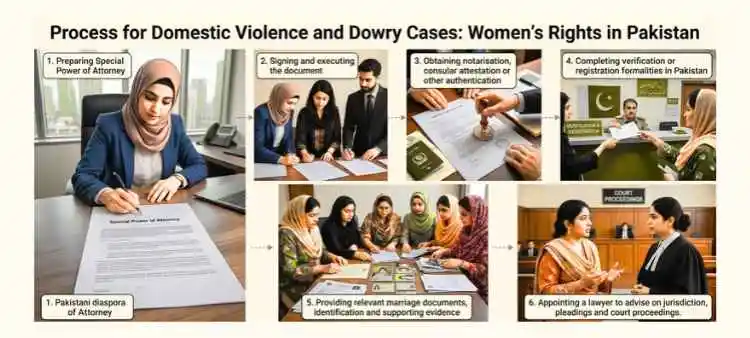
In appropriate circumstances, an overseas Pakistani woman may pursue legal proceedings in Pakistan through an authorised representative, subject to the applicable court procedure and requirements.
A Special Power of Attorney may be required to authorise a representative to undertake specified legal actions on her behalf.
The process may involve:
Preparing a Special Power of Attorney containing the necessary authority.
Signing and executing the document in the country of residence.
Obtaining the required notarisation, consular attestation or other authentication.
Completing any required verification or registration formalities in Pakistan.
Providing relevant marriage documents, identification and supporting evidence.
Appointing a lawyer to advise on jurisdiction, pleadings and court proceedings.
The exact requirements depend on the country where the document is signed and the requirements of the receiving authority in Pakistan.
Can a lawyer represent an overseas woman in Family Court?
An advocate may represent a woman in accordance with the applicable procedural rules and valid authority.
However, the existence of a Power of Attorney does not guarantee that the woman will never need to attend court personally.
The court may require her attendance, evidence or cross-examination where necessary. Whether a particular hearing can be attended through a representative or another permitted arrangement depends on the nature of the proceedings and the court's directions.
What documents should overseas women prepare?
The following documents may be useful:
- CNIC or NICOP.
- Passport and overseas residence details.
- Nikah Nama or marriage certificate.
- Details of the husband and relevant family members.
- Dowry articles list.
- Receipts and purchase records, where available.
- Wedding photographs and videos.
- Relevant messages and communications.
- Previous complaints or court orders, if any.
- Special Power of Attorney, where required.
A woman should preserve original documents and provide copies to her lawyer for assessment.
Can a woman seek domestic violence protection while living abroad?
- A woman living overseas should distinguish between protection available in her country of residence and remedies available in Pakistan.
- If the abuse occurs in her country of residence, local protection laws and authorities may be relevant. If the conduct, matrimonial relationship or property dispute has a sufficient legal connection with Pakistan, Pakistani proceedings may also need to be considered.
- A foreign residence does not automatically give a Pakistani court jurisdiction over every aspect of a family dispute. Jurisdiction must be assessed according to the applicable law and facts.
- For overseas Pakistani families, cross-border legal advice can help identify the appropriate proceedings and avoid unnecessary delays.
11. How Can a Woman Prove a Domestic Violence or Dowry Case?
Evidence is important in both domestic violence and dowry disputes.
A court does not decide a claim simply because one party makes an allegation. The parties must present relevant material to support their respective positions.
Evidence in domestic violence cases
Depending on the nature of the complaint, evidence may include:
- Medical examination reports.
- Hospital and treatment records.
- Photographs of injuries.
- Messages, emails and recorded communications lawfully obtained.
- Witness statements.
- Police reports and previous complaints.
- Records of financial abuse or relevant transactions.
- Other documents showing a pattern of alleged abusive conduct.
Evidence in dowry recovery cases
Evidence relating to ownership, delivery and possession may include:
A written dowry inventory.
Wedding photographs and videos.
Purchase receipts and invoices.
Jewellery records.
Statements from people who witnessed the delivery of articles.
Messages acknowledging receipt of belongings.
Other documents identifying the property and its ownership.
What if the woman has no receipts for dowry articles?
The absence of purchase receipts does not automatically establish that the woman has no claim.
Other evidence may be relevant, including photographs, wedding records, witness testimony, communications and the surrounding circumstances.
The strength of a claim depends on the total evidence available and the applicable legal principles.
12. What Happens During Dowry Recovery Proceedings in Family Court?
A dowry recovery claim generally involves identifying the property, establishing the woman's entitlement and presenting the supporting evidence before the competent court.
The process may include the following stages:
Step 1 - Legal assessment
The lawyer reviews the marriage documents, ownership details, disputed articles and available evidence.
Step 2 – Preparation of the claim
A detailed list of the claimed dowry articles is prepared. Their description, quantity and available valuation information should be recorded as accurately as possible.
Step 3 – Filing before the competent court
The claim is filed before the appropriate Family Court, subject to territorial jurisdiction and applicable procedural requirements.
Step 4 – Notice to the other party
The court process requires the other party to be brought into the proceedings and given an opportunity to respond.
Step 5 – Evidence and hearing
Both parties may present their respective positions and evidence. The court considers the relevant documents, statements and legal arguments.
Step 6 – Court decision
The court decides the claim according to the evidence and applicable law. Depending on the circumstances, relief may concern the return of articles or their legally established value.
The duration of proceedings varies according to the complexity of the dispute, evidence, court schedule and procedural developments. No particular outcome or completion date can be guaranteed.
For legal assistance with a property claim, visit our Recovery of Dowry Articles in Pakistan service page.
13. What Should a Woman Do If She Is Facing Domestic Violence?
When a woman faces domestic violence, personal safety should come before property disputes or lengthy legal proceedings.
Some practical steps include:
- Move to a safe location if there is an immediate threat.
- Contact local emergency services or appropriate authorities where necessary.
- Seek medical attention if there has been physical injury.
- Preserve relevant evidence without putting personal safety at risk.
- Inform a trusted person about the situation.
- Obtain legal advice about protection, maintenance, matrimonial rights and property recovery.
- Keep copies of important documents in a secure location.
A woman should not be pressured into remaining in an unsafe situation merely because she is concerned about divorce, financial support or the recovery of dowry articles.
Similarly, family members should not use threats or intimidation to force a woman to withdraw a lawful complaint.
14. How Can Overseas Pakistani Families Obtain Legal Assistance?
Overseas Pakistani families may need legal advice involving more than one jurisdiction. A family dispute may involve a marriage registered in Pakistan, a husband living in another country, property located in Pakistan or a woman who cannot easily travel for court proceedings.
A careful legal assessment should consider:
- The location of the marriage and its registration.
- The current residence of both spouses.
- The location of the disputed property.
- The relevant Pakistani court's jurisdiction.
- The applicable domestic violence or family legislation.
- Whether a Power of Attorney is necessary.
- The documents and evidence available in each country.
- Whether parallel proceedings exist outside Pakistan.
A lawyer should also consider whether foreign documents require notarisation, apostille, consular attestation or another form of authentication before they can be used in Pakistan.
Legal support for international clients
A.A. Dewan & Co. provides legal assistance in Pakistan to individuals and families dealing with family law matters, including matrimonial disputes, dowry recovery and proceedings involving overseas Pakistanis.
Our legal approach focuses on assessing the facts, identifying the appropriate legal remedies and explaining the procedural requirements before proceedings are initiated.
International clients can obtain guidance concerning representation, documentation and the steps required to pursue a case in Pakistan.
15. Frequently Asked Questions About Domestic Violence and Dowry Cases
Can a woman file a domestic violence case against her husband in Pakistan?
Yes. A woman may seek legal protection against domestic violence under the legislation applicable to her location. The available remedies depend on the nature of the abuse, the relationship between the parties and the applicable law.
Can a wife recover dowry articles after divorce?
Yes. Dowry and bridal gifts given to the bride are her property under Section 5 of the Dowry and Bridal Gifts (Restriction) Act, 1976. Divorce does not automatically transfer ownership to the former husband.
Can a woman file a dowry recovery case without a receipt?
Yes, a lack of receipts does not automatically prevent a claim. Photographs, witnesses, wedding records, communications and other relevant evidence may help establish ownership and delivery.
Can a woman file a case against her in-laws for keeping her dowry?
Depending on the facts, a woman may pursue recovery of her property against the person or persons who wrongfully retain it. The appropriate parties and legal proceedings should be determined after examining ownership, possession and the applicable law.
Is dowry harassment punishable in Pakistan?
The legal consequences depend on the conduct involved and the applicable legislation. Conduct that constitutes domestic violence or a separate criminal offence may attract legal consequences. A simple disagreement about marriage expenses does not automatically establish a criminal offence.
Can a husband file a false dowry case against his wife?
A husband may raise a defence against a disputed or allegedly false claim. However, whether a claim is false must be determined through evidence and legal proceedings. An unsuccessful claim is not automatically a criminal offence.
Can a woman recover dowry articles after khula?
Yes. Khula and dowry ownership are separate legal issues. A woman's entitlement to her dowry articles does not automatically disappear because she obtains dissolution of marriage through khula.
Can an overseas Pakistani woman pursue a dowry case in Pakistan?
In appropriate circumstances, yes. She may be able to pursue proceedings through an authorised representative, subject to jurisdiction, court procedure and any requirements for personal attendance or evidence.
Does a woman have to return her dowry after divorce?
No. Property given to the bride as dowry or bridal gifts belongs to her under Section 5 of the 1976 Act. However, dower and other financial matters must be assessed separately.
Can domestic violence and dowry recovery cases be filed separately?
Yes. They involve different legal issues and may require separate proceedings. Whether claims can be combined or pursued alongside one another depends on the applicable legislation and court procedure.
Which court handles dowry recovery cases in Pakistan?
Dowry recovery claims generally fall within the jurisdiction of the Family Court under the applicable family law framework. The appropriate court and territorial jurisdiction must be assessed according to the circumstances.
Can a woman recover the value of dowry articles instead of the original items?
Where the original articles are unavailable, their value may become an issue in the proceedings. The court determines the appropriate relief after considering the evidence and applicable law.
16. Get Legal Advice on Domestic Violence and Dowry Disputes in Pakistan
Domestic violence and dowry disputes can affect a woman's personal safety, financial independence and property rights. For women living abroad, these matters may involve additional challenges concerning documentation, jurisdiction and legal representation in Pakistan.
Understanding the available legal remedies is an important first step. Whether the matter concerns domestic violence, dowry recovery, matrimonial disputes or a claim involving an overseas Pakistani family, the appropriate legal strategy should be based on the facts and applicable legislation.
A.A. Dewan & Co. assists individuals and international clients with family law matters in Pakistan, including domestic disputes, matrimonial proceedings and recovery of dowry articles.
If you are dealing with a domestic violence or dowry dispute connected to Pakistan, you can seek legal guidance to understand your rights and available options.
Related legal services:
Important legal resources and references
These official and authoritative resources can help readers verify the applicable law:
Domestic Violence (Prevention and Protection) Act, 2026 – National Assembly of Pakistan
Dowry and Bridal Gifts (Restriction) Act, 1976 – Pakistan Code
Punjab Women Development Department – Laws
Khyber Pakhtunkhwa Domestic Violence Against Women Act, 2021
UN Women – Pakistan Country Profile
Legal information notice: This article provides general information and is not a substitute for legal advice. The applicable law, available remedies and court procedure depend on the jurisdiction and individual circumstances. Legislation and procedural requirements should be checked before initiating proceedings.
Comments
No comments yet. Be the first to comment!
Leave a Comment