

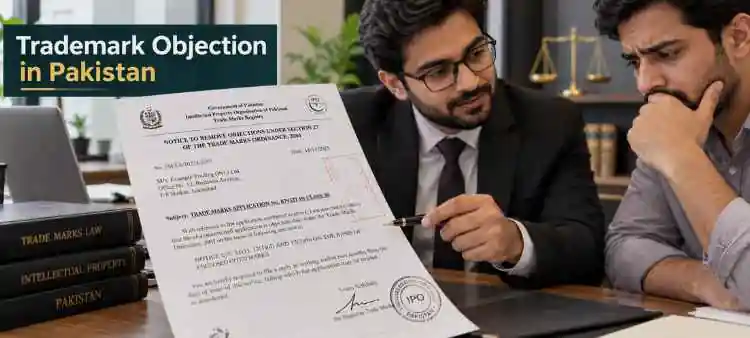
Why Does IPO Pakistan Raise Trademark Objections?
A trademark objection in Pakistan arises when the Trade Marks Registry identifies a legal or procedural issue during the examination of a trademark application. The objection may refer to an earlier pending or registered trademark, a descriptive or non-distinctive brand name, prohibited matter, or a defect in the application.
Not every objection has the same legal effect. Some can be addressed through a clarification, correction or disclaimer. Others require detailed legal arguments and evidence. Certain objections may make registration particularly difficult.
The first step is to understand why the Registrar objected, rather than submitting a standard reply.
This guide explains the principal grounds of trademark objections under Pakistan's Trade Marks Ordinance, 2001, how to assess their seriousness, and the legal options that may be available.
What Happens When IPO Pakistan Examines a Trademark?
The Trade Marks Registry examines an application to determine whether the proposed mark meets the requirements for registration.
The examination may involve checking earlier trademark records and considering whether the mark is distinctive, descriptive, prohibited or otherwise affected by existing rights.
Under Section 27 of the Trade Marks Ordinance, 2001, the Registrar examines applications. Rule 26 of the Trade Marks Rules, 2004 addresses searches for earlier marks, while Rule 27 provides the procedure for communicating objections and seeking representations or a hearing.
An examination objection is not automatically a final refusal.
However, the applicant must respond within the applicable period and address the particular legal grounds raised.
1. Objection Based on an Earlier Pending Trademark Application
Legal basis: Sections 17 and 18 of the Trade Marks Ordinance, 2001
A common trademark objection arises when the Registry cites an earlier application for an identical or similar mark.
The cited application may still be pending rather than registered.
Why can a pending trademark be cited?
Under Section 18(2), references to an earlier trademark can include an earlier application that would qualify as an earlier trademark if registered, subject to that application ultimately being registered.
This means a pending application cannot simply be ignored because its registration certificate has not yet been issued.
Example
Business A applies for the trademark ZELORA for clothing.
The Registry identifies an earlier pending application for ZELORA covering clothing.
Both applications concern the same brand name and goods. The later application may face a significant conflict.
This is a hypothetical example, not an actual Registry case.
How serious is this objection?
Its seriousness depends on the facts.
An identical mark for identical goods presents a substantial risk. A partially similar mark covering unrelated products may require a more detailed comparison.
The cited application's current status is particularly important.
How may this objection be resolved?
The applicant should:
Verify the earlier application's filing date, priority, ownership and current status.
Compare the marks and their goods or services.
Determine whether the cited application remains pending, has proceeded to registration, has been refused or has otherwise ceased to be relevant.
Assess whether the marks are legally distinguishable.
Consider any applicable consent or honest concurrent use provisions.
Submit relevant evidence and legal arguments within the prescribed period.
Important: An earlier application that has been withdrawn, finally refused or abandoned may affect the objection differently from an application that remains valid and proceeds to registration. Its status must be verified, not assumed.
2. Objection Based on an Earlier Registered Trademark
Legal basis: Section 17(1) and 17(2)
An existing registered trademark can create a substantial obstacle to registration of a later mark.
The degree of conflict depends on the similarity of the marks and the goods or services.
Identical trademark for identical goods or services
Section 17(1) addresses an identical earlier trademark covering identical goods or services.
This is among the most serious forms of conflict.
For example, a later application for VELNORA covering soaps may face a major obstacle if an earlier valid registration already protects the identical name for the same goods.
A routine explanation that the applicant independently selected the name will not necessarily overcome the objection.
Identical or similar marks involving similar goods or services
Section 17(2) addresses relevant situations involving identical or similar marks and similar or identical goods or services where there is a likelihood of public confusion, including association.
The Registrar may consider the overall impression of the marks, the relationship between the goods or services, and the potential for consumers to mistake their commercial origin.
What can the applicant do?
Possible legal arguments depend on the circumstances and may include:
Challenging the asserted similarity between the marks.
Demonstrating relevant differences between the goods or services.
Examining the validity, scope and status of the earlier registration.
Providing legally relevant evidence of consent.
Considering honest concurrent use under Section 19.
Evaluating whether an appropriate limitation could address the conflict.
These are possible avenues for assessment, not automatic rights to registration.
A minor spelling change is not a reliable solution if the resulting trademark still creates a likelihood of confusion.
Practical assessment: A valid earlier registration for an identical mark and identical goods should normally be treated as a high-risk objection requiring careful legal evaluation.
3. Objection Base On The Distinctiveness
Legal basis: Section 14(1)(b)
A trademark must function as an identifier of commercial origin. It should help consumers distinguish one undertaking's goods or services from those of others.
Section 14(1)(b) provides a ground for refusing marks devoid of distinctive character.
Example
A business applies for a mark consisting of an ordinary, non-distinctive expression that consumers would not understand as identifying a particular business.
The Registrar may question whether that expression performs the function of a trademark.
How may it be overcome?
The applicant may consider whether:
The mark has inherent distinctive character.
The mark as a whole creates a distinctive commercial impression.
The objection overlooks relevant features of the mark.
Evidence establishes acquired distinctiveness through use before the application date.
Section 14 provides an exception for relevant grounds under subsections (1)(b), (c) and (d) where the statutory requirements concerning acquired distinctiveness or a well-known mark are satisfied.
Relevant evidence may include dated sales records, advertising, market materials and other reliable evidence connecting the mark with the applicant's business.
Practical assessment: This objection may be overcome in suitable cases, but long use alone does not automatically establish acquired distinctiveness.
4. Objection Base On the Descriptive
Legal basis: Section 14(1)(c)
A descriptive trademark objection arises when the proposed mark consists exclusively of indications that describe characteristics of the relevant goods or services.
These may include their kind, quality, quantity, intended purpose, value, geographical origin or other characteristics.
Example
A business applies to register FRESH BREAD as a plain word trademark for bread.
The expression directly describes the goods and may lack the distinctiveness required for registration.
Is a descriptive objection always fatal?
No.
Section 14 contains an exception where qualifying acquired distinctiveness before the application date or the relevant well-known mark requirement is established.
However, the applicant must provide evidence supporting the statutory exception.
Possible approaches
Examine whether the mark is genuinely descriptive of the specified goods or services.
Assess whether the mark contains distinctive elements.
Consider evidence showing that the public identifies the mark with one commercial source.
Determine whether a different, inherently distinctive brand would offer stronger protection.
Adding a simple logo to descriptive wording does not automatically provide exclusive rights over those words.
Practical assessment: A descriptive mark without acquired distinctiveness may face a substantial obstacle. A distinctive composite mark may require a different assessment.
5. Objection Against Generic or Customary Words
Legal basis: Section 14(1)(d)
Section 14(1)(d) concerns marks consisting exclusively of indications that have become customary in the current language or established practices of the trade.
Generic and customary expressions are problematic because competitors may legitimately need to use them.
Example
A business attempts to claim exclusive trademark protection over a commonly used product-category term for the very product it describes.
Such a claim may conflict with the requirement that a trademark distinguish commercial origin.
Can the objection be resolved?
The legal analysis should determine whether the proposed mark consists exclusively of customary matter and whether the statutory exception under Section 14 is supported by evidence.
In some cases, adopting an inherently distinctive brand may be commercially preferable to pursuing exclusive rights over ordinary trade terminology.
Practical assessment: This can be a serious objection, particularly where the claimed wording is genuinely generic and there is no credible basis for the statutory exception.
6. Objection Requiring a Trademark Disclaimer
Legal basis: Section 21
Some trademarks contain a distinctive brand name alongside ordinary descriptive or non-distinctive wording.
In appropriate cases, registration may be subject to a disclaimer concerning exclusive rights in particular elements.
Example
A composite trademark includes an invented brand name together with the words QUALITY TEXTILES for textile products.
The Registrar may examine whether a disclaimer is appropriate for the non-distinctive wording.
Does a disclaimer mean the entire trademark is rejected?
No.
A disclaimer can define the scope of exclusive rights arising from the registration. It does not necessarily prevent registration of the mark as a whole.
How should the applicant respond?
The applicant should review the proposed disclaimer and consider whether it accurately reflects the distinctive and non-distinctive elements of the trademark.
An unnecessarily broad disclaimer should not be accepted without evaluating its consequences.
Practical assessment: A properly limited disclaimer may resolve an objection, but it cannot cure every underlying registrability problem.
7. Objection Involving a Well-Known or Reputed Trademark
Legal basis: Sections 17(3) and 18
A trademark may face an objection even where the later application covers goods or services different from those associated with an earlier mark.
Under Section 17(3), an earlier mark with a reputation in Pakistan may receive protection where the statutory conditions are satisfied, including unfair advantage or harm to its distinctive character or reputation.
Why is this serious?
The applicant may not be able to overcome the objection merely by arguing that the products belong to different classes.
Trademark classes are administrative tools. Different classes do not automatically establish that conflicting marks can coexist.
Possible response
The applicant should examine:
The actual identity and similarity of the marks.
The earlier mark's relevant rights and reputation.
The statutory conditions concerning unfair advantage or detriment.
The claimed priority and supporting evidence.
Any legally applicable defence or consent.
Practical assessment: This is a potentially high-risk objection, particularly where the earlier brand has strong, demonstrable rights and the later mark closely resembles it.
8. Objection Based on Earlier Unregistered Rights
Legal basis: Section 17(4)
Not every earlier right depends on a trademark registration certificate.
Section 17(4) recognizes circumstances involving passing off and other earlier rights, including rights arising under copyright or design law.
What does this mean?
A business may face legal difficulty where the proposed mark conflicts with enforceable earlier rights, even if those rights do not arise from an ordinary registered trademark citation.
Possible response
The applicant must examine the nature, ownership, priority and enforceability of the alleged earlier right.
Relevant evidence may include prior commercial use, goodwill, consumer association and other documents, depending on the legal ground.
Practical assessment: Risk varies considerably. A well-supported earlier right may present a serious obstacle, while an unsupported claim may be contestable.
9. Objection Against Deceptive, Unlawful or Bad-Faith Marks
Legal basis: Sections 14(3) and 14(4)
Section 14 also addresses marks containing legally objectionable matter, including specified deceptive, prohibited or unlawful material.
Section 14(4) separately provides for refusal where an application is made in bad faith.
Examples
An application may raise concerns if the mark:
Misleads consumers in a legally relevant manner.
Contains material prohibited under the applicable law.
Falls within the statutory restrictions concerning religious susceptibilities or morality.
Is filed in circumstances that establish bad faith.
How serious are these objections?
These can be among the most difficult objections to overcome.
A successful response generally requires challenging the factual or legal foundation of the objection rather than relying on ordinary evidence of marketing or commercial success.
Where the proposed mark is inherently unlawful or the application is established to have been made in bad faith, minor changes or disclaimers may not provide a solution.
10. Objection Based on Product Shape or a Restricted Chemical Name
Certain objections are more specialized.
Section 14(2) restricts registration of marks consisting exclusively of specified types of product shapes, including shapes resulting from the nature of the goods or necessary to obtain a technical result.
Section 16 contains restrictions relating to certain chemical names and international non-proprietary names, subject to its statutory wording and exception.
Such matters require an examination of the specific product, mark and legal provision.
A generic response prepared for an ordinary word-mark objection may be inappropriate.
11. Objection Due to Incorrect Classification or Application Details
Legal basis: Sections 12 and 22, together with applicable Rules
Some examination issues relate to the information submitted with the application rather than a conflict between two brands.
Possible issues include:
Inaccurate or incomplete applicant particulars.
Incorrect or unclear descriptions of goods and services.
Questions concerning classification.
Incomplete representations or supporting particulars.
Other deficiencies under the applicable filing requirements.
How can these issues be resolved?
The applicant should identify the exact deficiency and determine whether the Registry permits correction, clarification, amendment or compliance through the prescribed procedure.
Not every amendment is permitted, and changing the substance of a trademark or its coverage may have legal consequences.
Practical assessment: Filing defects may be more straightforward to address than substantive conflicts. However, failure to correct them within the applicable period can still endanger the application.
Which Trademark Objections Are Easier or Harder to Resolve?
The following table provides a practical comparison. It is not an official IPO Pakistan severity classification.
| Type of objection | General difficulty | Possible approach |
|---|---|---|
| Filing deficiency | Often manageable | Permitted correction |
| Classification clarification | Often manageable | Clarify goods or services |
| Disclaimer | Often manageable | Assess and accept or contest appropriate wording |
| Descriptive wording | Case-dependent | Legal argument or evidence of acquired distinctiveness |
| Lack of distinctiveness | Case-dependent | Demonstrate distinctiveness |
| Earlier pending mark | Case-dependent | Verify status, priority and similarity |
| Earlier registered similar mark | Moderate to high | Assess confusion and available legal options |
| Identical registered mark for identical goods | Very high | Detailed legal assessment of earlier rights |
| Reputed earlier trademark | Potentially high | Examine reputation and statutory conflict |
| Prohibited matter or bad faith | Very high where established | Address underlying legal grounds |
The strength of the objection depends on the facts. It cannot be determined reliably from the section number alone.
How to Respond to a Trademark Objection: Step-by-Step Procedure
Once the grounds are identified, the applicant should follow a structured process.
Step 1: Obtain the Exact Examination Objection
Collect the Registry communication and confirm the application number, class, applicant name and deadline.
Step 2: Identify Every Legal Ground
Some applications contain more than one objection.
For example, the Registry may cite an earlier trademark under Section 17 and separately question descriptiveness under Section 14.
Each ground must be addressed independently.
Step 3: Check the Cited Trademark Records
Where earlier trademarks are cited, verify their status, priority, ownership, goods or services, and relevant rights.
An examination report should not be answered solely on the assumption that a cited application is still valid or that a registered mark has no possible relevance.
Step 4: Select the Appropriate Legal Response
Depending on the circumstances, a response may involve:
Legal submissions on registrability.
A reasoned comparison of conflicting marks.
Evidence of acquired distinctiveness.
Evidence relevant to honest concurrent use under Section 19.
Legally relevant consent from the earlier rights holder under Section 17(5).
An appropriate disclaimer or permitted limitation.
Correction of procedural deficiencies.
A request for hearing.
These are conditional legal possibilities, not guaranteed remedies.
Step 5: Submit the Response Within the Prescribed Period
Rule 27 of the Trade Marks Rules, 2004 generally provides two months from communication of the objection for the required response, action or hearing request.
Failure to take the required action may result in the application being treated as abandoned.
The actual Registry notice and applicable procedure must always be checked.
Step 6: Attend the Hearing Where Required
If the Registrar lists the matter for hearing, the applicant should prepare submissions and supporting material relevant to each disputed ground.
The Registrar may then decide whether the application can proceed, whether conditions are necessary, or whether registration should be refused.
Can Honest Concurrent Use Overcome an Earlier Trademark Objection?
Section 19 provides a specific legal mechanism involving honest concurrent use in circumstances satisfying the statutory requirements.
However, honest concurrent use is not automatic permission to register a conflicting trademark.
The applicant must establish qualifying use in Pakistan to the Registrar's satisfaction. The provision also preserves relevant opposition rights and does not remove absolute grounds for refusal under Section 14.
Evidence of coexistence must therefore be examined carefully.
Simply showing that both businesses have used similar names does not necessarily establish the legal requirements.
What Happens if a Trademark Objection Is Not Answered?
Failure to respond to an examination objection within the prescribed procedure can result in abandonment of the application.
Rule 27 also contains a restoration mechanism where sufficient cause is shown and the prescribed requirements are satisfied.
Restoration is not automatic, and it is unsafe to rely on it instead of meeting the original deadline.
Applicants should preserve all Registry communications and filing records.
Trademark Objection vs Trademark Opposition
These are different procedures.
An examination objection is raised during the Registry's examination of an application.
A trademark opposition is a challenge by another party after the relevant application has been advertised, under the statutory opposition procedure.
The grounds, filing requirements and deadlines differ.
A trademark objection reply is not the same as a formal opposition counter-statement.
Frequently Asked Questions
Can IPO Pakistan cite a pending trademark application?
Yes. Section 18(2) recognizes qualifying earlier applications subject to the conditions stated in the law.
Is an objection based on a registered trademark more serious?
It may be, particularly where an identical registered mark covers identical goods or services. The outcome still depends on the legal and factual circumstances.
Can a descriptive trademark be registered?
In some cases, yes. Section 14 contains a relevant exception for acquired distinctiveness before the application date and well-known marks, subject to its requirements.
Can a trademark disclaimer remove an objection?
An appropriate disclaimer may address certain issues relating to non-distinctive elements, but it cannot resolve every statutory ground for refusal.
Does registering in a different trademark class avoid an objection?
Not necessarily. Goods and services may be related across classes, and reputed earlier marks may receive protection under the applicable statutory provisions.
Can the owner of an earlier mark give consent?
Section 17(5) addresses consent from the proprietor of an earlier trademark or earlier right. The legal effectiveness of consent depends on the circumstances and applicable requirements.
Can long-term use overcome a similarity objection?
Long-term use alone is not enough. Section 19 provides for qualifying honest concurrent use, but its conditions must be established and relevant opposition rights remain.
How long is the response period?
Rule 27 generally provides two months from communication of the objection for the required action. Applicants must verify their own notice and procedural circumstances.
When Should You Consult a Trademark Lawyer?
Professional advice is particularly important where the examination report involves:
An identical or closely similar registered trademark.
Multiple cited applications or registrations.
A reputed or well-known earlier brand.
Objections based on more than one statutory provision.
Acquired distinctiveness or honest concurrent use evidence.
Allegations of bad faith.
A scheduled hearing or adverse decision.
A proper legal assessment should consider both the immediate objection and the broader commercial implications of using or registering the proposed brand.
Official legal references
Trade Marks Ordinance, 2001 — Pakistan Code
Trade Marks Rules, 2004 — WIPO Lex
Legal notice: This article provides general information under Pakistani trademark law and does not replace advice on a specific application. The correct approach depends on the examination report, the status of cited rights, available evidence and applicable procedural requirements.


Comments
No comments yet. Be the first to comment!
Leave a Comment