

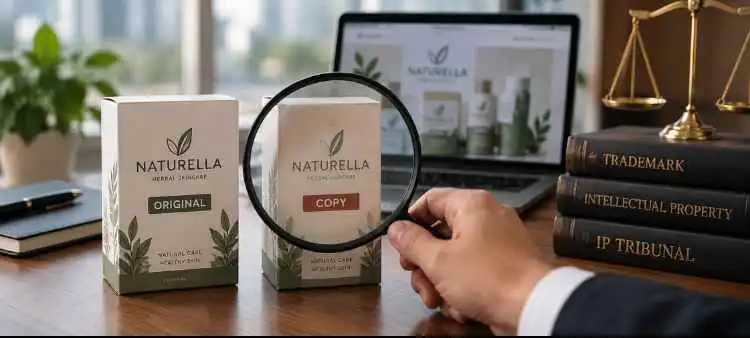
Someone is using your brand name, logo, packaging, or business identity and customers are starting to confuse that business with yours. If your sales are falling, your reputation is being affected, or customers are buying lower-quality goods believing they came from you, the problem is more serious than simply saying that someone has "copied your name."
The right response depends on several facts: whether your trademark is registered, what the other party is using, what goods or services are involved, whether customers are likely to be confused, and what evidence you have of your rights, goodwill, and loss.
This guide explains what a business owner can do in Pakistan when a brand is being copied, including the difference between registered and unregistered brands, goodwill and passing off, legal notices, IP Tribunal proceedings, possible injunctions and other remedies, criminal enforcement, and customs action for imported counterfeit goods.
Your Brand Is Being Copied: Start With These 3 Questions
- Is your trademark registered in Pakistan?
- If it is not registered, can you show established goodwill and reputation in the brand?
- What exactly is the other party doing?
Do not assume that every similar name is automatically unlawful, and do not assume that an unregistered brand has no protection. The legal analysis depends on the facts.
If Your Trademark Is Registered
A registered trademark gives the proprietor exclusive rights in the mark, subject to the Trade Marks Ordinance, 2001. Section 39 states that a registered trademark is personal property and that the proprietor has exclusive rights in the mark which are infringed by unauthorized use in Pakistan. The rights take effect from the date of registration. Trade Marks Ordinance, 2001
Section 40 identifies circumstances in which use of an identical or deceptively similar mark can amount to infringement, including situations involving identical or similar goods or services and a likelihood of confusion or association. The Ordinance also addresses certain uses as a trade name and domain name. See sections 39–40 of the Trade Marks Ordinance
Check the Scope of Your Registration
- The exact registered mark
- The registered proprietor
- The registration number and date
- The relevant class or classes
- The registered goods or services
- Any limitations, disclaimers, assignments or licences
Registration does not mean that every use of a similar word by every person in every market is automatically infringement. The competing marks, goods or services, circumstances of use and likelihood of confusion can matter.
What If Your Trademark Is Not Registered?
This is where many business owners make the wrong assumption. 'My trademark is not registered, so I have no legal protection' is too broad.
Section 46(3) of the Trade Marks Ordinance expressly preserves rights of action against a person who passes off goods as the goods of another person, or services as the services of another person. That means an unregistered brand dispute may involve the law of passing off, rather than a statutory infringement claim based on registration. See section 46(3)
But do not make the opposite mistake either. Simply using a business name for a number of years does not automatically establish every element of a passing-off claim. The evidence of goodwill or reputation, the alleged misrepresentation, the relationship between the businesses, customer confusion and resulting or likely damage all need to be considered.
What Does Goodwill Mean for an Unregistered Brand?
Goodwill is the commercial reputation and customer recognition attached to a business and its identifying brand or get-up. It is more than simply proving that the business exists.
Depending on the circumstances, useful evidence can include:
- Old invoices and sales records
- Dated advertisements and marketing material
- Product packaging and labels
- Website and domain history
- Social-media pages and dated posts
- Customer reviews and communications
- Distributor and dealer records
- Catalogues and brochures
- Photographs of shop signs and products
- Evidence of market recognition
- Evidence of customer confusion
- Evidence of actual commercial damage where available
The important question is not merely, “How long have I used the name?†It is whether the evidence demonstrates a protectable business reputation and the other legal elements of the claim.
Are Customers Being Misled?
This is often one of the most important factual questions.
Suppose your business has used a particular name for years and customers associate it with your products. A second business starts using the same or a deceptively similar name, similar packaging, or a similar logo. Customers then begin asking whether the second business is connected with you.
That type of confusion should be documented rather than merely asserted.
Save customer messages, mistaken orders, complaints, screenshots, marketplace listings, advertisements, photographs, invoices and other records showing that customers may be confusing the businesses.
What If the Copycat Is Selling Inferior Products?
If a copycat is selling lower-quality products while presenting them in a way that makes customers believe they come from your business, the issue can affect both market identity and reputation.
Preserve evidence of:
- The genuine product
- The copied product
- Names, logos and packaging
- Where the competing product is being sold
- Customer complaints and confusion
- Online listings and advertisements
- Distributor or retailer communications
- Any demonstrable commercial loss
Do not exaggerate losses. A documented loss is more useful than a large number that cannot be supported.
What Should You Do Immediately?
1. Preserve the Evidence
Online listings, social-media posts and product pages can disappear quickly. Preserve screenshots, URLs, dates, product photographs, packaging, invoices and communications before approaching the other party where possible.
2. Confirm Your Ownership
Collect your trademark certificate, application or registration details, assignments, licences and other ownership documents. If the mark is registered to a company or another legal person, verify that the correct proprietor is identified.
3. Record the Copycat's Identity
Record the other business's name, address, website, domain, social accounts, marketplace listings, products, packaging, advertisements and any available company or seller information.
4. Compare the Two Businesses
- Brand name
- Logo
- Pronunciation and appearance
- Packaging and overall get-up
- Goods or services
- Market and customer base
- Distribution channels
- Website and online identity
5. Identify the Actual Legal Problem
The dispute may involve registered trademark infringement, passing off, copyright, industrial design, domain-name misuse, false trade descriptions, counterfeit goods, or more than one right at the same time.
Can You Send a Legal Notice?
A legal notice can be a useful first step when the identity of the other party is known and the evidence is sufficiently clear. Depending on the facts, a notice can identify your rights, demand cessation of the disputed use, request removal of online material, seek undertakings, and create a documented record before litigation.
However, a legal notice should not make unsupported allegations. If the trademark is unregistered, for example, the notice should not pretend that the owner has statutory registered-trademark rights that do not exist.
What Legal Remedies Can Be Available?
For registered trademark infringement, section 46 of the Trade Marks Ordinance provides for relief including injunctions, damages and accounts, subject to the facts and the applicable legal requirements.
Injunction
An injunction may be sought to restrain continuing conduct where the requirements for interim or final relief are established. An injunction is not automatic merely because a trademark is registered; the court or tribunal considers the evidence and the applicable principles of interim relief.
Damages
Where the legal requirements are met, damages may be claimed for the loss caused by infringement. The evidence should connect the alleged conduct to the loss rather than relying on an unsupported estimate.
Account of Profits
An action may also seek an account in appropriate circumstances. The choice between damages and other monetary relief should be considered as part of the case strategy.
Erasure, Removal or Destruction of Infringing Goods
Section 47 permits the High Court or IP Tribunal, where a person is found to have infringed a registered trademark, to order the offending mark to be erased, removed or obliterated from infringing goods, material or articles, or to secure destruction where removal is not reasonably practicable. See section 47
Delivery Up of Infringing Goods
Section 48 allows the proprietor of a registered trademark to apply for delivery up of infringing goods, material or articles held in the course of business, subject to the statutory requirements and time limits. See section 48
Do You File Trademark Suit in a Civil Court or IP Tribunal?
This point is important because older articles and websites may still describe the District Court or High Court as the ordinary forum for a trademark infringement suit.
Under the current section 117 of the Trade Marks Ordinance, 2001, a suit for trademark infringement or otherwise relating to a right in a trademark is to be instituted before the IP Tribunal having jurisdiction. The current text expressly substitutes the IP Tribunal for the earlier forum. See section 117
The Supreme Court of Pakistan in Muhammad Multazam Raza v. Muhammad Ayub Khan and others, 2022 SCMR 979, held that where a trademark infringement claim is coupled with passing off, the matter falls within the jurisdiction of the IP Tribunal. The Court emphasized that a claim described as passing off may still require determination of trademark infringement. See 2022 SCMR 979
More recently, the Sindh High Court in Sadiq & Suharwardy v. Ismail Industries Limited, 2025 CLD 1029, considered the effect of the 2023 amendment to section 117 and treated future trademark infringement suits as matters for the IP Tribunal, while distinguishing certain statutory applications such as revocation, invalidity or rectification that may remain within the High Court's jurisdiction under the applicable provisions. See Sindh High Court case-law materials
Practical point: for a new trademark infringement action, do not assume that filing an ordinary civil suit in the High Court is the correct route. The current statutory forum is the IP Tribunal, while the High Court can remain relevant for appeals and for particular statutory applications or matters falling within its jurisdiction.
Can You Ask for Urgent Interim Relief?
Potentially, yes. Where the facts justify urgent intervention, the claimant may seek interim relief to restrain continuing conduct while the dispute is being determined.
The application must still satisfy the applicable principles for interim relief. A registered trademark does not automatically guarantee an injunction. The evidence, urgency, balance of convenience, prima facie case and potential harm all matter.
Where the matter is being brought before the IP Tribunal, the Tribunal exercises civil-court powers under the Intellectual Property Organization of Pakistan Act, 2012, including powers under the Code of Civil Procedure where applicable. Intellectual Property Organization of Pakistan Act, 2012
What If the Brand Is Unregistered but Has Goodwill?
An unregistered brand may require a different legal strategy. Passing off can be relevant where the evidence supports the necessary elements. The Trade Marks Ordinance expressly preserves passing-off actions, and Pakistani case law recognizes that a trademark infringement claim and a passing-off claim can arise together. Trade Marks Ordinance, 2001
For an unregistered brand, the case should be built around the evidence of goodwill or reputation, the alleged misrepresentation, the relevant market, customer confusion and damage. Do not present an unregistered claim as if it were identical to a registered-trademark infringement action.
What If the Copycat Is Selling Counterfeit Goods?
If the conduct involves counterfeit goods or false trade descriptions, the matter may extend beyond a private civil dispute.
The Trade Marks Ordinance contains offences relating to false trade descriptions. Section 99 provides criminal penalties for applying a false trade description and related conduct where its statutory requirements are met. The current text provides imprisonment of not less than three months and up to two years, or a fine of not less than Rs. 50,000, or both; higher penalties apply to subsequent convictions under section 100. See sections 99–100
But not every trademark dispute is automatically a criminal case. A dispute over similar business names should not simply be labelled “criminal†without identifying the specific offence and evidence.
Can a Criminal Complaint Be Made?
Where the facts disclose an offence under the intellectual-property laws, criminal enforcement may need to be considered in addition to civil remedies. The Intellectual Property Organization of Pakistan Act, 2012 gives the IP Tribunal exclusive jurisdiction to try offences under intellectual-property laws and gives the Tribunal criminal-jurisdiction powers comparable to those of a Court of Session for that purpose. See sections 15, 17 and 18 of the IPOP Act
The practical starting point for an alleged criminal offence can depend on the offence, the available evidence and the relevant enforcement procedure. A lawyer should identify the offence and appropriate enforcement channel before advising a client simply to “file an FIR.â€
What If Counterfeit Goods Are Coming Into Pakistan?
Imported counterfeit goods can trigger a separate customs-related process. The Trade Marks Ordinance allows the relevant authority to seize goods bearing an infringing trademark in specified circumstances. The applicant may then need to bring the infringement action before the IP Tribunal within the statutory period to prevent release of the seized goods. Sections 56–60 contain the relevant framework, including a ten-working-day period in the notice process and a possible extension of up to ten further working days where the statutory requirements are met. See sections 56–60
This route is particularly important where the counterfeit products are being imported rather than manufactured or sold only within Pakistan.
What If the Copycat Is Using Your Brand Online?
Brand misuse can also involve a domain name, website, social-media account, online marketplace or digital storefront.
For a registered trademark, section 40 expressly addresses certain unauthorized uses of a registered mark as a domain name. The Trade Marks Ordinance also contains a separate schedule dealing with domain names used as source identifiers. See section 40 and the Third Schedule
If the dispute concerns a domain or online identity, review our Domain Name and Trademark Protection service as part of the wider enforcement assessment.
Registered vs Unregistered Brand: What Changes?
| Situation | What Needs to Be Examined |
|---|---|
| Registered trademark | Registration, proprietor, scope, goods/services, similarity and infringing use |
| Unregistered brand | Goodwill, reputation, misrepresentation, customer confusion and damage |
| Copied logo | Trademark rights and potentially copyright or other IP rights |
| Copied packaging | Trademark, passing off and other applicable rights |
| Counterfeit products | Civil enforcement and, where an offence is established, criminal enforcement |
| Imported counterfeit goods | Customs intervention and the statutory infringement process |
| Copied domain or online identity | Trademark, domain and online enforcement issues |
Which Legal Route Is Right for Your Situation?
Legal Notice
Useful where the other party is identifiable and the immediate objective is to stop the disputed conduct without commencing litigation immediately.
IP Tribunal Proceedings
For a new trademark infringement suit, section 117 places the matter before the IP Tribunal. The Tribunal has civil-court powers under the IPOP Act. IPOP Act, 2012
Passing Off
Potentially relevant where the brand is unregistered but the evidence supports a protectable goodwill/reputation claim and the other legal elements of passing off are established.
Criminal Enforcement
Relevant only where the conduct also amounts to a specific offense under the applicable intellectual-property laws. The criminal jurisdiction of the IP Tribunal should be distinguished from the investigation or enforcement process that may precede trial.
Customs Action
Relevant where registered-trademark counterfeit goods are being imported and the statutory requirements for customs intervention are met.
What Evidence Should You Take to a Lawyer?
Your Rights and Business
- Trademark certificate or application records
- Assignments and licences
- Invoices and sales records
- Advertising and marketing history
- Packaging and product photographs
- Website and domain history
- Social-media records
- Distributor and dealer records
The Other Party
- Copied name and logo
- Product photographs
- Packaging and labels
- Website and domain
- Marketplace listings
- Social-media accounts
- Advertisements
- Shop or distribution details
- Invoices or purchase evidence where lawfully obtained
Confusion and Loss
- Customer complaints
- Mistaken orders
- Messages showing confusion
- Distributor communications
- Returns or complaints about inferior products
- Documented sales impact where available
Do Not Make These Mistakes
- Do not assume every similar name is infringement.
- Do not assume an unregistered brand has no possible remedy.
- Do not assume goodwill gives exactly the same rights as registration.
- Do not delete or alter evidence before it is preserved.
- Do not exaggerate business losses.
- Do not call every dispute a criminal case.
- Do not file a new trademark infringement suit in the wrong forum.
- Do not send a legal notice containing rights or allegations that cannot be supported.
Related Intellectual Property Services
If the dispute requires broader IP assessment, you can review our Intellectual Property legal services in Pakistan.
For a brand that still needs formal protection, see our Trademark Registration in Pakistan service.
For domain-related misuse, see our Domain Name and Trademark Protection service.
You can also read our existing Trademark Search Worldwide article for international search considerations.
Frequently Asked Questions
Someone is using the same brand name as my business. Is that automatically illegal?
No. The answer depends on factors such as registration, similarity, goods or services, market circumstances and the likelihood of confusion. A legal assessment should be based on the actual use rather than the name alone.
My trademark is registered. What can I do?
Where the statutory requirements for infringement are satisfied, the proprietor may pursue remedies including injunctions, damages and accounts, together with statutory remedies concerning infringing goods. The appropriate relief depends on the facts and evidence.
My trademark is not registered, but my business is well known. Can I take action?
Potentially. Section 46(3) preserves passing-off actions. The strength of the claim will depend on evidence of goodwill or reputation, misrepresentation, customer confusion and damage, together with the other facts of the case.
Can I get an injunction against the copycat?
Interim or final injunctive relief may be available where the legal requirements are established. Registration alone does not guarantee an injunction; the evidence and applicable principles of interim relief remain important.
Should I file an FIR for trademark copying?
Not automatically. First determine whether the conduct discloses a specific criminal offence. Civil trademark infringement, passing off and criminal offences are different legal routes and should not be treated as interchangeable.
Where should a new trademark infringement suit be filed in Pakistan?
Under the current section 117 of the Trade Marks Ordinance, a new suit for trademark infringement or otherwise relating to a right in a trademark is to be instituted before the IP Tribunal having jurisdiction. The High Court remains relevant for appeals and for certain statutory applications or matters that fall within its jurisdiction.
Can I take action if the copycat is importing counterfeit products?
Potentially. The Trade Marks Ordinance contains a customs-intervention framework for registered-trademark counterfeit goods, including seizure and a statutory process requiring timely infringement action before the IP Tribunal to prevent release in the circumstances covered by the law.
What should I preserve before contacting the copycat?
Preserve the original brand records, registration documents, invoices, advertisements, packaging, websites, social-media pages, marketplace listings, customer complaints, screenshots, photographs and other evidence showing the disputed use and its commercial impact.
Final Takeaway
If someone is copying your brand, do not start with only the question, “Is the name the same?â€
Start with:
- Who owns the brand?
- Is the trademark registered?
- What exactly is being copied?
- Are the goods or services related?
- Are customers being confused?
- Has the business built goodwill or reputation?
- What evidence proves the copying?
- What loss or reputational harm can be demonstrated?
- Is the matter civil, passing off, criminal, customs-related, or a combination?
- What is the correct forum and remedy under the current law?
For a registered mark, the Trade Marks Ordinance provides a statutory infringement framework and remedies. For an unregistered brand, passing off may become important where the evidence supports it. Where counterfeit goods or specific offences are involved, criminal or customs enforcement may also need to be considered. The correct strategy should be selected after reviewing the rights, evidence and commercial objective.
Need help with a brand-copying or trademark dispute? A.A. Dewan & Co. can review the registration position, ownership, evidence, competing use and available Pakistan-focused legal routes before you decide whether to send a notice or commence proceedings.
Discuss Your Intellectual Property Matter
Legal Information: This article is for general information and does not constitute legal advice. Trademark infringement, passing off, criminal enforcement, customs intervention, interim relief and available remedies depend on the facts, evidence, applicable law and procedural position. Laws and case law can change, so a current case-specific legal review should be obtained before commencing proceedings or making allegations against another business.


Comments
No comments yet. Be the first to comment!
Leave a Comment