

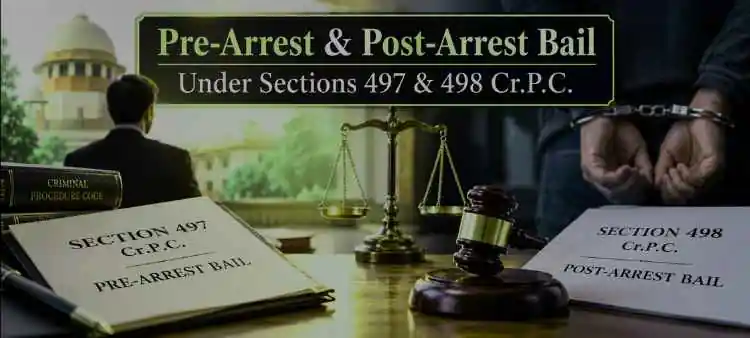
Understanding the Legal Framework for Criminal Bail
Bail proceedings require an assessment of the allegations, the accused's legal position and the material available at the relevant stage of a criminal case. The appropriate remedy depends on whether the accused is seeking protection from arrest or release from custody.
The Code of Criminal Procedure, 1898 (Cr.P.C.) establishes the statutory framework, while judicial precedents guide courts in evaluating reasonable grounds, further inquiry, misuse of arrest powers and other relevant considerations.
For advocates, the starting point is to identify the applicable provision and connect the facts of the case with the legal requirements for bail.
Section 496 Cr.P.C. — Bail in Bailable Offences
Section 496 governs bail in bailable offences. Where its statutory conditions are satisfied and the accused is prepared to furnish the required bail, release is generally a legal entitlement rather than a matter of ordinary judicial discretion.
Section 497 Cr.P.C. — Bail in Non-Bailable Offences
Section 497 principally governs post-arrest bail in non-bailable offences.
The court examines the material connecting the accused with the alleged offence, the prescribed punishment, the prohibitory clause and whether the case falls within the scope of further inquiry under Section 497(2).
The provision also contains specific statutory exceptions and grounds relating to prolonged detention, subject to their applicable conditions.
Section 498 Cr.P.C. — Bail Powers of the High Court and Court of Session
Section 498 empowers the High Court and Court of Session to direct admission to bail or reduce excessive bail.
It provides the principal statutory basis for pre-arrest bail jurisdiction, developed through judicial interpretation.
In considering pre-arrest relief, courts assess the circumstances of the apprehended arrest, the available prosecution material, the applicant's conduct and other relevant judicial principles.
Section 498-A Cr.P.C. — Restrictions on Bail Orders
Section 498-A places statutory limitations on the exercise of powers under Sections 497 and 498.
Its requirements concern the existence of a registered criminal case, the applicant's presence before the court and the circumstances in which bail directions may be issued.
A bail order under these provisions applies to the specific registered case identified in the order.
Practical consideration: Before filing, counsel must also check whether a special criminal law imposes additional conditions or prescribes a different forum or procedure.
Pre-Arrest Bail vs Post-Arrest Bail: Key Differences
| Pre-arrest bail | Post-arrest bail |
|---|---|
| Sought before arrest | Sought after arrest or detention |
| Ordinarily under Section 498 | Principally under Section 497 |
| Addresses apprehended arrest and grounds for protective relief | Addresses continued custody and statutory bail eligibility |
| Applicant's presence and conduct are particularly important | Custody status, prosecution material and investigation stage are central |
| Court considers applicable principles including mala fide, improper arrest and tentative merits | Court examines reasonable grounds, further inquiry and statutory exceptions |
A lawyer should not use the same factual grounds mechanically in both applications. The accused's circumstances and applicable legal tests differ.
Step 1: Examine the FIR Before Drafting Bail
The FIR is generally the starting point of bail preparation, but it must be read alongside other available case material.
Counsel should identify the following:
- The alleged occurrence: What incident is reported, when and where did it allegedly occur, and what is the complainant's version?
- The accused's alleged role: Is the applicant assigned a specific act, a general allegation, an allegation of common intention or a role based on later statements?
- The invoked offences: What statutory provisions appear in the FIR, what are their legal ingredients and prescribed punishments, and are they bailable or non-bailable?
- The timing of the report: Is there a delay between the alleged occurrence and FIR registration? If so, what explanation is recorded?
- The available corroboration: Does the allegation refer to medical evidence, recovery, CCTV footage, documents, identification or independent witnesses?
- The procedural history: Has the accused joined investigation, been arrested, appeared before a court or previously sought bail?
An FIR is not the entire prosecution case. Depending on the stage, the court may also consider statements under Section 161 Cr.P.C., medical material, recovery memos, investigation records and other legally relevant evidence.
A delay in lodging an FIR or the absence of a particular document is not automatically sufficient for bail. Its importance depends on the surrounding facts.
For an explanation of FIR registration and procedure, see our guide to filing an FIR.
Step 2: Identify the Correct Bail Forum and Procedure
A bail petition must be filed before a court legally empowered to entertain it.
For a post-arrest application, counsel should assess the competent Magistrate or trial court, the Court of Session or the High Court, as permitted by the procedural framework.
For pre-arrest bail, the Court of Session is ordinarily approached first, subject to jurisdiction and the circumstances recognized by law.
Before filing, confirm:
- The court's territorial and subject-matter jurisdiction.
- Whether the FIR falls under an ordinary or special criminal statute.
- The accused's arrest or custody status.
- The existence of any previous bail application or order.
- Whether the same grounds have already been decided.
- The applicant's required presence before the court.
Any procedural or documentary requirements imposed by the relevant court.
Where earlier bail has been refused, the previous order and any subsequently arising circumstances must be disclosed and carefully considered.
A change of forum alone should not be used to conceal an adverse order.
Step 3: Determine Whether the Prohibitory Clause Applies
Section 497(1) places particular restrictions on bail where there are reasonable grounds for believing that the accused committed an offence punishable with death, imprisonment for life or imprisonment for ten years.
This is commonly called the prohibitory clause.
The expression refers to the statutory punishment and applicable legal test, not simply whether the allegation appears serious.
What Should the Lawyer Examine?
First identify the actual offence and the punishment provided by its governing statute.
Then examine whether the prosecution material creates reasonable grounds connecting the accused with that offence.
Where the case falls outside the prohibitory clause, bail is generally approached more favourably under established judicial principles, although release is not automatic.
Where the case falls within the clause, counsel should examine whether further inquiry, a statutory exception or another legally recognized ground applies.
Important Drafting Principle
- Do not write merely that the offence falls outside the prohibitory clause.
- Identify the charged provision, its prescribed punishment and the legal consequence that follows.
- A court should be able to understand the argument from the petition itself.
Step 4: Evaluate Further Inquiry Under Section 497(2)
Section 497(2) is one of the most important provisions in post-arrest bail practice.
It applies where the available material does not disclose reasonable grounds for believing that the accused committed the non-bailable offence, but sufficient grounds exist for further inquiry into guilt.
The court makes a tentative assessment of the available material rather than deciding guilt or innocence conclusively.
Circumstances That May Support Further Inquiry
Depending on the facts, the following may be relevant:
- Material inconsistencies in the prosecution version.
- Uncertainty concerning the specific role attributed to the accused.
- Conflicts between material allegations and medical or documentary evidence.
- Serious questions concerning identification.
- A recovery whose connection to the accused is disputed on credible grounds.
- Material indicating that the prosecution requires further examination before reasonable grounds can be established.
- These circumstances are not automatic formulas.
For example, a general allegation may still be supported by other reliable evidence. Conversely, a specifically named accused may qualify for further inquiry if the material connecting that person with the offence is legally insufficient at the bail stage.
How to Draft a Further-Inquiry Ground
A legally useful ground should contain three parts:
- Fact: Identify the actual weakness or uncertainty in the available record.
- Law: Explain why that uncertainty is relevant under Section 497(2).
- Conclusion: Submit why continued detention is not justified on the tentative assessment permitted at the bail stage.
An example of the approach is:
Where the available medical record materially conflicts with the specific injury attributed to the applicant, counsel may identify the inconsistency and submit that the applicant's role requires further inquiry under Section 497(2).
The argument must refer to the real documents. An unsupported contradiction should never be invented.
Step 5: Establish Grounds for Pre-Arrest Bail
Pre-arrest bail is a distinct remedy considered under Section 498 and applicable judicial principles.
It is not an automatic entitlement whenever an FIR is registered.
The applicant must present a legally sustainable case for protection from arrest.
Mala Fide or Ulterior Motive
A contention that the complainant or investigating agency is acting with an improper purpose must have factual support.
Relevant material might include:
- A documented earlier dispute.
- Threats connected with the initiation of proceedings.
- A demonstrable attempt to misuse criminal proceedings.
- Material inconsistencies suggesting an ulterior purpose.
Merely writing that the FIR was registered with mala fide intention is not an adequate substitute for supporting facts.
Unwarranted Harassment or Humiliation
Pre-arrest bail may be considered where arrest appears intended to subject the applicant to unwarranted harassment, humiliation or persecution rather than serve a legitimate investigative purpose.
Counsel should explain the factual basis of the apprehension.
Tentative Assessment and Further Inquiry
Modern judicial principles also recognize the importance of a tentative assessment of the prosecution material.
The absence of reasonable grounds and the existence of a genuine further-inquiry issue may be relevant to the pre-arrest bail assessment alongside other factors.
In Salman Mushtaq and others v. The State (2024 SCMR 14), the Supreme Court discussed improper arrest, mala fide, evidence quality, further inquiry and the risks of absconding or interfering with justice.
Cooperation With Investigation
Where the applicant has joined investigation, complied with lawful notices and made themselves available, that conduct may support an application.
It does not independently guarantee bail.
Counsel should also consider whether custodial interrogation is genuinely required and whether the applicant's conduct raises concerns about absconding, interference with witnesses or obstruction of justice.
Step 6: How to Draft the Facts of a Bail Application
The facts section should provide an accurate procedural history rather than an emotional defence speech.
A well-organized statement of facts ordinarily identifies:
The FIR number, date, police station and invoked offences.
The alleged occurrence and specific role attributed to the applicant.
The date of arrest or apprehension of arrest, as applicable.
Relevant investigation developments.
Supporting documents and material circumstances.
Any earlier bail proceedings and their outcomes.
Distinguish Allegations From Established Facts
Where an allegation comes from the FIR, it should be presented as the complainant's allegation, not as an admitted fact.
Where the accused disputes it, the petition can clearly record the applicant's position.
Avoid describing disputed prosecution allegations as proven facts.
Example: Structuring the Facts
Assume, hypothetically, that an FIR alleges a physical assault. The applicant is specifically nominated, but the available medical record raises questions concerning the particular injury attributed to that person.
The factual section should accurately state the FIR allegation, the relevant medical finding and the stage of investigation.
The legal grounds should then explain the significance of that discrepancy.
Combining unsupported accusations against the complainant with lengthy personal arguments would weaken the clarity of the application.
Step 7: How to Draft Effective Bail Grounds
A bail ground should connect a verifiable fact to a relevant legal principle.
| Weak drafting | Stronger legal approach |
|---|---|
| The accused is innocent. | Identify specific material that fails to create reasonable grounds against the applicant. |
| The FIR is false. | Identify documented contradictions, prior disputes or other relevant facts supporting the contention. |
| The accused is respectable. | Establish facts legally relevant to presence, cooperation and risk of absconding, without treating status as entitlement. |
| The case requires further inquiry. | Identify the particular evidentiary issue and explain its relevance under Section 497(2). |
| Police acted mala fide. | Explain the factual basis of alleged improper purpose and connect it with the applicable pre-arrest bail principles. |
| No recovery was made. | Explain whether recovery is materially relevant to the alleged offence and whether its absence creates a genuine evidentiary issue. |
Organizing the Grounds
For post-arrest bail, grounds may be arranged around the statutory punishment, reasonable grounds, further inquiry, applicable exceptions, investigation status, custody duration and relevant judicial principles.
For pre-arrest bail, grounds may address the nature of apprehended arrest, improper purpose, tentative merits, cooperation, need for custody and risks relevant to discretionary relief.
The grounds should not repeat the facts word for word. Each ground should explain the legal importance of a fact already stated.
Step 8: Drafting the Prayer for Bail
The prayer is the part of the application requesting the court to grant the appropriate relief.
For a pre-arrest bail application, counsel may seek protective interim relief and confirmation of pre-arrest bail in the specifically identified registered case, subject to the court's powers and applicable procedure.
For post-arrest bail, counsel ordinarily seeks release on bail in the identified case, subject to appropriate bonds and sureties.
The prayer must match the applicant's actual custody status and the statutory provision invoked.
A post-arrest application should not contain a prayer appropriate only for pre-arrest protection, or vice versa.
Any request for interim relief, reduction of surety or other connected order must have an appropriate legal basis.
Step 9: Documents to Attach With the Bail Petition
The required documents depend on the case and court procedure.
Commonly relevant material includes:
- Copy of the FIR.
- Available arrest or remand record.
- Relevant earlier court orders.
- Medical certificates and medico-legal documents, where relevant.
- Available investigation documents.
- Documentary evidence supporting the stated grounds.
- Identity and authorization documents required by procedure.
- Affidavit or verification where applicable.
- Vakalatnama and required filing papers.
For a post-arrest application, counsel must identify the accused's custody position accurately.
For pre-arrest bail, the applicant's required personal attendance and procedural compliance must be checked before the hearing.
Documents should be arranged systematically and identified by appropriate annexure references.
A lawyer should not attach confidential third-party material obtained unlawfully or submit altered documents.
Step 10: How a Lawyer Should Argue Bail During the Hearing
Oral advocacy should be structured around the applicable legal test.
A useful sequence is:
Begin With the Correct Statutory Provision
Identify whether the matter concerns pre-arrest or post-arrest bail and the jurisdiction being invoked.
State the FIR Allegation and Specific Role
Briefly explain the accused's alleged involvement without turning the hearing into a complete trial.
Identify the Punishment and Prohibitory-Clause Position
Explain the statutory punishment and whether the prohibitory clause applies.
Present the Strongest Record-Based Grounds
Direct the court to the relevant portions of the FIR, medical record, investigation material or other documents.
Do not argue every minor discrepancy as though it independently determines the outcome.
Address Reasonable Grounds and Further Inquiry
Where Section 497(2) is relied upon, explain precisely why the available record raises further inquiry.
For pre-arrest bail, also address the factual basis for protective relief and any relevant apprehension of improper arrest.
Address Prosecution Objections
Anticipate arguments concerning gravity of the offence, absconding, witness interference, recovery, custodial investigation and previous conduct.
A useful reply addresses the objection on the record instead of denying it without analysis.
Conclude With the Appropriate Relief
Finish by identifying the statutory and judicial basis on which the application should be allowed.
A concise, record-based argument is generally more effective than repeating the same allegation of innocence throughout the hearing.
Step 11: Common Prosecution Objections and How to Analyze Them
The Offence Is Serious
Seriousness is relevant, but it must be considered alongside the prescribed punishment, statutory restrictions and strength of the material connecting the accused with the offence.
In Salman Mushtaq (2024 SCMR 14), the Supreme Court discussed why gravity alone should not substitute for an assessment of the available evidence.
The Accused May Abscond
Counsel should examine the applicant's actual conduct, court attendance, investigation cooperation and relevant circumstances.
An unsupported assurance is weaker than a documented history of compliance.
The Accused May Influence Witnesses
The court may examine credible risks of intimidation, interference or obstruction.
Counsel should address these concerns responsibly. Bail does not authorize contact intended to pressure complainants or witnesses.
Custodial Investigation Is Necessary
Where this contention is raised, the nature of the investigation and the demonstrated need for custody may be relevant.
The argument must be assessed against the offence, evidence and applicable case law.
Recovery Is Pending
The absence or pendency of recovery may affect the case, but it does not have the same legal significance in every offence.
Counsel should explain why the specific recovery matters to the statutory test.
Step 12: Statutory Exceptions and Delay-Based Bail Grounds
Section 497 contains particular provisions concerning women, persons under sixteen, and sick or infirm persons.
It also provides specified grounds concerning prolonged detention without conclusion of trial, subject to statutory conditions and exceptions.
A lawyer relying on these provisions must calculate the relevant custody period and determine whether the delay is attributable to the accused or someone acting on the accused's behalf.
The statutory exclusions must also be considered.
Length of custody alone should not be stated as an unconditional entitlement without checking the relevant legal requirements.
Step 13: What Happens After Bail Is Granted?
A favourable bail order does not itself terminate criminal proceedings.
Section 499 concerns the execution of bonds and sufficient sureties. Section 500 provides for discharge from custody following compliance with the applicable requirements.
Practical steps may include:
Obtaining the signed court order.
Completing the required bonds and sureties.
Securing acceptance or verification of surety documents.
Ensuring the release order reaches the appropriate custodial authority.
Confirming that no other lawful detention order prevents release.
Advising the accused about attendance and compliance conditions.
Bail may also be cancelled in legally recognized circumstances, including misuse of the concession or other grounds established under the applicable law.
Counsel should explain these obligations before the accused leaves custody.
Important Judicial Principles for Bail Applications
Salman Mushtaq and Others v. The State — 2024 SCMR 14
The Supreme Court discussed the interconnected considerations relevant to pre-arrest and post-arrest bail.
These included the quality of the prosecution material, further inquiry, improper arrest, alleged mala fide, gravity of the offence, degree of involvement and risks affecting the administration of justice.
The judgment demonstrates why a bail application should be based on the actual material rather than generic assertions.
Further Inquiry Does Not Mean Acquittal
A conclusion that the matter requires further inquiry under Section 497(2) does not finally determine the accused's guilt or innocence.
The trial court remains responsible for deciding the case on admissible evidence.
Bail Orders Require Case-Specific Reasoning
Judicial precedents should be selected according to the particular legal issue arising from the record.
A lawyer should verify the complete judgment, citation, subsequent treatment and factual context before relying on it.
Quoting a general proposition from a judgment without examining its facts may mislead the court.
Common Mistakes in Bail Drafting and Court Practice
Several avoidable mistakes can weaken an otherwise arguable bail application.
Using identical petitions for different cases: Bail grounds must be prepared from the individual FIR and record.
Invoking the wrong provision: Counsel must distinguish Sections 496, 497, 498 and 498-A and consider any special statute.
Ignoring the prohibitory clause: The applicable punishment and Section 497 analysis should be completed before selecting grounds.
Claiming mala fide without evidence: An allegation of ulterior motive needs a factual foundation.
Concealing previous bail proceedings: Relevant previous applications and orders should be disclosed accurately.
Arguing the entire trial at the bail stage: The court generally conducts a tentative assessment rather than a final determination of the prosecution case.
Ignoring adverse evidence: A responsible application anticipates and addresses material prosecution arguments.
Treating bail as an acquittal: Release from custody does not end investigation or trial.
A Practical Bail Preparation Checklist for Junior Advocates
Before presenting a bail application, a junior lawyer should be able to answer the following questions:
Which offences are alleged and what punishments do they carry?
Is the offence bailable or non-bailable?
Is the accused arrested, detained or apprehending arrest?
Which court has jurisdiction?
What specific role is attributed to the applicant?
What material supports or contradicts that role?
Does the prohibitory clause apply?
Is there a genuine further-inquiry issue?
If pre-arrest bail is sought, what facts support that remedy?
What prosecution objections can reasonably be anticipated?
Are all material documents and previous orders disclosed?
What exact relief should the court be requested to grant?
This checklist is a preparation tool, not a substitute for the statutory requirements or applicable case law.
Frequently Asked Questions
What is the difference between Sections 497 and 498 Cr.P.C.?
Section 497 provides the principal framework for bail in non-bailable offences. Section 498 empowers the High Court and Court of Session to direct admission to bail or reduction of bail and is central to pre-arrest bail jurisdiction.
Is pre-arrest bail granted only when mala fide is proved?
Mala fide, ulterior motive and improper arrest remain important judicial considerations. The court may also assess the available evidence and further inquiry in accordance with applicable precedents. The exact legal test must be applied to the case.
What is further inquiry under Section 497(2)?
It concerns a situation where the available material does not provide reasonable grounds for believing that the accused committed the non-bailable offence, but sufficient grounds remain for further inquiry into guilt.
Can bail be granted in an offence within the prohibitory clause?
Bail may be available where the statutory requirements, applicable exceptions or relevant further-inquiry principles support relief. Each case requires individual assessment.
Can a lawyer file pre-arrest bail without the accused appearing in court?
Section 498-A makes the applicant's presence and the existence of a registered case important statutory requirements. Applicable procedural directions and any legally recognized exceptions must be checked.
What should be included in the grounds of a bail petition?
Grounds should identify relevant facts, connect those facts with the applicable legal principles and explain why the requested relief is justified.
Can bail be cancelled after it is granted?
Yes, bail may be cancelled under the applicable statutory provisions and judicial principles where legally sufficient grounds are established.
Does a bail order mean the accused has been acquitted?
No. Bail concerns custody or protection from arrest. Investigation, trial and other criminal proceedings may continue.
Criminal Bail Representation and Legal Assistance
A.A. Dewan & Co. provides criminal-law services involving FIR review, pre-arrest bail, post-arrest bail, investigation, trial and connected criminal proceedings.
The appropriate legal strategy depends on the allegations, case record, custody status, applicable statutes and judicial precedents.
Explore our criminal bail legal services, criminal law practice and criminal justice system guide.
The firm's criminal law educational videos also discuss types of bail and related criminal procedure.
Legal Authorities and Further Reading
Code of Criminal Procedure, 1898 — Pakistan Code
Legal notice: This article provides general educational information concerning criminal bail procedure. It is not a specimen pleading ready for filing in every matter. Bail applications must be drafted from the authentic case record and checked against current statutes, applicable amendments, binding precedents and relevant court rules.



Comments
No comments yet. Be the first to comment!
Leave a Comment