

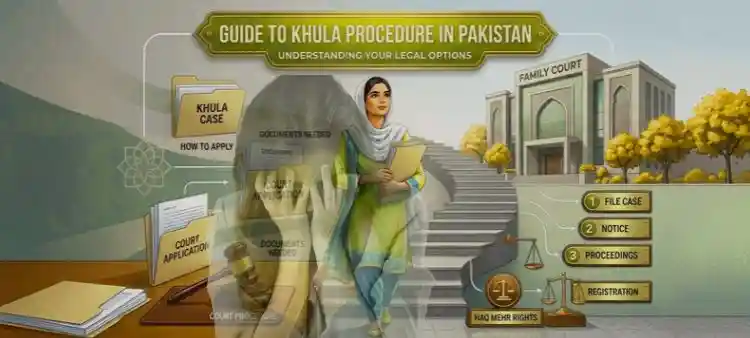
A Muslim woman in Pakistan can seek khula through a Family Court if she no longer wants to remain married. She does not need her husband's permission to file a khula case.
However, she must follow the legal process to end the marriage and obtain the required records.
The khula procedure in Pakistan includes filing a case, serving notice on the husband, attending court proceedings, and completing the required divorce registration steps.
This guide explains:
- How to file khula in Pakistan
- Documents needed for a khula case
- Family Court procedure
- How long khula may take
- Court fees and lawyer costs
- Rights concerning Haq Mehr
- Khula without the husband's consent
- How overseas Pakistani women can apply
What Is Khula in Pakistan?
Khula is a legal way for a Muslim wife to seek the end of her marriage.
If a woman cannot continue living with her husband, she may ask a Family Court to dissolve the marriage through khula.
Important facts about khula:
- The wife can start the case.
- The husband's consent is not required for the court to grant khula.
- The court follows the required reconciliation procedure.
- The wife does not have to prove that her husband committed cruelty to seek khula.
- Khula may affect her rights to Haq Mehr, also called dower.
Khula is different from talaq, which is a form of divorce initiated by the husband.
A wife may also have other legal options, such as dissolution of marriage on grounds recognised by law.
Legal basis: The Family Courts Act, 1964, as applicable in the relevant province or territory.
How to File Khula in Pakistan
The khula process usually involves the following seven steps.
Step 1 — Choose the Correct Legal Option
- Before filing, the wife should understand the difference between khula and other forms of marriage dissolution.
- For example, a woman who has faced cruelty or long-term failure to provide maintenance may have grounds to seek judicial dissolution under the Dissolution of Muslim Marriages Act, 1939.
- This difference matters because her financial rights may depend on the type of divorce granted.
- A family lawyer can help identify the correct claim.
Step 2 — Collect the Required Documents
Prepare copies of your marriage and identity documents.
You will usually need:
- CNIC or NICOP of the wife.
- Nikah Nama or marriage registration record.
- Husband's name and available identity details.
- Husband's current or last known address.
- Date and place of marriage.
- Details of separation and the reasons for seeking khula.
Other documents may be needed if the case includes children, Haq Mehr, maintenance, or property disputes.
Do not have your Nikah Nama?
You may be able to obtain a certified copy from the Nikah Registrar or relevant local authority.
If the marriage record is unavailable, ask a lawyer what other lawful evidence may be used.
Step 3 — File a Khula Case in Family Court
A khula case begins with a written legal claim called a plaint.
The plaint should explain:
- Who the parties are.
- When and where the marriage took place.
- Why the wife is seeking khula.
- Why the selected court has jurisdiction.
- What legal relief the wife is asking for.
The case must be filed before the Family Court that has legal authority to hear it.
In many cases, the court where the wife ordinarily lives may have jurisdiction. Other legal rules may also apply.
Step 4 — Court Sends Notice to the Husband
After the case is filed, the Family Court follows the required procedure to notify the husband.
The notice gives him an opportunity to respond.
The husband may:
- Appear before the court.
- File a written reply.
- Engage a lawyer.
- Choose not to appear.
What if the husband ignores the notice?
The case may still continue after the court is satisfied that the legal requirements for service have been met.
A husband's absence does not automatically stop a khula case.
Step 5 — Court Attempts Reconciliation
- Reconciliation is an important part of the Family Court process.
- The court gives the parties an opportunity to settle their differences where required by law.
- If reconciliation fails, the court proceeds according to the applicable law governing khula.
- The court cannot require a woman to remain married merely because her husband refuses to agree to khula.
Step 6 — Family Court Issues the Khula Decree
- If the legal requirements are met, the Family Court may pass a decree dissolving the marriage through khula.
- The decree is the court's formal decision.
- It may also deal with legal questions concerning Haq Mehr and other claims.
A court decree and a Divorce Registration Certificate are different documents.
The decree records the court's decision. The registration certificate is issued through the relevant local authority after the required legal process.
Step 7 — Complete the Divorce Registration Process
- After the khula decree, the required Union Council or other local authority procedure must be completed.
- In Punjab, Section 21-B of the Family Courts Act requires the Family Court to send a certified copy of the dissolution decree to the concerned Arbitration Council Chairman within three days.
- The relevant legal process then follows the applicable Muslim Family Laws Ordinance provisions.
A 90-day statutory period is generally relevant after the required notice reaches the local authority, subject to the applicable law and circumstances.
After completing the process, the parties can obtain the official Divorce Registration Certificate.
This document may be needed for:
- Updating marital status records.
- Future marriage registration.
- Immigration applications.
- Visa and foreign legal procedures.
Always confirm that the divorce has become legally effective before relying on the decree for remarriage or immigration purposes.
How Long Does the Khula Procedure Take in Pakistan?
There is no single guaranteed timeline for every khula case.
The time depends on:
- The Family Court's workload.
- Whether the husband's address is correct.
- How quickly court notices are served.
- Whether the parties appear.
- Any connected legal disputes.
- The required post-decree registration procedure.
A straightforward case may move faster than a case involving problems with service or disputed financial claims.
Remember: The time needed to obtain a court decree is different from the time needed to complete the divorce registration process.
Ask your lawyer about both stages before filing.
What Is the Cost of Khula in Pakistan?
The total khula cost depends on the individual case.
Common expenses include:
- Applicable court filing fees.
- Lawyer's professional fees.
- Documentation and certified copies.
- Notice and service expenses.
- Any required overseas document attestation.
There is no single fixed total lawyer fee for all khula cases in Pakistan.
Cases involving overseas clients, disputed Haq Mehr, or related claims may require additional work.
Request a written fee estimate that explains what is included and whether later proceedings will cost extra.
Does a Wife Have to Return Haq Mehr After Khula?
This is one of the most important questions in a khula case.
Haq Mehr, also called dower, is the amount or property promised to a wife under the Nikah Nama.
The financial consequences of khula depend on the applicable law, the marriage contract, the facts, and relevant court decisions.
For example, Section 10(5) of the Family Courts Act in Punjab contains provisions concerning the surrender of up to 25% of admitted prompt dower or up to 50% of deferred dower.
However, these provisions have been the subject of legal challenges and differing judicial interpretations. They should not be treated as a fixed deduction in every case.
The court may need to consider:
- What Haq Mehr was agreed upon.
- Whether it was actually paid.
- Whether it is prompt or deferred.
- Which legal ground the wife has chosen.
- The applicable law and latest court decisions.
Khula and dissolution on grounds such as cruelty are not the same legal remedy.
The Supreme Court of Pakistan has confirmed that a court cannot simply turn a wife's claim for dissolution on other legal grounds into khula without her clear and voluntary consent.
This distinction can protect important financial rights.
Before filing, have the Nikah Nama and Haq Mehr details reviewed by a qualified lawyer.
Can a Wife Get Khula Without Her Husband's Consent?
Yes.
- A Muslim wife can seek khula through the Family Court without her husband's agreement.
- The court must still follow the legal procedure, including the required notice and reconciliation stages.
- If the husband refuses to attend or sign documents, that refusal alone does not give him the power to stop the court from granting khula.
The case must still meet the applicable legal requirements.
Can Overseas Pakistani Women Apply for Khula?
Yes. A Pakistani woman living abroad may be able to file a khula case through the appropriate Family Court in Pakistan.
This can include women living in the:
- United Kingdom
- United States
- Canada
- United Arab Emirates
- Saudi Arabia
- Other countries
The correct court and process depend on the facts of the marriage, the parties' residence, and jurisdiction rules.
How to Start a Khula Case from Abroad
An overseas applicant should normally take these steps.
- Contact a family lawyer in Pakistan. Share the marriage details and country of residence.
- Send copies of the documents. These may include the Nikah Nama, NICOP, passport and husband's address.
- Arrange a Special Power of Attorney where needed. This gives a trusted person authority to take specified legal steps in Pakistan.
- Complete the required attestation. Depending on eligibility and local requirements, this may be arranged through a Pakistani diplomatic mission or NADRA's online Power of Attorney service.
- File the case in the correct Family Court. The lawyer or authorised representative can assist with the required steps.
- Follow the court's attendance directions. The judge may still require the wife's own statement or appearance. Video-link participation may be possible where the court permits it.
- Obtain the decree and complete registration. Keep certified copies for use abroad.
Is Online Khula Available in Pakistan?
- The term online khula usually refers to handling parts of a khula case remotely with legal assistance.
- It does not mean every woman can complete the entire divorce through one website.
- Court filing, verification, attendance, and divorce registration must meet the applicable legal requirements.
For overseas Pakistanis: A Pakistani divorce may also need to meet the recognition rules of the country where you live. This is especially important before remarriage or an immigration application.
What Happens to Children After Khula?
Khula ends the marital relationship through the legal process. It does not automatically settle every issue involving children.
- Parents may still need to address:
- Child custody.
- Child maintenance.
- Visitation rights.
- Guardianship.
Schooling and care arrangements.
The Family Court considers the applicable legal rules, including the welfare of the child in custody matters.
A father does not automatically receive custody because the mother has obtained khula.
Similarly, the mother's decision to seek khula does not by itself remove the father's legal duties towards the children.
For more information, read our guide on Child Custody After Divorce in Pakistan.
Common Mistakes to Avoid When Filing Khula
Small mistakes can cause delays or affect financial rights.
Before filing, avoid these common problems.
- Using the wrong court. Confirm legal jurisdiction first.
- Providing an incorrect address. This may delay notice to the husband.
- Ignoring Haq Mehr details. Check the Nikah Nama carefully.
- Choosing the wrong legal remedy. Khula may have different consequences from dissolution on statutory grounds.
- Forgetting connected claims. Discuss maintenance, custody and property issues before filing.
- Treating the decree as the final registration certificate. Follow the required post-decree process.
- Signing documents without understanding them. Review the legal effect of any agreement or waiver.
Frequently Asked Questions About Khula in Pakistan
1. Can a woman file khula without proving cruelty?
Yes. A woman seeking khula does not have to prove that her husband was cruel or committed another fault. A separate claim for dissolution on statutory grounds may require supporting facts and evidence.
2. Can a husband stop khula in Pakistan?
His refusal to agree does not by itself stop the Family Court from granting khula. The court must follow the required legal procedure.
3. How many court hearings are needed for khula?
There is no fixed number for every case. Hearings depend on service, appearances, reconciliation and any connected claims.
4. Can I file khula without my original Nikah Nama?
You may be able to use a certified copy or other lawful evidence of marriage. Ask a lawyer to check the available records before filing.
5. Can I get khula if my husband lives abroad?
Yes, a case may be possible in Pakistan if the Family Court has jurisdiction. The husband's overseas address and legal notice requirements must be handled correctly.
6. Can I file khula while living in the UK, USA or Canada?
Yes, where a Pakistani Family Court has jurisdiction. You may be able to appoint a representative through a properly prepared and attested Power of Attorney. The court decides any personal attendance requirements.
7. How long does a khula certificate take in Pakistan?
It depends on when the court decree is issued and when the required local authority procedure is completed. The statutory 90-day process may apply after the relevant notice is received.
8. Is Haq Mehr always returned in full after khula?
No fixed answer applies to every case. The amount and legal consequences depend on the applicable law, the Nikah Nama, the relief sought and the relevant court decisions.
9. Does the wife need to visit the Union Council after khula?
The required record and registration steps must be completed through the competent local authority. Whether the wife must attend personally depends on the process and her circumstances.
10. Can a woman remarry immediately after receiving a khula decree?
She should not assume the decree alone completes every legal requirement. The effective divorce date, registration process, and applicable waiting-period rules must be checked before remarriage.
11. Can khula and child custody be claimed in the same case?
The Family Courts Act permits certain connected family claims to be included in a dissolution suit. Whether to combine them depends on the circumstances and legal strategy.
12. Is a Pakistani khula accepted in other countries?
Recognition depends on the laws of the foreign country. Certified documents, proof of the divorce's effective date, and translations may be required.
Get Legal Help with Khula in Pakistan
A khula case requires more than filing divorce papers.
Choosing the correct legal route, protecting financial rights, serving proper notice and completing the registration process are all important.
A.A. Dewan & Co. provides family-law guidance in Pakistan, including assistance with khula, divorce, marriage dissolution and related Family Court matters.
The firm also assists overseas Pakistanis who need legal representation or document support in Pakistan.
If you are considering khula, you can begin by sharing your marriage documents and a short explanation of your situation.
Explore Our Marriage Dissolution Services
Legal References
Family Courts Act, 1964 — Section 7
Family Courts Act, 1964 — Section 10
Family Courts Act, 1964 — Section 21-B
Supreme Court of Pakistan — Ibrahim Khan v. Mst. Saima Khan
Ministry of Foreign Affairs — Power of AttorneyUS Department of State — Pakistan Divorce Documents
Disclaimer: This article provides general information about Pakistani Muslim family law. Legal requirements may differ by province, territory and individual case. It is not a substitute for advice from a qualified lawyer.
Comments
No comments yet. Be the first to comment!
Leave a Comment