

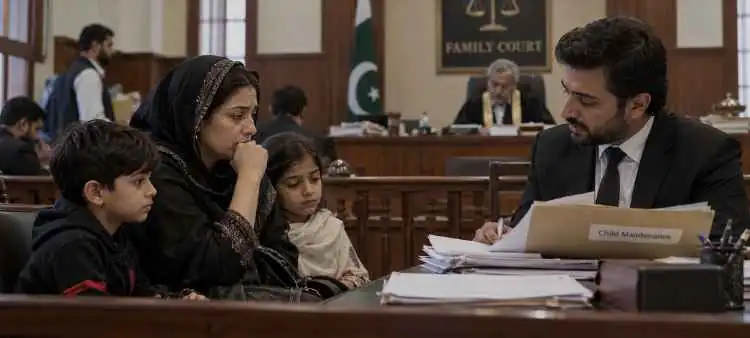
When a father dies, one of the most urgent questions facing his family is who will provide financial support for his children. School fees, medical expenses and everyday living costs continue, but the legal responsibility for meeting those expenses requires careful examination.
Under Pakistani Muslim family law, a child maintenance obligation may arise against the paternal grandfather in qualifying circumstances. However, the grandfather does not automatically become liable for every unpaid maintenance order issued against the father.
A separate question concerns the deceased father's property. Children may have inheritance rights in his estate, but inheritance and monthly child maintenance are different legal claims.
This guide explains the Supreme Court's approach, the evidence needed to establish a grandfather's responsibility, the effect of an existing maintenance decree, and the legal options available to local and overseas families.
Who Is Responsible for Child Maintenance After the Father's Death?
Under the Muslim personal-law principles discussed by the Supreme Court of Pakistan, responsibility for maintaining a child primarily rests with the father.
If the father dies, or is financially unable to provide support, the obligation may extend to the paternal grandfather where the relevant legal conditions are fulfilled.
The Supreme Court examined this question in Bashir Ahmad v. Additional District Judge, Hafizabad (PLD 2024 SC 67).
The judgment identified the conditional nature of the grandfather's responsibility and emphasized that disputed financial facts must be established through appropriate legal proceedings.
The court did not create an unconditional rule that every grandfather must automatically pay a deceased son's child-maintenance decree.
Where the grandfather is alive and financially capable, a maintenance claim may be considered under the applicable law and evidence.
Where the grandfather has no sufficient means, or the other legal requirements are not established, the result may be different.
For help identifying the appropriate claim, visit our Child Maintenance Legal Services.
Can a Grandfather Be Legally Required to Pay Child Maintenance?
Yes, in qualifying circumstances.
The Supreme Court in Bashir Ahmad explained two important conditions governing the paternal grandfather's maintenance liability.
1. The Father Has Died or Cannot Financially Maintain the Child
The claimant must establish the circumstances giving rise to a potential maintenance obligation against the grandfather.
In cases involving a living father, inability to maintain the child must be supported by evidence rather than an unsupported allegation.
Where the father has died, the court may need to consider the death, relevant financial circumstances and any estate or property available for satisfying an existing decree.
2. The Paternal Grandfather Has Sufficient Financial Resources
The grandfather's financial capacity is an essential part of the legal assessment.
The claimant must establish that the grandfather is financially capable of maintaining the child within the applicable legal framework.
Relevant evidence may include employment, business interests, assets and other lawfully obtainable financial information.
A grandfather's relationship to the child alone does not establish an enforceable maintenance obligation.
The grandfather must also receive an opportunity to contest the claim and present evidence concerning the statutory and personal-law requirements.
What Did the Supreme Court Decide in PLD 2024 SC 67?
The case of Bashir Ahmad v. Additional District Judge, Hafizabad and others, decided on 3 November 2023 and reported as PLD 2024 SC 67, provides important guidance.
The dispute concerned whether a maintenance decree originally issued against a child's father could be enforced against the paternal grandfather.
The Supreme Court explained that the grandfather's possible obligation was a separate civil liability requiring determination through due process.
The court emphasized the factual nature of the father's inability and the grandfather's financial capacity.
The Key Judicial Principles
A paternal grandfather's maintenance liability is conditional, not automatic.
Relevant financial circumstances must be established through evidence.
The grandfather must be allowed to defend the claim.
A maintenance decree against the father cannot simply be executed against a grandfather who was not liable under that decree.
A properly instituted maintenance suit may be required to determine the grandfather's liability.
This distinction matters because enforcement proceedings and a new maintenance suit have different legal purposes.
Read the judgment: Bashir Ahmad v. Additional District Judge — PLD 2024 SC 67.
Can the Father's Maintenance Order Be Enforced Against the Grandfather?
Not automatically.
Suppose a Family Court orders a father to pay monthly maintenance for his child. Later, the father dies without satisfying the entire decree.
The child cannot simply treat the grandfather as the original judgment debtor.
The court must distinguish between:
Enforcement of an existing decree against the father or legally available assets.
A separate claim seeking to establish the grandfather's own maintenance responsibility.
The Supreme Court in Bashir Ahmad held that a decree passed against the father could not be executed against a grandfather who was not a party liable under that decree.
The grandfather's separate liability must be determined through lawful proceedings.
Why Is a Separate Suit Important?
A maintenance claim against the grandfather may require evidence concerning his resources and the circumstances that bring him within the relevant personal-law obligation.
Those matters cannot simply be assumed during execution of the father's decree.
Article 10A of the Constitution protects the right to fair trial and due process.
Accordingly, the grandfather must have an opportunity to answer the allegations and contest the evidence before liability is imposed.
What Happens to Unpaid Child Maintenance After the Father's Death?
Outstanding maintenance raises a different question from future monthly support.
Where a maintenance decree exists, the claimant should first examine the unpaid amount, the wording of the decree and the legal status of any assets belonging to the deceased father.
Step 1: Review the Existing Maintenance Decree
Obtain a certified copy of the order and identify the amount awarded, the period covered and any applicable increase or variation.
Step 2: Prepare an Accurate Arrears Statement
List the amounts that became payable, payments actually received and the balance claimed.
Step 3: Identify Available Estate Assets
Investigate whether the deceased father left property or other assets legally available for satisfying enforceable liabilities.
Step 4: Determine the Appropriate Enforcement Procedure
Section 13 of the applicable Family Courts Act provides a framework for enforcement of Family Court decrees.
However, the procedure following a judgment debtor's death, the effect of succession and the extent to which estate assets may be reached require case-specific assessment.
Important: A deceased person's lawful liabilities and an heir's independent personal liability are not the same. A legal heir should not automatically be treated as personally responsible for every unpaid amount.
Step 5: Consider a Separate Maintenance Claim
If the circumstances support a maintenance claim against the paternal grandfather, that claim must be assessed under the applicable legal principles and procedural requirements.
Recovery of old arrears and obtaining a new order for future maintenance should not be confused.
Do Children Inherit Their Father's Property After His Death?
Children may inherit from their deceased father's estate under the succession law applicable to the family.
However, the share depends on the governing personal law, the surviving heirs and the nature of the deceased's estate.
For Muslim families, succession is generally governed by applicable Muslim personal-law principles together with relevant statutory provisions.
The estate must first be identified, including legally relevant liabilities and property interests.
What Property May Form Part of the Estate?
Depending on ownership and applicable law, estate assets may include:
Land and residential property.
Bank accounts and deposits.
Business interests.
Vehicles and other movable property.
Financial assets and legally recoverable claims.
Not every property occupied or used by the father necessarily belonged to him.
Ownership documents, title records, transfers and other relevant evidence must be examined.
Do Sons and Daughters Both Have Inheritance Rights?
Yes. Eligible sons and daughters may have inheritance rights under the applicable succession law.
The precise shares are not the same in every family and must be calculated by identifying all relevant surviving heirs.
A child should not be deprived of a lawful inheritance merely because the parents were divorced or separated.
For a fuller legal analysis, see the Muslim Family Laws Ordinance, 1961 and the applicable personal-law framework.
Can Children Claim Property When Their Parents Divorce?
Divorce itself generally does not create an immediate inheritance share for a child in the property of a living parent.
This is an important distinction.
When the Father Is Alive
A child may have an enforceable maintenance entitlement under the applicable law.
However, a future expectation of inheritance is not ordinarily the same as present ownership of the father's property.
A child does not automatically become a co-owner of the father's house merely because the marriage has ended.
After the Father's Death
Succession rights may arise when the father's estate opens upon death, subject to the applicable succession rules.
At that stage, a legally entitled child may claim an inheritance share.
What if Property Was Already Transferred?
A valid lifetime transfer may raise questions different from inheritance.
Where a transfer is challenged, the relevant documents, legal formalities, ownership history and possible grounds for challenging the transaction must be examined.
A property cannot automatically be brought back into the estate merely because an heir dislikes an earlier transfer.
Practical distinction: Child maintenance provides financial support. Inheritance concerns ownership rights arising through succession. The remedies, evidence and competent forums may differ.
Can a Mother Claim the Deceased Father's Property on Behalf of a Minor Child?
A mother caring for a minor may need to protect the child's lawful inheritance interests.
However, a child's inheritance belongs to the child, not automatically to the person providing daily care.
The appropriate legal steps depend on the nature of the property, the child's legal representation and the applicable guardianship and succession requirements.
Documents That May Be Relevant
A preliminary case review may require:
Father's death certificate.
Child's birth certificate or B-Form.
Relevant family registration records.
Identity records of the surviving heirs.
Land ownership or property records.
Bank or financial documentation, where available.
Existing succession, guardianship or court orders.
A mother's custody of a child does not automatically authorize every sale, transfer or disposal of the child's inherited property.
Minor-property management may require additional legal safeguards.
For related issues concerning minors, see our Child Custody and Guardianship Services.
How to File a Maintenance Case Against the Grandfather
Where the circumstances justify a claim against the paternal grandfather, the claimant must establish the legal and factual grounds for relief.
The Family Courts Act, 1964, including its Section 5 and Schedule, provides the relevant Family Court framework for maintenance matters, subject to applicable amendments and personal law.
Step 1: Establish the Family Relationship
Identify the minor child, deceased or financially incapable father, and paternal grandfather.
Step 2: Explain the Father's Circumstances
Where the father is deceased, provide relevant proof. Where he is living but financially incapable, identify the facts and evidence supporting that position.
Step 3: Identify the Grandfather's Financial Resources
Present legally obtained financial information relevant to the grandfather's ability to provide maintenance.
Step 4: State the Child's Support Requirements
Identify current educational, healthcare and other reasonable expenses.
Step 5: Prepare the Plaint
The pleading should distinguish between the claim against the grandfather and any existing decree previously obtained against the father.
Step 6: Provide an Opportunity for Defence
The grandfather is entitled to respond to the claim and contest the allegations.
Step 7: Request Appropriate Relief
Where legally justified, counsel may seek maintenance and consider interim relief under the applicable Family Courts legislation.
The precise prayer must reflect the governing law, evidence and case circumstances.
For broader guidance on litigation preparation, read our guide to filing a child maintenance case.
What Evidence Is Required From Both Sides?
The evidence should address the actual issues in dispute.
| Issue | Potential supporting evidence |
|---|---|
| Father's death | Death certificate and relevant official record |
| Child's relationship | Birth certificate and family records |
| Child's financial needs | School fees, medical bills and expense statement |
| Father's estate | Property records, bank information and existing decrees |
| Grandfather's financial position | Lawfully obtained employment, business or asset records |
| Existing unpaid maintenance | Certified decree and accurate payment statement |
| Prior payments | Receipts, bank records and remittance details |
The grandfather may also present evidence showing that the legal conditions for liability have not been satisfied.
The claimant should not presume that owning a home necessarily proves sufficient disposable resources or that the grandfather's financial position can be determined without evidence.
What if the Father Was Living Abroad?
A father's death abroad may create additional legal and administrative questions.
For example, he may have left property in Pakistan, bank accounts overseas, assets in more than one jurisdiction or children living in different countries.
Documents From Abroad
Relevant documents may include a foreign death certificate, employment records, proof of residence, overseas asset information and properly verified identity records.
Depending on their intended use, foreign documents may require translation, authentication or other procedural formalities.
Foreign Estate and Local Property
Property situated in different countries may be governed by different succession and administration rules.
A Pakistani court's jurisdiction over local property should not be treated as automatic authority over all foreign assets.
Foreign Maintenance Orders
A child-support order made abroad may raise separate questions about recognition and enforcement.
International clients should not assume that a UK, UAE, US or Canadian child-support order will operate as an identical domestic decree without examination of the applicable legal framework.
For local and overseas family matters, explore our Family Law Services for Overseas Pakistanis.
Child Maintenance and Inheritance: Three Practical Examples
Example 1: Father Dies and Leaves Property
A father dies while a maintenance decree remains partly unpaid.
His children may need legal advice concerning both their inheritance rights and whether the unpaid decretal amount can be lawfully recovered from available estate assets.
The two matters require separate legal analysis.
Example 2: Father Dies Without Available Assets
A minor child requires financial support, but the deceased father leaves no assets available to satisfy the existing decree.
Where the paternal grandfather is financially capable, a separate maintenance claim may be available under the conditions discussed in Bashir Ahmad.
Example 3: Parents Divorce While Father Remains Alive
The mother has custody and the father owns residential property.
The child may pursue maintenance rights, but the parents' divorce alone does not automatically transfer an ownership share in the father's house to the child.
These examples are hypothetical illustrations, not reported court cases.
Frequently Asked Questions
Who pays child support if the father dies?
Under the applicable Muslim personal-law principles, a paternal grandfather may become liable in qualifying circumstances if the father has died or cannot provide support and the grandfather has sufficient resources.
Is a grandfather legally responsible for grandchildren?
Not automatically. The applicable conditions must be established through appropriate legal proceedings.
Can a mother execute a father's maintenance decree against his father?
A decree against the child's father cannot simply be executed against a grandfather who was not liable under that decree. The Supreme Court addressed this distinction in PLD 2024 SC 67.
What happens to child maintenance arrears after the father's death?
The existing decree, unpaid amount, available estate assets and applicable enforcement law must be examined. Future support and old arrears are different legal issues.
Can children inherit property after their parents divorce?
Divorce alone does not ordinarily create a present inheritance share in a living parent's property. Succession rights may arise upon the parent's death, subject to applicable law.
Does a daughter inherit from her father?
Yes, an eligible daughter may have inheritance rights under the applicable succession law. The precise share depends on the family circumstances and surviving heirs.
Can a grandfather refuse to pay child maintenance?
A grandfather may contest the claim and present evidence concerning the legal conditions for liability. The court determines the matter under the applicable law.
Can a child receive maintenance and inheritance?
Maintenance and inheritance are distinct rights. Their interaction in a specific case depends on the legal obligation, estate, prior orders and governing law.
Can overseas children claim their father's inheritance?
Potentially, yes. Overseas residence alone does not extinguish inheritance rights, but property ownership, succession and procedural requirements must be established.
Can a mother sell property inherited by her minor child?
Not automatically. Transactions involving a minor's property may be subject to guardianship law, legal authority and court safeguards.
Legal Authorities and Further Reading
Bashir Ahmad v. Additional District Judge — PLD 2024 SC 67
Family Courts Act, 1964 — Pakistan Code
Legal information notice: This article provides general educational information, primarily concerning Muslim family-law principles applicable in Pakistan. Grandfather maintenance liability, inheritance entitlement, execution of decrees and property rights depend on the governing law, family circumstances, documentary evidence and judicial decisions. It is not a substitute for case-specific legal advice.
Comments
No comments yet. Be the first to comment!
Leave a Comment