

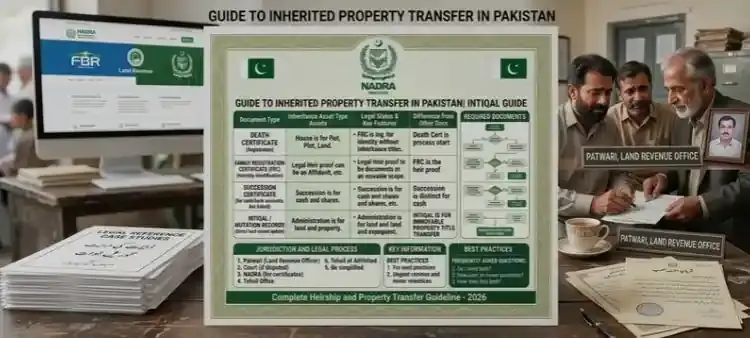
A parent dies and leaves a house, a plot or agricultural land. The family has the death certificate, but the property is still in the deceased person's name. Can one son visit an office and transfer everything to himself? Is a NADRA succession certificate enough?
No. Property transfer after death depends on the property record, all lawful heirs, and the authority that maintains that record. In many land-record cases, the key step is inheritance mutation (warasati intiqal). For some houses and plots, a Letter of Administration or separate housing-society process may also be needed.
This guide explains how to transfer inherited property in Pakistan, what documents to prepare, where to apply, what happens to daughters' shares, and what to do if the record is wrong.
On This Page
- The Quick Answer: What Happens After Death?
- Where Do You Apply: Land Office or Housing Society?
- Documents Needed for Inherited Property
- Inheritance Mutation: Step-by-Step Process
- Do You Need a NADRA Letter of Administration?
- Fees and Processing Time
- Can a Daughter or Widow Be Left Out?
- What If an Heir Lives Abroad?
- What If Someone Refuses or the Record Is Wrong?
- Frequently Asked Questions
- Before You Submit: Final Checklist
The Quick Answer:
What Happens After Death?
When an owner dies, inheritance rights arise under the applicable law. The deceased person's name remaining in a land record does not mean the heirs have no rights. But the record still needs to be updated so the heirs can deal with the property properly.
An inheritance mutation, often called warasati intiqal, records a change caused by inheritance in the relevant revenue record. It is different from a sale: the deceased owner is not selling the property to the family.
The important distinction is that a mutation records or recognises rights for revenue purposes; it is not, on its own, a guarantee of perfect ownership title. A dispute over a forged deed or the deceased's actual ownership may need a court decision.
Example: A father dies leaving farmland to his wife, two sons and one daughter, assuming they are the relevant heirs. The land must not simply be entered in the eldest son's name because he manages the farm. The lawful heirs and their shares must be determined under the law that applies to the deceased.
Where Do You Apply:
Land Office or Housing Society?
Start by finding out who maintains the property record. The same family may need different procedures for two properties.
| Type of property | Usually the first place to check | What to ask |
|---|---|---|
| Agricultural or other revenue-record land in Punjab | Relevant Arazi Record Centre / Punjab Land Records Authority | How to apply for inheritance mutation and obtain an updated fard |
| Revenue-record land in Sindh | Relevant revenue office and Board of Revenue Sindh | Which inheritance entry, heir verification and record update are required |
| Plot or house in a housing society | Society, development authority or allotting agency | Which death, heirship, LoA, transfer and dues documents are required |
| Flat or house with registered title documents | Relevant land/registration authority | Whether mutation, registration, LoA or another title-update process applies |
The Punjab Land Records Authority's mutation guide explains the land-record process. For Sindh, the Board of Revenue's Sindh Zameen portal provides access to land and registry records.
Do not pay for a certificate or deed before the relevant office tells you what it actually needs.
Documents Needed for Inherited Property
Make one folder containing the following, as relevant to your property and province:
- Death certificate of the registered owner.
- CNIC cancellation certificate, if required by the chosen procedure.
- CNIC/NICOP copies of all legal heirs and relevant birth records for minors.
- NADRA Family Registration Certificate (FRC) and other proof of family relationships where needed.
- Ownership records such as registered deed, allotment letter, existing fard, khewat, khata, khasra, plot number or earlier mutation.
- Property details and dues records, if the society or authority requests them.
- Letter of Administration, court order, authorization or Power of Attorney, if required for that particular process.
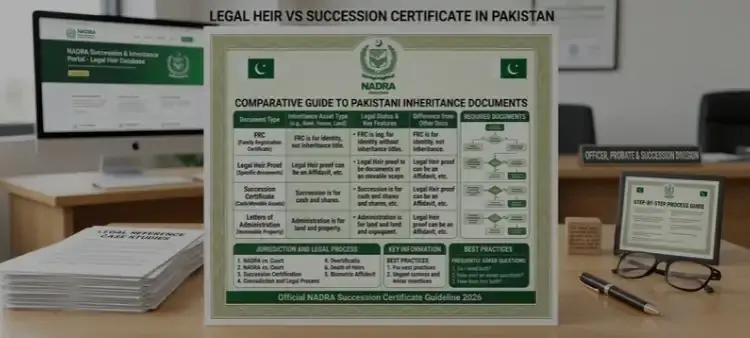
An FRC is a family registration record, not a final court decision about inheritance shares. A person missing from the FRC may still be a lawful heir. For a detailed distinction between heirship proof, FRC and succession documents, read Legal Heir vs Succession Certificate in Pakistan.
Before filing: Check whether the spelling of the deceased person's name, CNIC, property number and family details match across records. An error can delay the case.
Inheritance Mutation: Step-by-Step Process
The following is a practical outline, not one nationwide procedure for every property.
Step 1 — Obtain the existing ownership record
Get a current fard or certified ownership record for land, or obtain the property file from the housing society. Confirm the deceased was the recorded owner and whether there are co-owners, mortgages, court orders or other restrictions.
Step 2 — Identify every legal heir
List the spouse, children, parents and any other relatives who may inherit under the deceased's applicable personal law. Do not calculate shares based on a family guess or exclude a married daughter. If the heirship is disputed, resolve that issue through the proper legal process.
Step 3 — Apply for inheritance mutation at the correct office
For Punjab revenue land, approach the relevant Arazi Record Centre with identity and property documents. The PLRA entry and attestation guide describes submitting an application, checking the land record, entering the mutation and obtaining official approval. For property in another system, use that authority's prescribed inheritance-transfer route.
Step 4 — Complete heirship and record verification
The revenue staff or competent authority checks the deceased's interest, family details and proposed shares. In Punjab inheritance matters, this can include a Shajra Nasab (family pedigree) and inquiry into the lawful heirs. The exact appearances, identity checks and supporting evidence depend on the case.
Step 5 — Pay only official charges and obtain approval
If charges apply, request a system-generated challan or official receipt. The competent officer must approve or attest the mutation; merely submitting the application is not the same as completion.
Step 6 — Collect and check the updated record
Ask for the mutation number, certified mutation copy and updated fard or ownership statement, as applicable. Check every heir's name and share immediately. If a name is missing, do not accept the document as correct simply because it bears an official stamp.
Example: Four heirs are named in a proposed inheritance entry, but the final copy shows only three. The missing heir should request the supporting mutation record and seek correction or an appropriate legal remedy rather than assuming their right has disappeared.
Do You Need a NADRA Letter of Administration?
NADRA's succession framework distinguishes Succession Certificates for movable assets, such as bank funds, from Letters of Administration (LoA) for immovable property, such as land or a house.
But this does not mean an LoA is automatically required for every ordinary inheritance mutation of revenue land. The governing provincial law, the property type, whether heirs agree and the receiving authority's rules must be checked. A housing society may have requirements different from those of a Punjab revenue office.
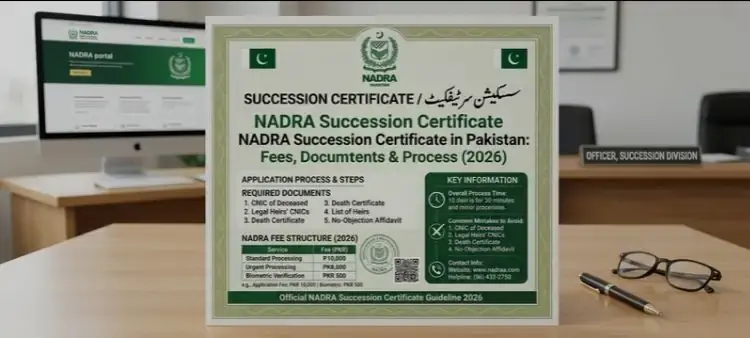
If your family is applying through NADRA, see the published guide to NADRA Succession Certificate in Pakistan and NADRA's official succession and LoA instructions.
Ask the office directly: “For this specific property, can we apply for inheritance mutation using the death and heirship records, or do you require a Letter of Administration or court order?â€
Fees and Processing Time
There is no single fee or guaranteed completion time for all inherited-property transfers in Pakistan. The amounts depend on the province, authority, property record and services involved.
You may encounter separate charges for a fard, mutation processing, certified copies, society transfer, outstanding dues or other legally applicable steps. A NADRA LoA fee is not the same as a land mutation fee. Do not copy taxes or transfer charges from an ordinary property sale into an inheritance case without checking whether they apply.
In Punjab, the PLRA mutation service describes obtaining the official challan and paying assessed dues. Request a written breakdown instead of relying on a verbal quote.
Delays often arise because a deceased owner's property details are incomplete, an heir is missing, the family pedigree is disputed, or the property belongs to a society with separate verification rules.
Can a Daughter or Widow Be Left Out?
No lawful heir should be excluded merely because she is a woman, married or living elsewhere. Inheritance shares depend on the law applicable to the deceased and the actual family structure. They must not be replaced by an informal statement that “the brothers will handle the land.â€
Punjab's Women Development Department explains safeguards in inheritance mutation, including inquiry into heirs and identification documents intended to prevent women being omitted from land records.
Example: A married daughter is told that her brothers have already transferred the farmland and she has “no share because she received dowry.†That claim is not, by itself, a lawful reason to erase an inheritance entitlement. She should obtain the mutation copy, family documents and legal advice about correction or recovery.
In Punjab, a woman deprived of ownership or possession can also check whether the Ombudsperson's property-rights complaint process is available for her situation. The proper remedy depends on the records, existing proceedings and applicable law.
What If an Heir Lives Abroad?
Living in the UK, UAE, Saudi Arabia or another country does not automatically end an heir's claim to property in Pakistan. However, overseas heirs need to clarify whether the relevant authority requires a personal appearance, biometric verification, attested authorization or a valid Special Power of Attorney.
If appointing someone in Pakistan, the authority should be limited to the actions genuinely needed. Do not sign an unrestricted power to sell or give away property merely to obtain an inheritance mutation. Confirm execution and attestation requirements with the Pakistani mission and the receiving office.
NADRA succession applications and land-record transfer procedures are different processes, so do not assume one set of biometric rules applies to both. The Pakistan High Commission's succession guide explains overseas verification in the NADRA context.
For a broader estate-document checklist, see Inheritance & Succession for Overseas Pakistanis.
What If Someone Refuses or the Record Is Wrong?
A relative may occupy the house, withhold documents, deny another heir's share or insist that the whole property belongs to them. These situations require different responses.
- Missing name or wrong share: Obtain the certified mutation and underlying heirship record. Ask about correction, appeal or review under the applicable revenue law.
- Disputed ownership or forged deed: A simple mutation correction may not decide title. A civil case or other appropriate legal proceedings may be necessary.
- One heir occupies the property: Occupation alone does not always settle ownership. Check whether partition, possession or another remedy is legally appropriate.
- Heirs disagree about selling: First establish ownership shares and the lawful mechanism for division or disposal. One co-heir should not assume authority to sell everyone's interest.
A useful legal distinction appears in Sindh High Court inheritance jurisprudence: inheritance rights can arise by operation of law, while a revenue mutation is not by itself an independent grant of title.
Frequently Asked Questions
1. How do I transfer my father's property after his death in Pakistan?
Find the title or land record, identify all lawful heirs, collect the death and family documents, and apply to the relevant revenue office or property authority. The required procedure depends on the asset and province.
2. Is a succession certificate required for inherited land in Punjab?
Not automatically for every inheritance mutation. Punjab revenue-land procedures and NADRA's LoA route are distinct. Ask the relevant Arazi Record Centre or property authority which documents your case requires.
3. What is warasati intiqal?
It means an inheritance mutation: the entry and approval process used to update a land record following an owner's death. It is not the same as a sale deed.
4. Can one brother transfer inherited property into his own name?
Not lawfully at the expense of other entitled heirs merely because he is the eldest or handles paperwork. Any claim that heirs gave up or transferred shares needs proper legal scrutiny and documentation.
5. Is an FRC enough to transfer a house?
Not necessarily. An FRC can help identify registered family members, but the housing society or other authority may require additional proof, an LoA, court documents or a separate transfer procedure.
6. Can a married daughter claim inherited property?
Yes, if she is a legal heir under the law applicable to the deceased. Marriage or dowry alone does not automatically extinguish her inheritance rights.
7. Can an overseas Pakistani complete inheritance mutation without visiting Pakistan?
Some steps may be completed through a properly executed authorization or representative, depending on the authority. Do not assume every biometric or appearance requirement can be waived.
8. How long does transfer of inherited property take?
There is no reliable nationwide number. Record verification, heirship, objections and the authority's process affect timing. Obtain the current timeframe and fee schedule directly from the office handling the property.
Before You Submit:
Final Checklist
- Confirm the property: Who is the recorded owner, and which office maintains the title or land record?
- List every heir: Include daughters, widows and heirs living abroad where legally entitled.
- Check the documents: Death record, CNICs, FRC, ownership papers and any required authorization.
- Choose the correct route: Revenue inheritance mutation, society transfer, NADRA LoA or court process, as applicable.
- Keep proof: Official application receipt, mutation number, challans and certified final records.
- Review the result: Check that all heirs and shares were correctly recorded before treating the matter as complete.
The key point: Inheriting property and updating the government or society record are connected, but they are not the same event. Start with the existing title, the complete list of heirs and the correct authority. That prevents many costly mistakes.
Legal note: This article provides general educational information for Pakistan. The correct procedure depends on the province, property type, governing personal law, actual heirs, title documents and any dispute. It does not replace advice on a particular estate.

Comments
No comments yet. Be the first to comment!
Leave a Comment