

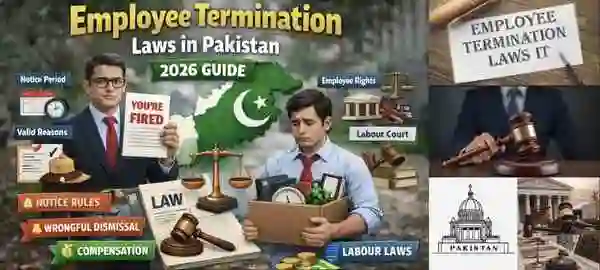
Employee Termination Laws in Pakistan (Full Guide-2026)
What Is Employee Termination?
Employee termination means ending a job. It happens when:
An employee resigns (leaves the job by choice), or
An employer fires (dismisses) the employee.
In Pakistan, employee termination laws say that a worker cannot be fired without a valid reason. The employer must follow legal rules, company policy, and the employment contract.
Understanding labour laws in Pakistan helps both employers and employees avoid legal problems.
Legal Framework for Employee Termination in Pakistan
Pakistan does not have only one law for dismissal. Different provinces have different labour laws.
Important Labour Laws in Pakistan
West Pakistan Industrial and Commercial Employment (Standing Orders) Ordinance, 1968
- Punjab Industrial Relations Act
- Sindh Industrial Relations Act
- Khyber Pakhtunkhwa Industrial Relations Act
- Balochistan Industrial Relations Act
Federal and Provincial Service Rules (for government employees)
Main Legal Rule
An employer cannot fire an employee unfairly. The termination must be:
- Just
- Fair
- Based on valid reason
- Properly documented
Types of Employee Termination in Pakistan
| Type | Meaning | Example |
| Resignation | Employee leaves job | Worker quits |
| Expiry of Contract | Contract ends | Fixed-term contract finishes |
| Termination by Employer | Employer fires worker | Poor performance |
| Constructive Dismissal | Employee forced to resign | Salary delayed again and again |
Legal Reasons to Fire an Employee in Pakistan
An employer can legally terminate an employee for the following reasons:
Serious Misconduct
- Theft
- Fraud
- Violence
- Harassment
- Breaking company rules seriously
Poor Performance
If the employee does not improve after warnings and performance reviews.
Violation of Company Policy
Repeated late attendance or breaking safety rules.
Redundancy or Retrenchment
When the company closes, downsizes, or removes a position for business reasons.
Termination Without Notice in Pakistan
Termination without notice is allowed only in serious misconduct cases such as:
- Theft
- Fraud
- Harassment
- Violence
- Serious breach of confidentiality
- But the employer must have proof and proper evidence.
Notice Period Rules in Pakistan
In most jobs, an employer must give notice before termination.
Typical Notice Period
| Employment Type | Notice Period |
| Permanent Employee | 1 Month |
| Probation Employee | As per contract |
| Fixed-Term Contract | No notice (ends automatically) |
If no notice is given, the employer may have to pay salary instead of notice (called notice pay).
Always check the employment contract for exact notice terms.
Documents Required for Legal Termination
To follow employee termination laws in Pakistan, employers must prepare:
- Written termination letter
- Warning letters (if any)
- Proof of misconduct (if applicable)
- Attendance record
- Performance evaluation reports
- Proper documentation protects the company in case of legal dispute.
Simple Sample Termination Letter
Date: ________
To: Mr./Ms. ________
Employee ID: ________
Dear ________,
This letter informs you that your employment with [Company Name] will end on [Date]. The reason is [performance issue / policy violation / misconduct].
As per your employment contract, you will receive [notice pay / final salary / dues]. Please return company property before your last working day.
Sincerely,
[HR Manager]
[Company Name]
What Is Wrongful Termination in Pakistan?
Wrongful termination happens when:
- No valid reason is given
Notice period is not provided
Legal procedure is not followed
Contract terms are violated
Discrimination occurs
If termination is unfair, the employee can file a complaint.
Where to File a Complaint?
Employees can go to:
- District Labour Office
Labour Court
Civil Court (in some cases)
If the court finds termination illegal, the employee may receive:
- Reinstatement (job back)
- Compensation
- Back wages
- How to Prove Wrongful Termination
- Employees should keep:
- Signed employment contract
- Warning letters
- Payslips
- Attendance record
- Emails or messages
- Witness statements
- Documentation is very important in labour cases.
Employee Benefits After Termination
After termination, employees usually receive:
- Final salary
Leave encashment (if policy allows)
Provident fund or gratuity (if applicable)
Bonus (if mentioned in contract)
Permanent vs Contract Employee Termination
| Employee Type | Notice Required | Severance Pay |
| Permanent | Yes | Yes (if policy allows) |
| Fixed-Term | No (contract ends) | No |
| Probation | As per contract | Depends |
Common Employer Mistakes
- No written termination letter
No warnings before firing
No valid reason
No records or evidence
Ignoring labour laws
Tips for Employers
- Keep proper documentation
Follow labour laws in Pakistan
Follow company policy
Take legal advice if needed
Employee Rights Checklist
After termination, ask yourself:
- Did I get a valid reason?
Was notice given?
Did I receive my final payment?
Were legal rules followed?
If the answer is "No" to any, you may have a legal case.
FAQs About Employee Termination Laws in Pakistan
Can an employer fire without reason?
No. A valid reason and legal process are required.
Is compensation required after dismissal?
Usually yes, depending on the contract and labour law.
Can I go to labour court?
Yes, if you believe the termination was unfair.
What is constructive dismissal?
When the employer makes working conditions so bad that the employee is forced to resign.
Are contract employees protected?
Yes, but their contract ends automatically on expiry.
Final Summary
- Employee termination in Pakistan must follow labour laws
A valid reason is necessary
Notice period is usually required
Documentation protects both employer and employee
Wrongful termination can be challenged in court
Furthermore employee termination laws in Pakistan are designed to protect both employers and employees. Employers must follow legal procedures before firing someone. Employees must know their rights to avoid unfair treatment.
By understanding the legal process, notice period rules, and wrongful termination rights, both parties can handle termination fairly and lawfully in 2026.



Comments
No comments yet. Be the first to comment!
Leave a Comment