

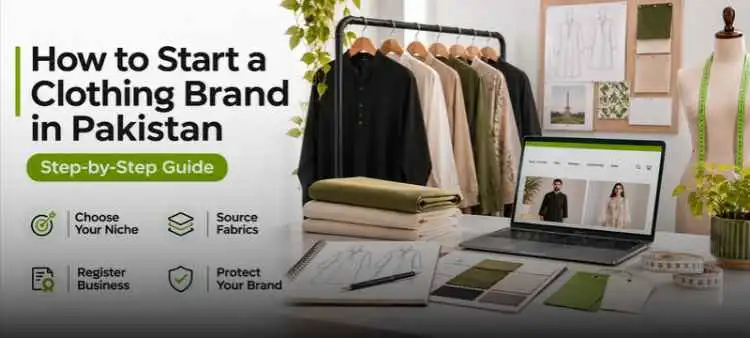
Starting a clothing brand in Pakistan can turn your interest in fashion into a real business. You can begin with a small clothing collection, work with local manufacturers, or create your own designs. However, a successful brand needs more than attractive clothes and a social media page.
If you want to learn how to start a clothing brand in Pakistan, this guide explains the process from choosing your products to launching your first collection. It also covers manufacturing agreements, business registration, tax requirements, trademark protection, and options for overseas Pakistanis.
Choose the Right Clothing Niche
Before buying fabric or contacting manufacturers, decide what type of clothing you want to sell.
A clear niche helps you understand your customers and control your startup costs.
Some popular clothing business categories include:
| Clothing niche | Target customers |
|---|---|
| Women's eastern wear | Everyday and occasion wear buyers |
| Men's casual wear | Customers looking for shirts, trousers and everyday clothing |
| Kids' clothing | Parents shopping for children |
| Modest fashion | Customers looking for modest clothing |
| Activewear | Fitness and sports customers |
| Formal and luxury wear | Wedding and special-event buyers |
| Streetwear | Younger customers interested in casual fashion |
You do not need to launch every product category at once.
For example, a new women's clothing brand could begin with a small collection of everyday cotton suits. After reviewing sales and customer feedback, the business could expand into other products.
Start with a narrow product range that you can produce and sell well.
How to Build Your First Clothing Collection
Once you have chosen your niche, decide what your first collection will include.
Start by answering a few questions:
- What problem will your clothing solve?
- Who is your ideal customer?
- What price range can your customers afford?
- What fabrics and styles will you use?
- How many sizes and colours will you offer?
You should also study similar brands.
Look at their products, prices, size ranges, customer reviews and delivery policies.
Avoid copying another brand's logo, photographs, original artwork or protected designs.
You can learn from market trends without presenting another business's creative work as your own.
Start With Samples Before Bulk Production
A sample is an early version of a clothing product.
It helps you check:
- Fabric quality.
- Stitching.
- Fit and sizing.
- Colour.
- Finishing.
- Washing performance.
- Overall appearance.
For example, if you want to sell men's T-shirts, order samples before producing hundreds of pieces.
Test the fit on different body sizes and check whether the fabric shrinks or loses shape after washing.
Poor-quality products can lead to complaints, returns and damage to your brand's reputation.
Find Fabric Suppliers and Clothing Manufacturers
Pakistan has an established textile and garment industry. New clothing brands can explore fabric markets, garment workshops, stitching units and larger manufacturers.
Your choice should depend on the product, quantity and quality you need.
Common Production Options
| Production method | How it works | Suitable for |
|---|---|---|
| Ready-made wholesale | Buy existing products for resale | Testing demand |
| Private label | Sell products made by a supplier under your brand | Small and growing brands |
| Custom manufacturing | Manufacture clothing according to your specifications | Original collections |
| In-house production | Manage stitching and production yourself | Businesses seeking direct production control |
Each option has different costs and responsibilities.
For example, private-label production may reduce your need to manage stitching directly. Custom manufacturing may provide more control over fabric, patterns and design.
However, custom products can also require more time, samples and quality checks.
What Should You Ask a Manufacturer?
Before paying an advance, ask about minimum order quantities, fabric specifications, sample charges, production deadlines and payment terms.
Also confirm what happens if the manufacturer delivers defective products or misses the agreed deadline.
Do not rely only on WhatsApp conversations for an important manufacturing arrangement.
Why Clothing Brands Need Written Supplier Agreements
A supplier agreement is particularly useful when you are paying for custom designs or placing a large production order.
The agreement can explain each party's responsibilities.
Important matters include:
- Product specifications and approved samples.
- Fabric quality and material composition.
- Sizes, colours and quantities.
- Production deadlines.
- Pricing and payment stages.
- Quality inspection and rejected goods.
- Delivery and transport arrangements.
- Confidentiality of business information.
- Ownership and permitted use of supplied artwork or designs.
- Procedures for resolving disputes.
For example, suppose you provide original artwork for embroidery on your clothing.
The agreement should clearly state whether the manufacturer may use that artwork for other customers.
A written contract can help reduce misunderstandings, although it cannot prevent every commercial dispute.
For important manufacturing or distribution arrangements, professional legal review may be useful.
Choose a Clothing Brand Name and Logo
Your brand name should be easy to remember, suitable for your products and different from competing brands.
Before printing labels or packaging, check whether another business already uses a similar name.
A distinctive brand name may be easier to identify and protect than a name that simply describes the product.
Is Company Name Registration Enough?
No. Company name registration and trademark registration are different processes.
SECP deals with company incorporation and company names.
IPO Pakistan deals with trademark registration.
Registering a company does not automatically give you exclusive trademark rights over its name.
You can begin preliminary research using the A.A. Dewan & Co. Free Trademark Checker.
The tool searches available published trademark journal records. It is not a complete live Registry search or a guarantee that the brand is available.
For a detailed explanation of trademark ownership and registration, read our Brand Name Registration Guide.
Which Trademark Class Covers Clothing?
Class 25 generally covers clothing, footwear and headwear.
A clothing business may also need to consider other classes depending on its actual products or services.
For example, Class 35 can cover certain retail-related services. However, selling clothing does not automatically mean every brand needs Class 35.
The correct classification depends on the protection being requested.
If you want to protect your clothing brand name or logo, explore our Trademark Registration Service.
Register Your Clothing Business in Pakistan
A clothing brand can operate under different business structures.
The appropriate structure depends on ownership, liability, business plans and legal requirements.
| Business structure | General description |
|---|---|
| Sole proprietorship | One person operates the business personally |
| Partnership | Two or more people carry on business together |
| Single Member Company | A company formed with one member |
| Private Limited Company | A company with multiple shareholders |
Not every small clothing business must incorporate a company with SECP.
However, if you choose to establish a Single Member Company or Private Limited Company, the incorporation process is handled through SECP.
How Does SECP Company Registration Work?
SECP provides the eZfile system for company incorporation.
The process generally involves selecting the company type, applying for the proposed name, providing the required ownership information and completing the incorporation documents.
The requirements depend on the company structure and the people involved.
A company may also have continuing filing and compliance obligations after incorporation.
For detailed assistance, visit our Company Registration Service in Pakistan.
What If You Start With a Sole Proprietorship?
A sole proprietor does not establish a separate company merely by using a business name.
However, the business may still need tax registration, appropriate banking arrangements and applicable local permissions.
The correct requirements depend on the business activity and location.
If you later decide to incorporate a company, review how existing contracts, inventory, trademark ownership and other assets will be handled.
Understand Tax Requirements Before Selling
Clothing businesses should review their tax obligations before launching.
FBR provides income tax registration through the Iris system.
The requirements depend on whether the business is operated by an individual, partnership or company.
Income tax registration and sales tax registration are separate matters.
Does a Clothing Business Need Sales Tax Registration?
The answer depends on the business model and applicable law.
A business manufacturing clothing, operating a retail outlet or selling products through an online marketplace may face different tax obligations.
The Sales Tax Act, 1990 contains registration requirements for relevant businesses.
The Finance Act, 2025 also introduced specific provisions for sellers of digitally ordered goods.
These provisions may apply to clothing businesses that sell through websites, marketplaces or applications, subject to the statutory exceptions and applicable requirements.
Do not assume that selling through Instagram or another online platform removes tax-registration obligations.
Businesses should review the latest FBR rules and obtain appropriate tax advice before selling.
For help with applicable registration requirements, explore our Sales Tax Registration Service.
Calculate the Cost of Your Clothing Brand
There is no single fixed amount required to start a clothing brand in Pakistan.
Your budget depends on the type of clothing, production quantity, fabric quality, selling platform and marketing plan.
A small private-label business may have different costs from a brand developing custom garments.
Main Startup Expenses
| Expense | What it includes |
|---|---|
| Product development | Designs, patterns and samples |
| Fabric and manufacturing | Materials, cutting, stitching and finishing |
| Branding | Labels, packaging and visual identity |
| Business setup | Applicable registrations and professional charges |
| Photography | Product images and promotional content |
| Online sales | Website, marketplace or selling tools |
| Marketing | Advertising and promotions |
| Delivery | Packaging, couriers and returned parcels |
Calculate the actual cost of each product before setting its selling price.
For example, the cost of one shirt may include fabric, stitching, labels, packaging, transaction fees and a share of advertising expenses.
Your selling price must cover these costs and leave room for profit, overheads and possible returns.
A Simple Pricing Formula
Selling Price − Total Product and Selling Costs = Contribution Before Other Expenses and Taxes
Do not confuse sales revenue with profit.
A product may sell quickly but still lose money if manufacturing, advertising and returns cost too much.
Set Up Your Clothing Store Online
Many clothing brands begin with social media and later establish a website.
You may sell through:
- Your own e-commerce website.
- Online marketplaces.
- Instagram or Facebook.
- WhatsApp business channels.
- A physical shop alongside online sales.
Choose the platform that matches your customers and budget.
Your product pages should include clear photographs, accurate size information, fabric descriptions, prices and delivery details.
Create Clear Size Charts
Clothing customers often return products because the fit is different from what they expected.
Provide measurements in a consistent format.
For example, a shirt size chart may include chest, length, shoulder and sleeve measurements.
Explain whether the measurements relate to the garment or the customer's body.
Clear product information can reduce complaints and unnecessary returns.
Prepare Your Return and Refund Policy
Before accepting orders, decide how you will handle damaged products, wrong sizes and incorrect deliveries.
Your policies should be clear and comply with applicable consumer protection law.
For example, Punjab's Consumer Protection Act, 2005 contains provisions concerning receipts, return and refund policy disclosure, and misleading representations.
Consumer protection requirements may vary by province.
A store should not assume that a simple “No Refund†statement overrides every legal right.
For a broader guide to online selling, read How to Start an Online Business in Pakistan.
Launch Your Brand With a Small Collection
A new brand does not need a large catalogue.
Start with products you can manage and deliver consistently.
Before launch, check that:
- Your samples meet the expected quality.
- Your supplier has confirmed production.
- Product photographs and descriptions are ready.
- Sizes and prices are accurate.
- Payment and delivery arrangements work.
- Customer policies are available.
- Required business and tax obligations have been reviewed.
You can begin with a limited collection and use customer feedback to improve future designs.
Avoid spending your entire budget on advertising before testing product quality and delivery performance.
Can Overseas Pakistanis Start a Clothing Brand in Pakistan?
Yes. Overseas Pakistanis may establish or invest in a clothing business in Pakistan, subject to the relevant legal and regulatory requirements.
For example, someone living in the UK, UAE, Saudi Arabia, Canada or USA may want to manufacture garments in Pakistan and sell them locally or internationally.
However, remote ownership requires careful planning.
Key Issues for Overseas Founders
Consider who will own the business, who will supervise production and who will receive customer payments.
Other important matters include:
- Selecting the business structure.
- Identifying the correct shareholders or proprietor.
- Arranging local manufacturing and quality inspection.
- Preparing supplier and management agreements.
- Confirming banking and tax requirements.
- Protecting the brand name in the relevant markets.
- Reviewing import and export rules if products cross borders.
SECP's incorporation guidance recognises NICOP-based registration routes for overseas Pakistani users and specifies additional documentation where applicable.
If your business involves foreign investment or international transfers, confirm the relevant banking and regulatory requirements before moving funds.
For Pakistan-based legal assistance from abroad, explore our Business Setup Services for Overseas Pakistanis.
Is a Pakistani Trademark Valid Worldwide?
No. Trademark rights are generally territorial.
A trademark registered in Pakistan does not automatically provide registered protection in the UK, USA, UAE or every other country.
If you plan to sell clothing internationally, consider trademark protection in the markets where you operate or expect to expand.
The appropriate filing strategy depends on your business plans and applicable international arrangements.
Common Mistakes New Clothing Brands Should Avoid
Some mistakes can create financial or legal problems even when the clothes themselves are good.
Producing Too Much Stock
Large production orders can tie up money before demand is proven.
Test demand before expanding the collection.
Paying Manufacturers Without Clear Terms
Without agreed specifications and delivery terms, disputes about quality, quantity or delayed orders may be harder to resolve.
Use appropriate written agreements.
Using a Brand Name Without Checking It
Printing thousands of labels before reviewing existing trademarks can create avoidable risk.
Complete appropriate preliminary checks before making a major investment.
Ignoring Business and Tax Requirements
A brand may sell through social media but still have registration and compliance obligations.
Review the requirements before launching.
Copying Another Brand's Designs or Marketing
Do not assume that images, artwork or logos found online are free to use.
Creative content and distinctive commercial signs may be protected by copyright, trademarks or other applicable rights.
Misleading Customers
Avoid false claims about fabric, product origin, discounts or quality.
Use accurate descriptions and fair customer policies.
How A.A. Dewan & Co. Can Help Clothing Entrepreneurs
Starting a clothing brand involves business decisions, contracts and legal requirements.
A.A. Dewan & Co. provides legal assistance for company registration, corporate documentation, trademark matters and relevant business setup issues in Pakistan.
Depending on the agreed scope of work, assistance may include:
- Reviewing the appropriate business structure.
- Preparing company incorporation documents.
- Assisting with relevant corporate agreements.
- Reviewing supplier and manufacturing contracts.
- Advising on trademark search and registration.
- Assisting overseas founders with Pakistan-based legal documentation.
Our aim is to help business owners understand the legal requirements before making important commercial commitments.
For company formation and related matters, visit our Corporate & Business Law Services.
Frequently Asked Questions
Can I start a clothing brand in Pakistan with a small budget?
Yes. You can begin with a limited product range, small production quantities or private-label arrangements. The required budget depends on product quality, manufacturing, marketing and delivery costs.
Do I need to register a company before selling clothes?
Not every clothing seller must incorporate a company with SECP. However, the business must consider applicable tax, local and regulatory requirements. A company must be incorporated if you choose to operate through that legal structure.
Can I start a clothing business from home?
Yes, some clothing businesses can begin from home. However, the applicable business, tax, labour, manufacturing and local requirements depend on the activity and location.
Which trademark class is used for a clothing brand?
Class 25 generally covers clothing, footwear and headwear. Other classes may be relevant depending on the specific goods or services. A proper classification review is recommended.
Should I register my clothing brand name or logo?
That depends on the protection you need. A word mark and a logo may be treated as different trademark representations. Separate applications may be appropriate in some cases.
Can I use another manufacturer's clothing under my own brand?
Private-label arrangements are common, but you should confirm the supplier's authority, branding terms, quality standards and contractual obligations before selling the goods under your name.
Is a supplier agreement necessary?
A written agreement is strongly recommended, especially for custom manufacturing or substantial orders. It can define specifications, payment terms, quality standards, delivery deadlines and responsibilities.
Do I need sales tax registration to sell clothes online?
It depends on the relevant registration provisions, business activity and any applicable statutory exceptions. The e-commerce provisions introduced in 2025 are especially important for sellers of digitally ordered goods.
Can I manage a clothing business in Pakistan while living abroad?
Yes, subject to applicable requirements. Clear ownership records, reliable local management, appropriate banking and written supplier agreements are particularly important.
Does registering a clothing brand in Pakistan protect it internationally?
No. Pakistani trademark registration does not automatically provide registered protection in every other country. International expansion may require additional trademark filings.
Build Your Clothing Brand on a Strong Foundation
A clothing brand needs a clear product, reliable manufacturing, fair pricing and a way to reach customers.
It also needs proper attention to business ownership, supplier agreements, tax obligations and brand protection.
Before placing a large production order, make sure you understand both the commercial costs and the legal responsibilities involved.
Planning to start a clothing brand in Pakistan?
A.A. Dewan & Co. can assist with relevant company formation, corporate documentation and trademark registration matters.
Explore Our Corporate Legal Services
Official Legal References
SECP – Registration of Company
SECP – Companies Regulations 2024 and eZfile FAQs
IPO Pakistan – Trademark Classification
FBR – E-Commerce Sales Tax Circular
Punjab Consumer Protection Act, 2005
Last reviewed: 27 November 2026. This guide provides general business and legal information. Tax obligations, registration rules, consumer laws and industry-specific requirements depend on the circumstances and may change.
Comments
No comments yet. Be the first to comment!
Leave a Comment