

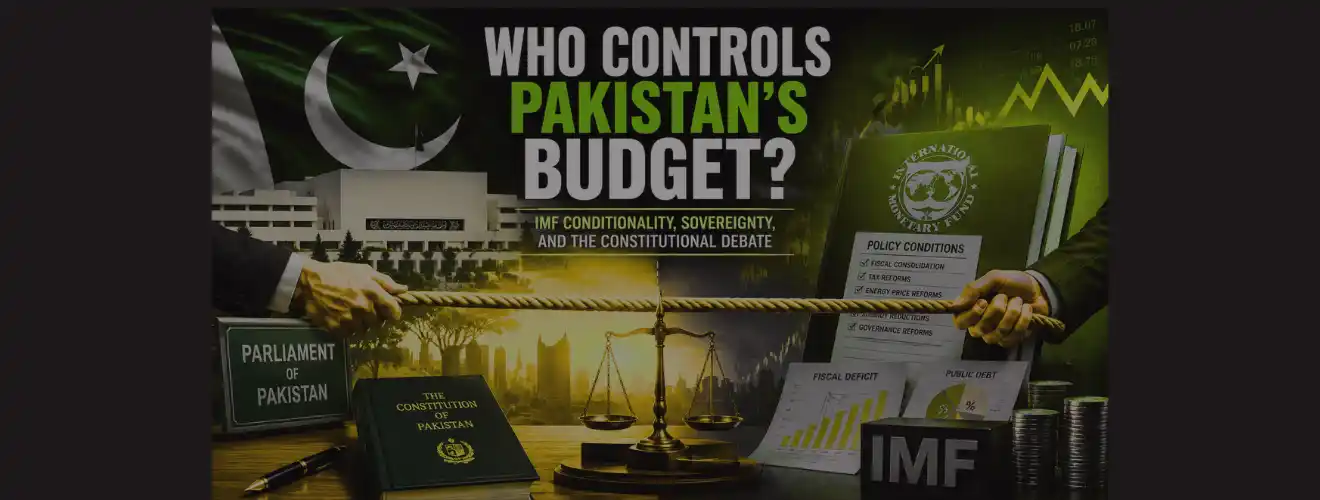
Who really controls Pakistan's budget?
It sounds like a dramatic question. Some may even call it politically loaded. But it is also a fair question.
Every year, Pakistan presents a national budget. The government announces tax measures, subsidy decisions, development plans, defence allocations, education spending, and borrowing projections. Parliament debates the finance bill. Experts discuss fiscal policy. Citizens complain about inflation.
On paper, the process looks democratic and straightforward.
But outside Parliament, another conversation continues.
How much of Pakistan’s budget is truly shaped at home?
When a country depends on IMF funding, negotiates reform commitments, accepts fiscal discipline targets, and aligns policy choices with external financing expectations, the sovereignty debate becomes unavoidable.
That debate is especially relevant now. Pakistan remains under a $7 billion IMF program, and the IMF recently approved additional financing while emphasizing continued reforms and strong macroeconomic discipline. (reuters.com)
This article explores that debate from a legal, political, and economic perspective.
Why This Debate Matters Beyond Pakistan
This is not only a Pakistan story.
Countries across the world face similar questions.
When governments borrow from international institutions, the issue becomes larger than economics. It becomes a governance issue.
Who makes national decisions?
How much influence should external lenders have?
Can a sovereign parliament still act freely when financial pressure is intense?
These are global democratic questions.
Pakistan simply offers a highly visible example.
What Is a National Budget, Really?
Many people think a budget is simply an accounting document.
That is incomplete.
A national budget is one of the strongest political and legal instruments in any state.
It determines:
- how much tax citizens will pay
- where public money goes
- how much the government borrows
- whether subsidies continue
- whether social programs survive
- how defence and education priorities are balanced
- whether inflationary pressures rise
A budget is not just economics.
It is public power in numerical form.
That is why asking who controls the budget is actually asking who controls national priorities.
Budget Making Process in Pakistan
To understand the sovereignty debate, we first need to understand the formal legal structure.
Step 1: Government Departments Submit Financial Demands
Each ministry estimates future needs.
These may include:
- salaries
- pensions
- development spending
- administrative costs
- operational expenses
- sectoral projects
Step 2: Ministry of Finance Builds the Fiscal Framework
The Ministry of Finance combines competing demands and creates the national financial plan.
This includes:
- projected tax collection
- debt servicing estimates
- fiscal deficit assumptions
- subsidy allocations
- development expenditure
- borrowing plans
Step 3: Executive Review
The cabinet reviews the broader framework.
This is where executive authority becomes critical.
Many major decisions are effectively shaped before public debate begins.
Step 4: Finance Bill Presentation
The finance bill is introduced in Parliament.
This is legally important because taxation generally requires legal authority.
Step 5: Parliamentary Debate
Lawmakers debate:
- taxation
- expenditure priorities
- fiscal policy direction
- economic assumptions
Step 6: Legal Approval
After approval, the budget becomes operational.
This is the formal system.
But the sovereignty debate asks whether major fiscal decisions are already constrained before this process starts.
What Does Sovereignty Actually Mean?
The word sovereignty gets used often but rarely explained clearly.
At its simplest, sovereignty means supreme authority.
A sovereign state governs itself.
- It makes its own laws.
- It controls its territory.
- It manages internal governance without external command.
But in modern economics, sovereignty is more complicated.
No country exists in isolation.
Countries:
- borrow internationally
- sign trade agreements
- join global institutions
- accept treaty obligations
- rely on external capital
So the real question is not whether outside influence exists.
The real question is:
When does influence become control?
Parliamentary Sovereignty vs Practical Economic Constraints
In constitutional theory, Parliament represents democratic authority.
That sounds simple.
But reality creates tension.
Suppose elected lawmakers technically approve fiscal policy but only after the executive has already committed to difficult international reforms.
Then the question becomes:
Is Parliament independently deciding?
Or merely confirming prior commitments?
This is where legal theory and economic reality collide.
What Is IMF Conditionality?
IMF conditionality refers to policy commitments linked to financial support.
In simple words: financial assistance often comes with reform expectations.
These can include:
- tax expansion
- subsidy reduction
- fiscal deficit control
- energy sector reform
- monetary tightening
- governance reforms
- debt management improvements
Pakistan’s recent IMF discussions have included tariff reform and broader macroeconomic commitments. (reuters.com)
This is why IMF conditionality affects ordinary life.
It is not abstract policy language.
It can influence electricity bills, taxes, inflation, and public spending.
Why Critics Raise Sovereignty Concerns
Critics make a simple argument.
If a government agrees to external reform expectations before domestic political debate, democratic accountability weakens.
The criticism usually sounds like this:
- executive negotiates first
- parliament debates later
- public bears consequences
That creates a political legitimacy concern.
Critics ask whether elected institutions are making free fiscal choices—or responding to economic necessity shaped by lenders.
Why Supporters Defend IMF Engagement
Supporters reject the sovereignty alarm.
Their argument is equally straightforward.
Pakistan voluntarily enters agreements.
No foreign institution directly passes Pakistani laws.
No outside body can physically force Parliament to legislate.
In this view:
- sovereign governments choose financing arrangements
- elected officials remain accountable
- reform conditions reflect economic necessity
This argument is not unreasonable.
A government can be sovereign while making difficult negotiated choices.
The Difference Between Legal Sovereignty and Practical Sovereignty
This distinction matters.
Legal Sovereignty
Pakistan remains legally sovereign.
Its Constitution operates.
Its courts function.
Its Parliament legislates.
Its executive governs.
Practical Sovereignty
Practical sovereignty asks a harder question:
How much policy freedom exists under economic pressure?
A country may remain legally independent while having limited room for policy manoeuvre.
That is where the real debate lives.
Executive Authority: The Quiet Centre of Fiscal Power
Many public debates focus on Parliament.
But executive power deserves equal attention.
Why?
Because major economic negotiations often happen before public legislative drama begins.
That means executive decisions can shape outcomes long before parliamentary debate becomes visible.
Questions worth asking:
- How transparent are fiscal negotiations?
- When are lawmakers informed?
- How much room exists for genuine policy change?
This is where constitutional accountability becomes important.
Finance Bill and Taxation: Where Citizens Feel Policy Immediately
Nothing makes fiscal policy real like taxation.
People may ignore abstract macroeconomic language.
But new taxes get immediate attention.
Tax policy raises practical questions:
- Who pays more?
- Are indirect taxes fair?
- Are corporate taxpayers treated consistently?
- Is the burden equitable?
Taxation is not just economics.
It is a public legitimacy issue.
Citizens accept painful policies more easily when the process feels transparent and fair.
Budget Priorities: Defence vs Education Debate
Every budget reflects values.
When Pakistanis compare defence spending and education spending, they are debating national priorities not just accounting categories.
Important questions include:
- What counts as national security?
- Is education also a security investment?
- Can debt pressure distort spending choices?
- Does long-term stability require stronger social investment?
These questions drive public emotion because they connect directly with daily life.
Judicial Review: Can Courts Intervene?
This is where the legal discussion becomes especially interesting.
Can courts review economic policy?
Generally, courts avoid replacing governments as economic managers.
Judges are not finance ministers.
But that does not mean all economic decisions are beyond scrutiny.
Courts may examine:
- legality
- constitutional compliance
- procedural fairness
- discriminatory action
- arbitrary decision-making
The threshold is high.
But economic governance is not automatically immune from constitutional review.
IMF Conditionality: Pros and Cons
Potential Benefits
Supporters say IMF engagement can:
stabilize economies
improve investor confidence
strengthen reserves
encourage fiscal discipline
prevent deeper crises
For countries facing financing pressure, external support may prevent more severe economic disruption.
Common Criticisms
Critics say IMF programs may:
- increase austerity pressures
- reduce political flexibility
- create social hardship
- intensify public frustration
- create long-term dependency
Both perspectives contain truth.
The real issue is implementation quality.
The Bigger Problem: Structural Weakness
Here is the uncomfortable point many debates avoid.
The deeper issue may not be the IMF.
The deeper issue may be structural economic weakness.
Countries with:
- stronger exports
- better tax systems
- stable reserves
- efficient governance
- reduced leakage
have stronger negotiating positions.
Weakness reduces bargaining power.
Dependency changes leverage.
That is not ideology.
That is practical economics.
Economic Nationalism Sounds Powerful But Is It Enough?
Political slogans are emotionally effective.
“Reject foreign pressure.â€
"Take back control."
"Protect sovereignty."
But slogans alone do not finance imports, service debt, or stabilize reserves.
Economic nationalism without practical reform is theatre.
At the same time, permanent dependency is not strategy either.
Real sovereignty requires capability.
Why This Debate Has Viral Potential
This topic spreads because it combines:
- money
- politics
- constitutional questions
- national pride
- inflation anxiety
- public frustration
It touches emotion and policy simultaneously.
That makes it highly shareable.
But shareability should not replace seriousness.
This debate deserves substance.
What Ordinary Citizens Actually Want
Most citizens are not debating legal doctrine.
They want practical answers:
- Why are bills rising?
- Why do taxes increase?
- Why does relief feel temporary?
- Who made these decisions?
That demand for clarity is legitimate.
Final Verdict: So Who Controls Pakistan’s Budget?
Legally?
Pakistan does.
Constitutionally?
Pakistan does.
Formally?
Its elected institutions do.
Practically?
The answer becomes more complicated.
Economic dependence changes negotiating freedom.
External lenders may not write domestic law.
But financial pressure can shape policy choices before public democratic debate becomes visible.
That does not automatically mean sovereignty is lost.
But it absolutely means sovereignty has become more complex than slogans suggest.
The better question may not be:
Does the IMF control Pakistan?
The better question is:
Has Pakistan built enough economic strength to negotiate from real independence?
That is the debate worth having.
Frequently Asked Questions
Does the IMF control Pakistan’s budget?
No. Pakistan legally controls its own budget. However, IMF program conditions can strongly influence fiscal choices.
It refers to policy commitments linked to financial assistance, often involving taxation, reforms, subsidies, and fiscal discipline.
Can Pakistan reject IMF conditions?
Yes, legally. But rejecting conditions may create financing pressure depending on broader economic circumstances.
Can Pakistani courts review economic policy?
Courts may review legality and constitutional compliance, though they usually avoid directly managing economic policy making.
Why is sovereignty part of the budget debate?
Because external financing conditions can affect how freely domestic institutions make fiscal decisions.



Comments
No comments yet. Be the first to comment!
Leave a Comment