

Introduction
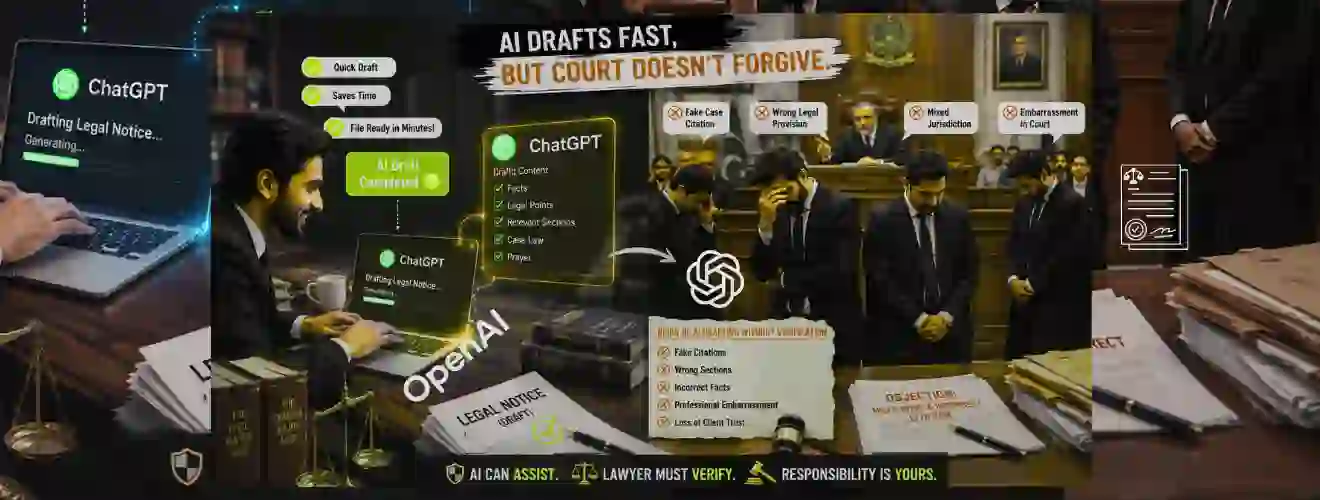
ChatGPT is now being used by many lawyers in Pakistan for legal drafting, notices, summaries, contracts, emails, and case preparation. It saves time and reduces typing pressure, but it also creates serious risks when lawyers rely on it without checking.
ChatGPT can draft quickly, but it cannot think like a lawyer. For Pakistani lawyers, the real question is not whether AI can help. The real question is whether it is being used safely, ethically, and with proper legal verification.
Why This Topic Matters for Lawyers in Pakistan?
Legal Work Is Becoming Faster, But Riskier
Legal work in Pakistan is already time-sensitive. Lawyers often handle urgent notices, court applications, plaints, written statements, affidavits, and client replies under pressure.
AI makes this process faster. But faster drafting does not always mean better drafting. A quick draft with wrong facts, fake citations, or weak legal reasoning can damage the client’s case.
AI Saves Time, But It Does Not Remove Responsibility
ChatGPT can reduce typing work, but it does not reduce the lawyer’s duty. If an AI-generated draft contains a wrong section, fake case law, or misleading statement, the responsibility still belongs to the lawyer.
The court will not ask ChatGPT for an explanation. The lawyer will have to answer.
How Lawyers Are Already Using ChatGPT
Legal Notices and Court Drafts
Many lawyers use ChatGPT to prepare first drafts of legal notices, plaints, written statements, applications, and replies.
This can be helpful when the lawyer already knows the law and facts. But it becomes risky when the lawyer copies the draft without proper review.
Case Summaries and Client Emails
ChatGPT can summarize long facts and convert rough notes into a professional email. This is useful for client communication and internal case preparation.
Still, every summary must be checked against the original facts. AI may miss important details or add something that was never provided.
Contracts, Applications and Affidavits
AI can help with agreement clauses, affidavit formats, and basic applications. But contract terms, legal consequences, and court requirements must be reviewed by the lawyer.
A polished draft is not always a legally safe draft.
Where ChatGPT Helps in Legal Drafting
It Can Create a First Draft Quickly
ChatGPT can prepare a basic draft within seconds. This helps lawyers save time during routine drafting.
However, the first draft should never be treated as the final draft.
It Can Improve Legal Language
AI can improve grammar, sentence flow, and formal tone. It can also turn rough client notes into cleaner legal language.
But legal language is not only about English. It must also match the law, facts, relief, and court practice.
It Can Organise Facts and Arguments
ChatGPT can arrange facts in chronological order and suggest headings for arguments.
This is useful, but the lawyer must decide which facts matter and which facts may harm the case.
The Real Risk: AI Sounds Right Even When It Is Wrong
What AI Hallucination Means in Law
AI hallucination means ChatGPT may give false information that looks real. In legal work, this can include fake cases, wrong sections, imaginary citations, and incorrect legal principles.
This is dangerous because the answer often sounds confident and professional.
Why Polished Legal Language Can Be Dangerous
A wrong legal paragraph written in poor English is easy to catch. A wrong paragraph written in polished legal English is more dangerous.
It may look impressive, but it may still be legally wrong.
Mixed Jurisdictions and Wrong Legal Principles
ChatGPT may mix Pakistani law with Indian, UK, or US law if the prompt is not clear.
For Pakistani lawyers, this is a serious risk. Every draft must clearly mention the relevant jurisdiction.
Fake Case Citations and Wrong Legal References
How AI Can Invent Case Law
ChatGPT may create case names, citations, court names, and quotations that look real but do not exist.
This is one of the biggest risks of AI legal drafting.
Why Every Citation Must Be Verified
No citation should be used unless it is checked from a reliable legal source. Lawyers must verify case law, statutory provisions, and legal principles manually.
A fake citation can damage both the case and the lawyer’s credibility.
Court Filing Risk for Lawyers
Once a fake citation enters a court document, it is no longer just an AI mistake. It becomes the lawyer’s professional problem.
AI does not sign the filing. The lawyer does.
The 'Clean Hands' Problem: When AI Misses Legal Meaning
Legal Words Are Not Always Literal
The phrase “plaintiff must come to court with clean hands†does not mean washed hands. It means the plaintiff must approach the court honestly and fairly.
AI may sometimes misunderstand legal expressions if the context is weak.
Why Human Legal Interpretation Still Matters
Legal drafting requires doctrine, context, strategy, and judgment. AI may understand words, but it may miss the legal meaning behind them.
This is why human review is not optional.
Client Confidentiality and ChatGPT
What Client Data Should Not Be Shared
Lawyers should avoid pasting sensitive client data into ChatGPT. This includes CNIC numbers, property documents, family disputes, criminal allegations, bank details, and private contracts.
Confidentiality is not a small issue. It is a professional duty.
Use Placeholders Instead of Real Details
Instead of sharing real client details, lawyers should use placeholders such as:
[Client Name]
[Property Details]
[Date of Agreement]
[Opposing Party]
[Court Name]
This keeps the drafting useful without exposing private information.
Confidentiality Is a Professional Duty
A lawyer should never trade client confidentiality for drafting convenience.
AI may help with wording, but client trust must remain protected.
General ChatGPT vs Legal AI To
What General ChatGPT Can Do
General ChatGPT can help with structure, grammar, summaries, brainstorming, and first drafts.
It is useful for support work, but it should not be treated as a legal research authority.
What Legal AI Tools May Offer
Legal AI tools may offer document-based answers, source references, matter files, and stronger privacy controls.
These tools may be better suited for legal workflows, but they are still not a replacement for legal judgment.
Why Verification Is Still Necessary
Whether a lawyer uses general ChatGPT or a legal AI tool, verification remains necessary.
The tool may assist, but the lawyer remains responsible.
Pakistan-Specific Prompting Tips for Lawyers
Mention Pakistani Law Clearly
Always mention that the draft is required under Pakistani law. If relevant, mention the province, court, forum, statute, and type of proceeding.
This reduces the risk of mixed-jurisdiction answers.
Tell AI Not to Invent Citations
A safe prompt should clearly say:
“Do not invent facts, dates, legal sections, citations, or case law.â€
This simple instruction can reduce some risk, but it does not remove the need for checking.
Use Missing Information Placeholders
Ask ChatGPT to leave placeholders where information is missing.
This is safer than allowing AI to fill gaps by guessing.
Checklist Before Using Any AI Draft in Court
Check Facts, Law and Jurisdiction
Before using any AI draft, verify all facts, applicable law, court name, party details, and jurisdiction.
Do not assume AI has understood the case correctly.
Verify Citations and Legal Sections
Every case law and legal section must be checked manually.
If a citation cannot be verified, remove it.
Review Relief, Limitation and Evidence
Check the relief clause, limitation period, evidence, cause of action, and maintainability.
These are legal judgment issues. AI cannot safely decide them alone.
Can AI Replace Lawyers in Pakistan?
AI Cannot Understand Court Strategy
AI can draft text, but it cannot understand court pressure, judge behaviour, opponent strategy, or litigation risk.
Court strategy needs human legal experience.
AI Cannot Handle Client Responsibility
A lawyer deals with clients, emotions, hidden facts, risks, and consequences.
AI cannot carry professional responsibility for any of these.
AI Is an Assistant, Not an Advocate
AI may help a lawyer work faster, but it cannot become the lawyer of record.
It can assist. It cannot advocate.
Final Thoughts: Use AI, But Do Not Outsource Your Legal Mind
The Safe Way Forward for Pakistani Lawyers
Pakistani lawyers should use ChatGPT carefully. It can help with first drafts, summaries, and structure, but every legal point must be reviewed.
The safest approach is simple: use AI for support, not final judgment.
Final Reminder for Legal Drafting
ChatGPT can type quickly, but it cannot carry legal responsibility.
Use it as a drafting assistant, not as your legal brain.
FAQs
Can lawyers use ChatGPT for legal drafting in Pakistan?
Yes, lawyers can use ChatGPT for legal drafting in Pakistan, but only as a support tool. Every draft must be reviewed, corrected, and verified before professional use.
Is ChatGPT reliable for legal research?
ChatGPT is not fully reliable for legal research. It may create fake citations, wrong legal principles, or mixed-jurisdiction answers. Lawyers must verify all legal references manually.
What is AI hallucination in legal drafting?
AI hallucination means the tool gives false information that looks real. In legal drafting, this may include fake cases, wrong sections, imaginary citations, or incorrect legal reasoning.
Should lawyers paste client documents into ChatGPT?
Lawyers should avoid pasting sensitive client documents into ChatGPT without caution. Names, CNIC numbers, property details, and private facts should be removed or replaced with placeholders.
Can AI replace lawyers in Pakistan?
No. AI can help with drafting and summaries, but it cannot replace legal judgment, advocacy, client handling, ethics, court strategy, or professional responsibility.

Comments
No comments yet. Be the first to comment!
Leave a Comment