

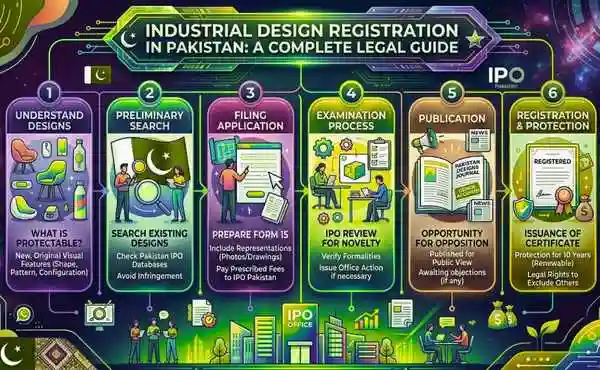
In today's competitive market, the visual appearance of a product often plays a decisive role in its commercial success. Businesses invest significant time and resources in creating products that are not only functional, but also attractive, distinctive, and marketable. For that reason, the legal protection of industrial designs has become increasingly important.
In Pakistan, the protection of industrial designs is governed primarily by the Registered Designs Ordinance, 2000, and the filing practice administered by IPO Pakistan. A registered design gives the proprietor a legal basis to prevent unauthorized copying or imitation of the visual appearance of a product and helps preserve the commercial value of the design.
Why Design Registration Matters
From a legal and commercial standpoint, design registration is important because it protects the external appearance of an article. If a product becomes successful in the market, competitors often attempt to imitate its shape, configuration, pattern, or ornamentation. Registration helps the proprietor establish formal rights over the design and strengthens enforcement against unauthorized use.
In practical terms, design registration may help a business to protect the identity of its product, preserve exclusivity in the market, add commercial value to the product, and improve the overall intellectual property portfolio of the business. The Pakistani framework for design protection is recognized under the Registered Designs Ordinance, 2000, and public-facing filing and publication mechanisms are maintained by IPO Pakistan.
What Is an Industrial Design?
Under Pakistani design law, a design generally refers to the features of shape, configuration, pattern, or ornament applied to an article by an industrial process or means, where those features in the finished article appeal to and are judged solely by the eye. In simple words, the law protects the visual appearance of a product rather than the technical idea behind it.
A design may therefore relate to the overall shape of an article, surface decoration, visible contours, ornamentation, packaging appearance, or even the appearance of a part of a product, provided that the feature is visible and forms part of the finished article's visual identity.
What Is Not Protected
Not every feature of a product can be registered as a design. The law does not protect a method or principle of construction, purely mechanical features, or features dictated solely by technical or functional considerations. Likewise, internal construction details that are not visible in the finished article do not usually form part of registrable design protection.
This means that the law focuses on what the eye sees, not on how the article works internally.
Novelty and Originality
A design must be new or original in order to qualify for registration. A design is generally not registrable if it does not significantly differ from known designs or if it has already been disclosed to the public before the filing date in a manner that destroys novelty. Public disclosure before filing may therefore create a serious risk for the applicant.
For that reason, one of the most important practical rules is this: a design application should preferably be filed before public disclosure, product launch, catalogue circulation, exhibition display, or online publication.
Grace Period
The material you shared also refers to a limited grace period concept for certain disclosures made within 12 months before filing, subject to the applicable legal conditions and proper explanation in the application. In practice, however, applicants should not rely casually on this exception. From a lawyer's perspective, the safer course is always to file the application as early as possible and before any public disclosure that may later become contentious.
Who May Apply
An application may be filed by the creator, proprietor, assignee, joint claimant, or another person legally entitled to claim ownership of the design. Where ownership is based on assignment, agreement, employment relationship, or transfer of rights, it is advisable to ensure that the ownership documents are clear, complete, and legally consistent before filing.
Where appropriate, certified copies of assignments or agreements may need to be produced to support the ownership claim.
Priority Claims for Foreign Applicants
Where the same design has first been filed in another relevant country, a foreign applicant may wish to claim priority in Pakistan. In such cases, the application should clearly mention the priority claim and the required supporting details, including the priority country, priority date, and application number, along with the supporting priority document within the required period.
From a legal drafting point of view, priority claims should always be handled carefully, because an incorrect or incomplete priority claim can affect the filing position and the scope of protection.
How a Design Application Is Filed in Pakistan
As reflected in the filing guidance and the material you shared, a design application may generally be lodged through physical submission at the Patent Office, through postal service, through courier service, and, increasingly, through the official IPO Pakistan online portal. IPO Pakistan also maintains a dedicated Designs Fee & Forms page and an online filing system for applicants and representatives.
All applications and supporting documents should be accompanied by the prescribed official fee. The official forms and fee references are publicly listed by IPO Pakistan.
Basic Filing Requirements
In practical terms, a design application typically requires:
- the prescribed application form, usually Form D-1;
- the prescribed official fee;
- a clear representation of the design as applied to the article; and
- where applicable, supporting documents such as priority documents, ownership documents, or authorization papers.
The application should clearly identify the applicant, the address, the article to which the design is applied, the relevant class, and an address for service in Pakistan. The application should also be properly dated and signed.
Classification of the Design
The applicant should specify the class in which the design is sought to be registered. If the same design is intended to cover articles falling in more than one class, separate applications may be required. From a practical perspective, proper classification is important because it affects examination, record keeping, and the scope of filing.
Design for a Set of Articles
Where the design relates to a set of articles, the representation should show the articles clearly as a set. The overall arrangement and visual relationship between the items should be visible enough for examination and for defining the scope of protection.
Registration of the Same Design for Other Articles
The material also refers to the procedure allowing the proprietor of a registered design, or an authorized person, to seek registration of the same design in relation to other articles in appropriate circumstances. This can be useful where a design concept is intended to be extended across a product range.
The Importance of Design Representations
One of the most critical parts of a design application is the representation of the design. In legal practice, the representation is not merely a picture; it is the visual document on the basis of which the Patent Office examines the application and defines the scope of protection.
A poorly prepared representation can lead to objections, unnecessary delay, ambiguity in examination, or a narrower scope of protection than intended. A well-prepared representation, by contrast, makes the application clearer, stronger, and easier to examine.
Acceptable Forms of Representation
A design may generally be represented through:
- drawings;
- photographs;
- three-dimensional models;
- a combination of these; or
- other suitable visual representations.
The selected form should show the design clearly and accurately.
Clarity and Accuracy
The representation should clearly depict the design and its important visual features, including, where relevant, lines, contours, shape, texture, pattern, configuration, and ornamentation. The Examiner should be able to understand the design without confusion and compare it with other designs where necessary.
Multiple Views
In many cases, one image is not enough. A complete filing may require multiple views, such as front, back, side, top, bottom, and perspective views. Where relevant, the article may also need to be shown in different positions or states, for example open and closed positions or different movable arrangements.
The purpose is to ensure that the design is fully disclosed and that the Examiner is not left guessing about any material visual feature.
Neutral Background and Clean Presentation
Representations should generally be prepared on a neutral background. Watermarks, distracting objects, clutter, unnecessary lines, creases, or marks should be avoided. The focus should remain entirely on the design itself.
Where shading is used, it should help reveal the design rather than obscure it.
Consistency Across Views
All views of the design should be consistent with one another. If the same article appears differently in different views without proper explanation, the application may become unclear. Where variations or alternate embodiments are intended, they should be clearly identified and presented carefully.
Resolution and Image Quality
The representation should be of sufficient quality and resolution to show the design details clearly. Blurred, pixelated, dark, distorted, or low-quality images may affect the Examiner's ability to assess novelty and may invite objection.
Use of Color
The material you shared indicates that representations may be in black and white or in color, provided they are clear and suitable for examination. Where color is an important feature of the design, it should be shown consistently and clearly in all relevant views.
Details, Annotations, and Reference Views
In some cases, reference views or explanatory indications may be helpful, especially where a product contains movable parts or a design is more easily understood through additional visual clarification. These supporting visuals should assist comprehension without making the representation confusing or overcrowded.
Optional Video Representation
The material also refers to the possibility of using a video file as an optional representation tool, particularly where the design becomes more comprehensible through movement or transitional display. This is best understood as a supportive aid rather than a substitute for the required formal representation.
This may be particularly relevant for display screens, transitional icons, or graphical user interfaces.
Graphical User Interfaces and Screen-Based Designs
Modern design practice is not limited to traditional physical products. The material you provided also contemplates protection for display screens, portions of screens, graphical user interfaces, and transitional icons where properly shown and described. From a practical perspective, such filings require especially careful drafting of the representation, because the claimed design may reside in only part of the visible display.
Novelty Statement
A novelty statement should be included to explain where the novelty of the design resides. Depending on the case, the novelty may reside in:
- the shape or configuration of the article;
- the pattern or ornamentation applied to the article;
- both shape/configuration and ornamentation together; or
- a specific identified part of the article.
The novelty statement should be tailored carefully to the actual design. Generic or inaccurate wording should be avoided. In legal practice, this statement is important because it helps define the protected visual feature and reduces ambiguity.
Visual Disclaimer
A visual disclaimer may be used where certain elements shown in the representation are not claimed as part of the protected design. This can be important where the applicant wishes to exclude background matter, unclaimed product portions, words, letters, numerals, trademarks, mechanical features, or construction-related elements.
Common techniques include broken lines, dotted lines, contrasting shading, blurring, or clear visual boundaries. The claimed and unclaimed features should be easy to distinguish at first glance.
Common Disclaimer Language
The material you shared also includes standard disclaimer concepts, such as disclaimers that no exclusive right is claimed in words, letters, numerals, trademarks, mechanical action, or any mode or principle of construction shown in the representation. From a lawyer's standpoint, these disclaimers are useful because they help separate design rights from trademark claims and from technical subject matter that falls outside design protection.
Physical Format of Representation Sheets
The representation sheets should be prepared neatly and in a compliant format. The details generally include the applicant's address, design number, class, number of sheets, and sheet number, with the representation displayed clearly in the designated area.
The material you provided also reflects certain practical formatting rules, including:
- representation size should not be smaller than the prescribed dimensions;
- staples should not be used;
- margins should be left around the representation;
- the representation should appear on one side of the paper only; and
- all views should be placed upright on the sheet.
These may appear technical, but they are important for orderly filing.
Examination of the Application
After filing, the Patent Office examines the application. The process generally includes a formal examination followed by substantive examination.
At the formal stage, the office reviews whether the minimum filing requirements have been met and whether the application is maintainable in form. If deficiencies are found, a formality examination report may be issued.
At the substantive stage, the Examiner assesses whether the design satisfies the relevant legal requirements, including registrability, novelty, originality, and compliance with the applicable framework.
Objections, Reply, Hearing, and Extension
If objections arise, the applicant is usually given an opportunity to respond. A written reply may be filed, and in some cases amendments may be made. Where necessary, an extension of time may be sought in the prescribed manner.
The applicant may also request a hearing instead of, or in addition to, a written reply where that is strategically appropriate. After considering the reply and/or hearing submissions, the Registrar may decide to accept the application or refuse it.
From a legal practice perspective, the response stage is critical. Many applications are not rejected because the design is weak, but because the filing record is not handled carefully.
Acceptance, Registration, Certificate, and Publication
If the application is found to be in order, it proceeds toward acceptance and registration. Once the prescribed formalities are completed, the registration certificate is issued and the registered design is published in the relevant official record. IPO Pakistan maintains a public designs e-journal for publication of registered designs.
Average Processing Time
Based on the average office timelines reflected in the material you shared, the registration process may broadly move through acknowledgement, examination, reply review, registration, and publication stages in the ordinary course. The average period from filing to registration has been described in your source material as approximately six months, subject of course to compliance with requirements, timely replies, and the absence of complications.
From a lawyer's perspective, it is better to describe any timeline as an average administrative estimate, not a guaranteed statutory deadline.
Duration of Protection
The material you shared states that design registration is initially protected for ten years, and that where a valid priority claim is accepted, the period may run from the priority date. It further refers to the possibility of extension for additional terms, subject to timely compliance with the applicable legal requirements.
Because term calculations and renewal strategy can affect enforcement and portfolio management, these matters should always be checked carefully at the time of filing and renewal.
Publication, Records, and Public Notice
Publication of registered designs serves an important function. It places the registration on public record, clarifies the existence of rights, and supports transparency in the design system. IPO Pakistan’s public design publication mechanism reflects this aspect of the registration process.
Practical Advice for Applicants
From a practical legal perspective, the following points are especially important:
First, file early. Do not wait until after product launch or public display.
Second, prepare the representation with extreme care. In many design matters, the representation is the case.
Third, make sure ownership is clear before filing, especially where the design was created by an employee, consultant, vendor, or affiliate company.
Fourth, draft the novelty statement and disclaimers thoughtfully. These are not mere formalities; they define the scope of protection.
Fifth, respond to examination reports properly and on time. Weak response handling often creates avoidable delay.
Conclusion
Industrial design registration in Pakistan is a valuable legal tool for protecting the visual appearance of products and preserving the commercial exclusivity of design-driven goods. A successful application depends not only on the originality of the design, but also on the clarity of the representation, the quality of the filing documents, the proper handling of ownership and priority issues, and the careful management of examination proceedings.
In our professional view, businesses should approach design registration strategically, not mechanically. A well-planned filing can strengthen market position, deter copying, and support long-term brand and product development. The legal framework for registered designs exists under the Registered Designs Ordinance, 2000, with filing, forms, online access, and publication administered through IPO Pakistan’s public-facing systems.



Comments
No comments yet. Be the first to comment!
Leave a Comment